
Articles
| Name | Author | |
|---|---|---|
| CASE STUDY: Improved change management capabilities for Infotel’s Orlando© | Alban Biard, General Manager, Orlando© Suite for TechPubs | View article |
| WHITE PAPER: How to capitalize on AI in aviation maintenance | Cameron Byrd, CEO and Founder, AIXI | View article |
| CASE STUDY: More than paperless: electronic logs delivered efficiency and integration at Air Europa | Francisco de Borja Mas Boned, Juan Miguel Sánchez García and Enrique García-Arcicollar, Air Europa | View article |
| CASE STUDY: Helvetic Airways Moves Beyond Paper Technical Logs | Christian Suhner, Chief Technology Officer (CTO) / Head of Flight Operations, Helvetic Airways | View article |
| CASE STUDY: Atlas Air transforms tech platform to optimize real-time data capabilities | Richard Steer, VP Technical Operations and Austin Wentworth, Director, both at Atlas Air, and Jim Buckalew, CEO, AeroATeam | View article |
| CASE STUDY: American Airlines optimizes maintenance scheduling | Joseph Kunnathusseril, Senior Manager – Aircraft Base Planning, American Airlines | View article |
CASE STUDY: American Airlines optimizes maintenance scheduling
Author: Joseph Kunnathusseril, Senior Manager – Aircraft Base Planning, American Airlines
Subscribe
A robust, data-driven maintenance planning tool delivers flexibility, handles complexity and enables greater collaboration, as Joseph Kunnathusseril, Senior Manager – Aircraft Base Planning, American Airlines, explains
With a mainline fleet of more than 1,000 aircraft of varying types and ages, optimizing maintenance is a tough challenge, but one that American Airlines now handles with confidence using a data-driven tool, as this case study illustrates.
HEAVY MAINTENANCE FOR A LARGE FLEET
The daily life of maintenance planning, and especially heavy maintenance planning, contains a host of interruptions, changes and supply shocks that require multiple adjustments to be made. It could be a damaged aircraft, an AOS (Air Operations Support) that has been a long sit and needs to be resolved or another airline asking for AOG (Aircraft on Ground) assistance. Our fleet maintenance plan is complex because aircraft ages vary, and each has very specific items that may need to be addressed. In addition, maintenance programs vary across our fleet families of Boeing 737s, 787s, 777s, and Airbus A320s. As a result, we needed a solution that gave us an optimized picture with the necessary flexibility.
It was critical for us to be able to track thousands of base maintenance requirements, on top of specific items that may need to be addressed in a base environment. Currently, our track plan goes out six years into the future on heavy maintenance requirements. This new tool may be capable of achieving even more than that in terms of our optimizing our heavy maintenance and extending to a much larger horizon.
REQUIREMENTS TO OPTIMIZE MAINTENANCE
Our journey to optimized maintenance planning focused on three areas (see figure 1). We had to be able to manage the complexity of our maintenance requirements across 1,000 aircraft and provide flexibility for different fleet families and ages. The tool had to weather changes and provide optimized solutions on a daily, and sometimes hourly, basis. On top of that, we needed a tool that allowed real-time, up-to-the-minute collaboration with our partners, so we could be as proactive and forward-thinking as possible.
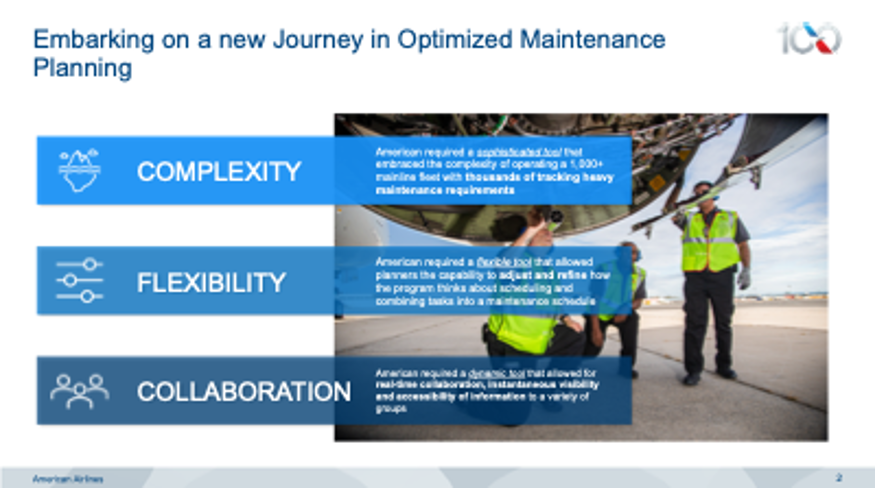
Figure 1
Choosing Aerostrat
We looked across the board of technology providers and landed on Aerostrat for our maintenance planning and heavy maintenance planning solution. As you can see in figure 2, Aerostrat’s solution solves a host of anchoring items.
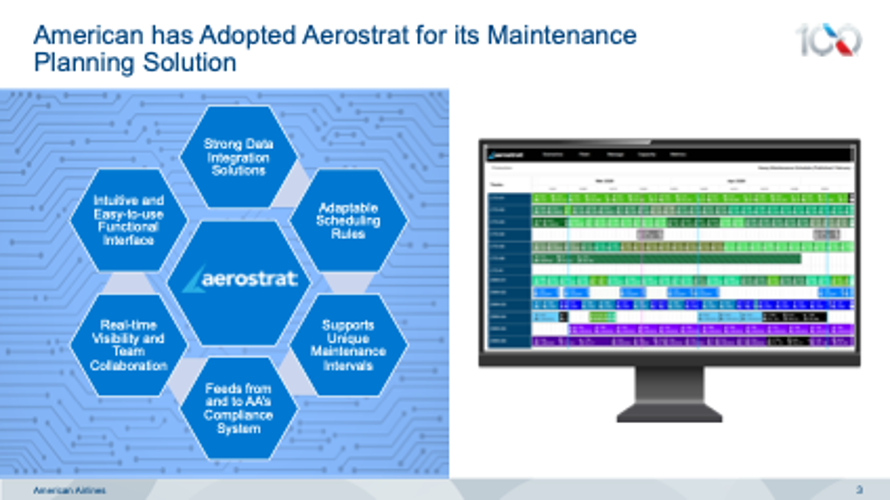
Figure 2
ADDRESSING DATA CHALLENGES
Being able to feed accurate, real-time data from our compliance system was a key aspect of what we needed to accomplish with the tool. Our previous planning system was more single-flow data going into groups. Now, we have a data flow that allows us to provide information to our compliance system and to create foundational information, such as where our heavy checks are located, when they are being accomplished, at what span, or at what time.
We are building integrated maintenance planning on this foundational anchor that not only helps us to balance thousands of base requirements, but also to optimize certain day-to-day and overnight requirements. This increases our work packaging team’s ability to use the foundation and then, on top of that, build and optimize a package that can immediately be sent to our heavy maintenance partners to execute. In addition, we have a data warehouse internally at American into which Aerostrat feeds information, so the system creates an ongoing loop.
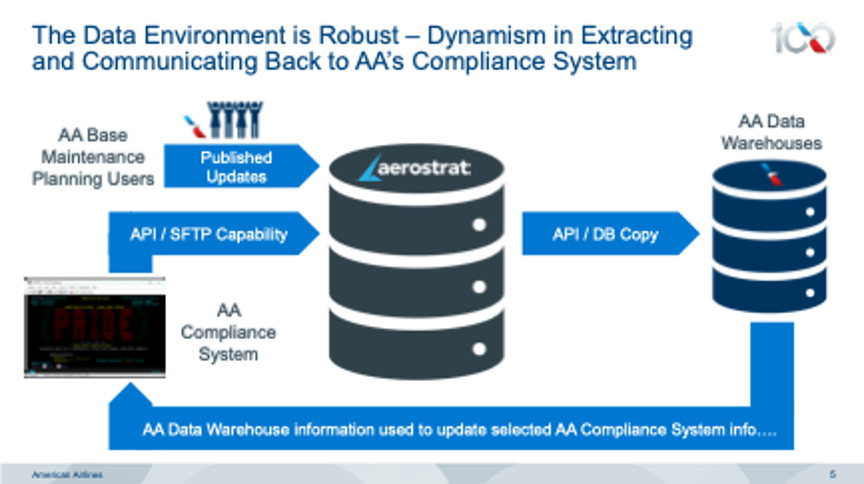
Figure 3
ROBUST AND FLEXIBLE TOOL
The six-year base maintenance environment referenced above involves nearly 50,000 tracking requirements, which are managed by the Aerostrat system. These maintenance requirements need to have the flexibility to be shifted, if required. The tool allows us to rebalance and optimize, for example, when we have an extended AOS downtime aircraft in a base location. This is vital for us to help with our overall maintenance and to alleviate stress on the line maintenance operation.
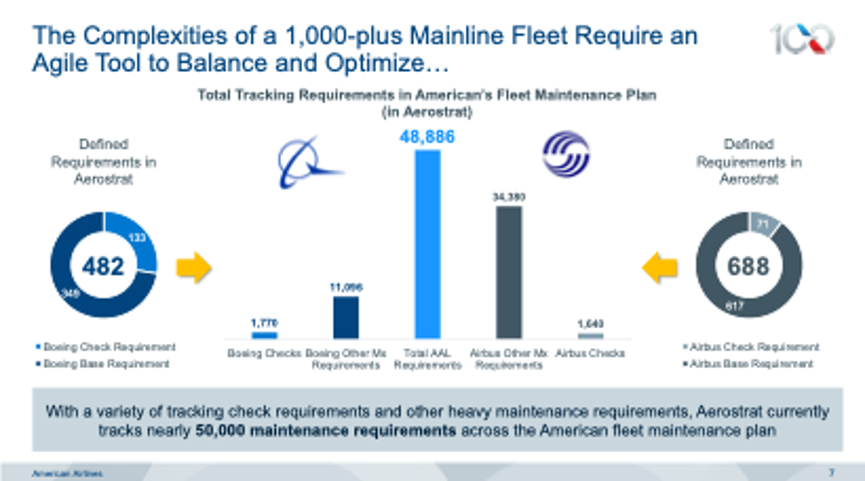
Figure 4
The tool is very robust and responsive. Some 95 percent of requests made by our maintenance planners to the system are resolved within 4.7 seconds, and at least 50 percent within five milliseconds.
Timeline for action
Another helpful feature of Aerostrat’s tool is the timeline view (see figure 5). This allows our work packaging and planning teams to see a spectrum of planned base requirements. The timeline view helps to visually showcase the foundation of base-only requirements and anchoring items that would be scheduled only in a base location. Using the timeline helps our work packaging team optimize additional work and alleviate demands on the line that might be otherwise stressed.
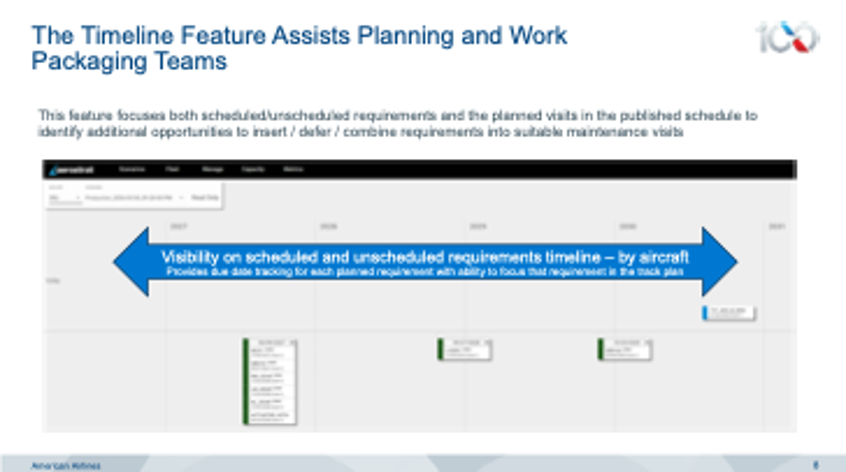
Figure 5
Better collaboration
Collaborative working is essential in the maintenance environment. We share the Aerostrat plan with a multitude of groups in our maintenance planning community, so they can visualize information in real-time and monitor information as it is refreshed.
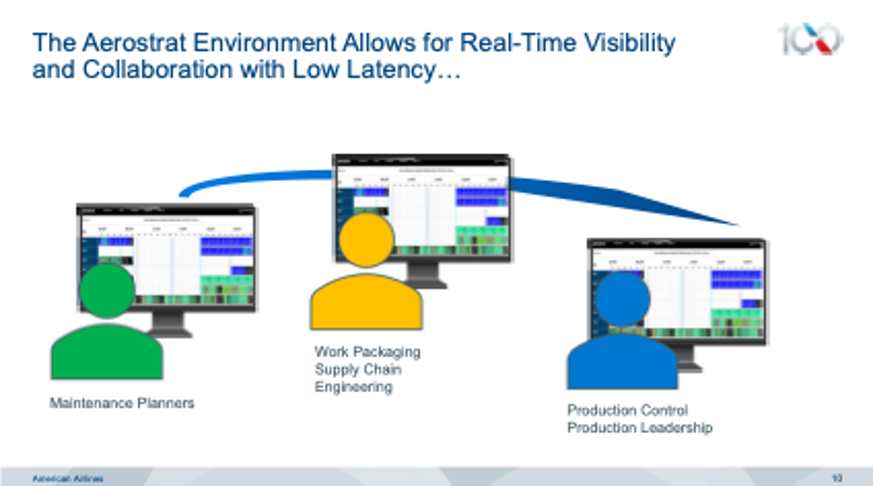
Figure 6
RAPID ADOPTION PAYS OFF
Aerostrat has been a great partner who has worked hand-in-hand with our IT team, architecture team and maintenance planning group. Following the completion of a proof of concept, which took about three months, we quickly hit the ground running. Within two and a half months, we were able to go live and move into a six-year plan in a matter of two-and-a-half months.
We were soon able to ramp up our use of the tool, for example, optimizing an Airbus C-Check opportunity. This helped us fill more capacity in the base, while alleviating some of the capacity that would have been felt on the line, which impacts the day-to-day resilience of being able to address aircraft and get them ready for the start of the day and launch operations.
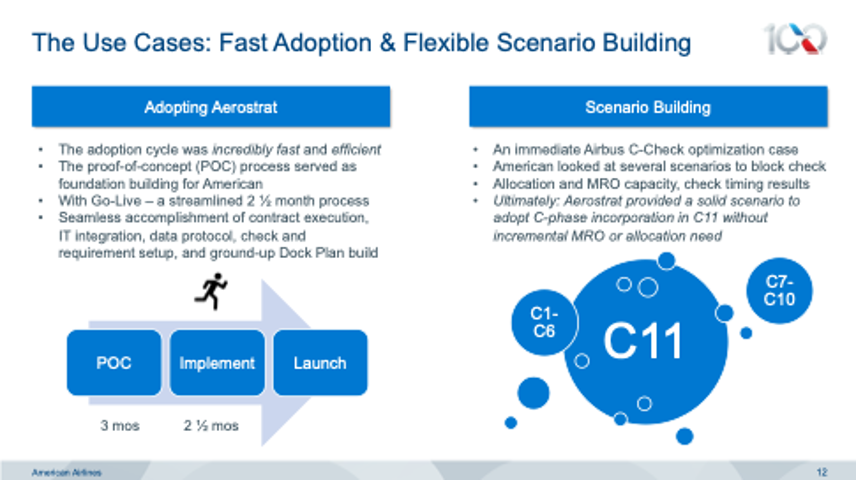
Figure 7
MEETING CRITICAL NEEDS
Everything we’re looking for is being delivered with this solution, as can be seen in figure 8.
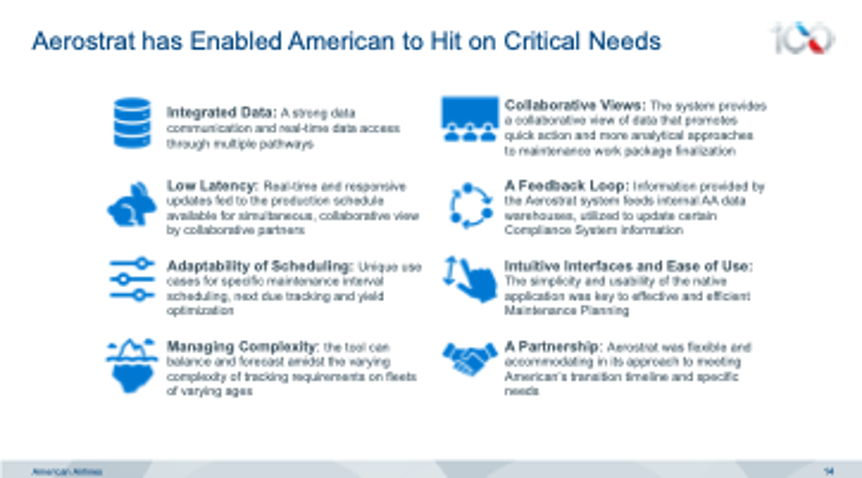
Figure 8
We have found a strong partner who gives us the answers we need and also executes on those answers with a product that allows our maintenance planning to be more resilient, flexible and collaborative.
Comments (0)
There are currently no comments about this article.
To post a comment, please login or subscribe.