Airlines keen to implement AI for maintenance tasks need a comprehensive implementation plan to avoid making expensive errors, says Cameron Byrd, CEO and Founder of AIXI
This article covers the high-level steps to take when deploying AI and machine learning (ML) in aviation maintenance. It highlights the issues around deployment and shows where companies can save money quickly. It explains how airlines can use AI to move from reactive maintenance to predictive operations.
KNOW WHAT YOU WANT
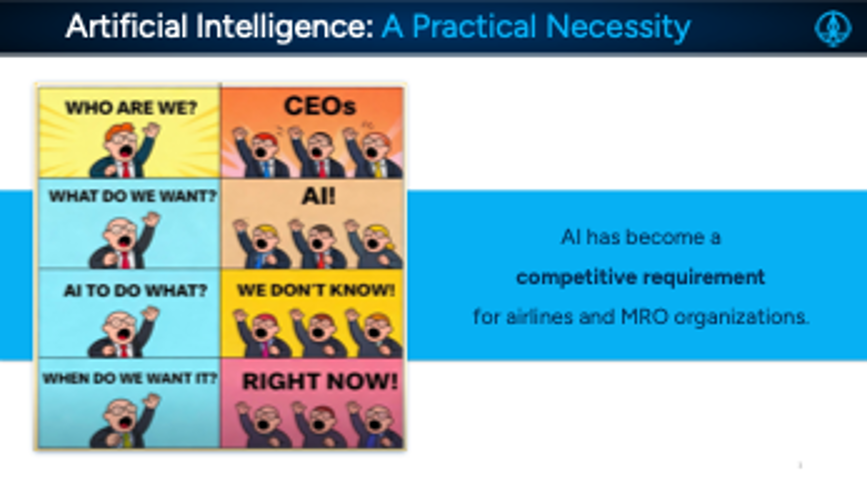
A common challenge facing CEO and leadership teams, not only in airlines, but in business generally, is understanding exactly what they want from AI. There is an urgency to adopt AI, but companies don’t exactly know how to do it (figure 1).
Figure 1
However, leaping into AI without a well-thought-out plan could end up costing teams a lot of money and degrade faith in AI, resulting in an entire AI program having to be shut down until you try again. The same problems with implementing AI can happen repeatedly, so it’s important to get it right the first time. The core problem that most businesses have with AI is that they don’t understand that it is more difficult to roll out than regular software.
An expensive problem
AI adoption is such a big challenge that 95% of AI pilot programs fail to reach production, see figure 2. In fact, AI research and deployment company OpenAI is so familiar with this problem that it started a consulting business to help companies put AI into their systems. In March 2026, the minimum buy-in just to start this with OpenAI is $10 million, so they would be taking your money right to the bank.
START WITH A STRONG USE CASE
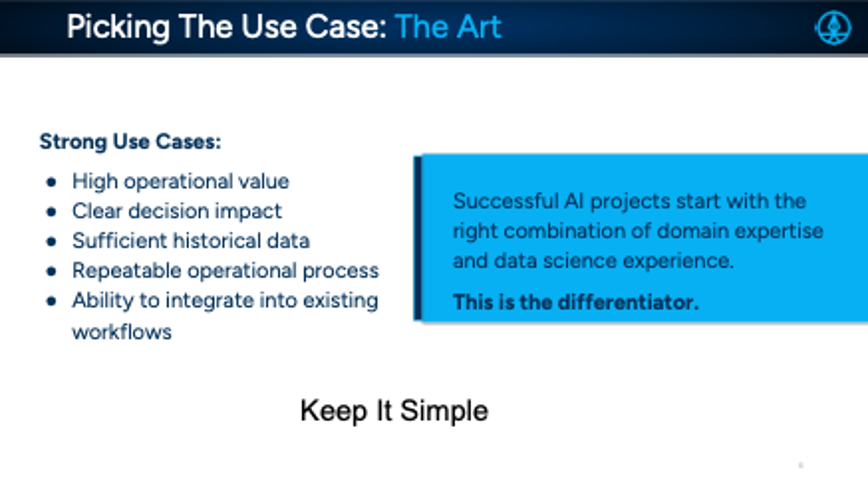
Picking a suitable use case is important when deciding how to introduce AI. To do this, you need someone who understands the domain that you’re working in, so they should have a strong understanding of aviation, as well as a solid foundation in data science. With this background, your AI lead can help you pick the right use case and keep it simple (figure 2).
Figure 2
People often think AI is going to be a robot that changes their world. However, AI is best when used for simple things, like finding all the times you ‘fat-fingered’ a key and made an error entering part numbers. We have found airlines that have tried to do an AI project internally come back to us one, two, even three years later. They’ve just been burning money. The fastest and easiest way to successfully implement an AI solution is to find a partner that’s already completed a successful install somewhere else. They can lead you through the process in a timely manner and within a more reasonable, predictable budget.
FINDING THE SIGNAL IN THE NOISE
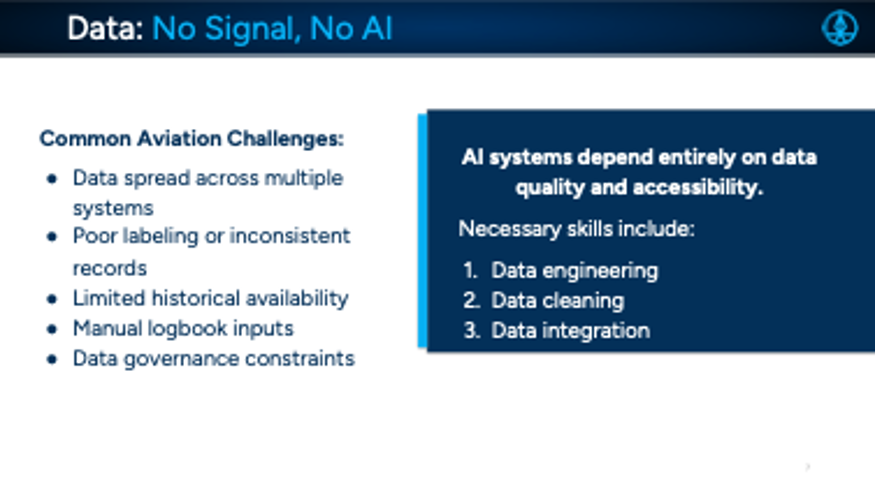
Once you have established an AI use case, you need data from your organization to identify the ‘signal’ about when an event is going to happen, such as a predictive maintenance event (figure 3). If there is no signal, then your AI isn’t going to work. However, finding that signal can be difficult for aviation companies with data spread across multiple systems. You need a data engineer or someone with experience in data-cleaning and data integration to get all the data in the right form. Identifying the signal won’t necessarily be right there on the surface.
Figure 3
BUILD THE INFRASTRUCTURE
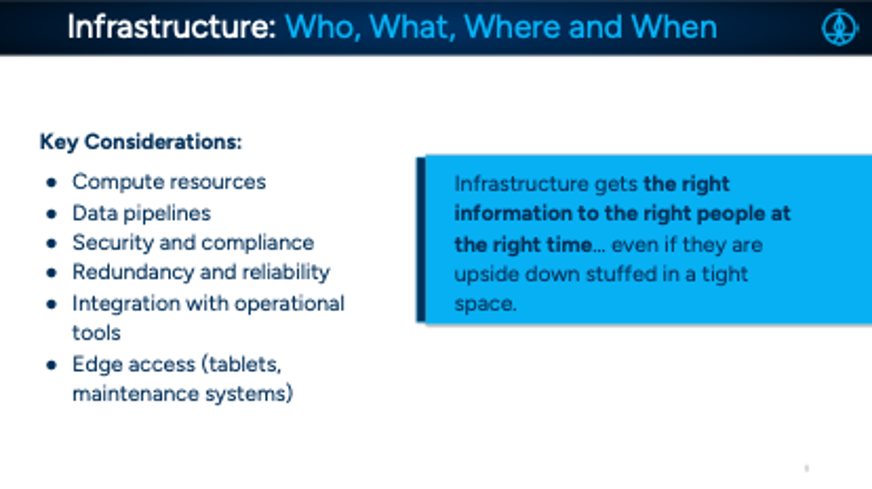
Next, you need the right IT infrastructure to support your AI. The infrastructure to run an AI program needs to operate quickly and effectively, so you can get the right information to the right people in a timely manner (figure 4).
Figure 4
Consider the end consumer of your AI tools. The person needing the AI-generated data might be a mechanic who’s physically upside down while working on a plane and wants information right there. He doesn’t want to extract himself to get it. He wants to pull up his iPad and access the information as easily as possible.
GAINING INTERNAL SUPPORT
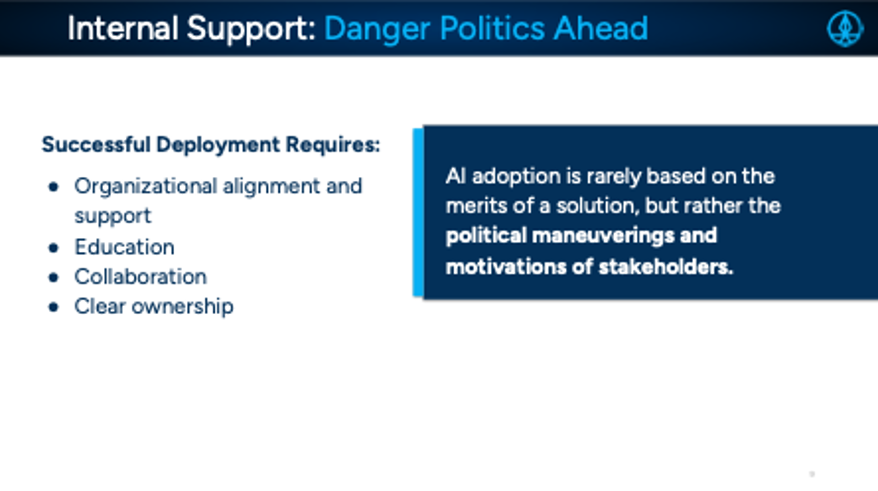
Perhaps the most difficult part of getting an AI project off the ground is gaining internal support (figure 5).
Figure 5
You’ve got to convince people in your organization that they want to use AI. There are examples where an AI solution with the best merits and the highest accuracy didn’t make it into production. This can happen when tools created by the ‘nerdy tech guys’ don’t have a champion who can lead the political manoeuvring necessary to gain senior-level support. You have to be careful about AI solutions being taken on for personal or internal political reasons, rather than a sound business case.
OVERCOMING THE CHALLENGES
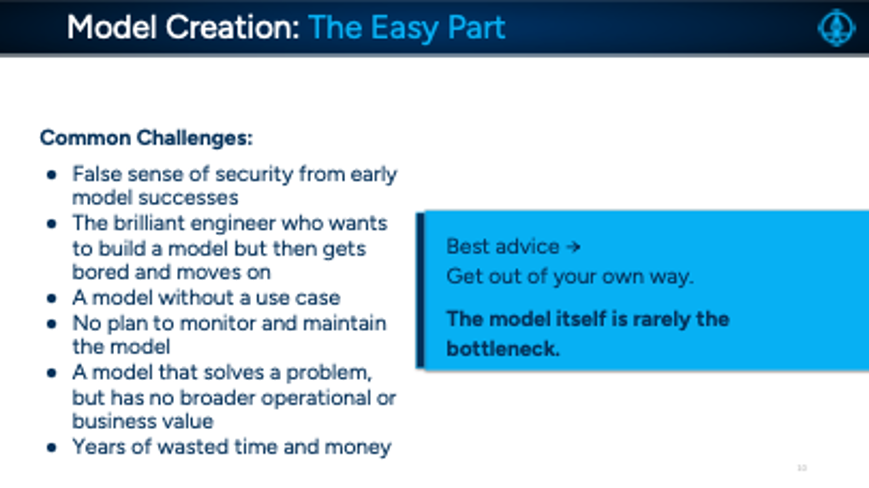
There are plenty of other pitfalls along the way to the successful adoption of AI. If you determine the use case and put in place the right infrastructure, future problems can still crop up, and these issues are rarely related to the AI model or method. (figure 6).
It is important to implement plans to monitor and maintain your AI model. An AI model that only solves a specific problem, but lacks a broader operational value, can prove to be a costly investment in the long term.
Figure 6
Topping the list of challenges is usually a false sense of security gained from early progress made during an AI implementation. This can create an unrealistic ease and confidence. Also, early success by an IT engineer on an AI project manager could encourage them to move on to other things, so you might lose their expertise.
BRINGING USERS ON BOARD
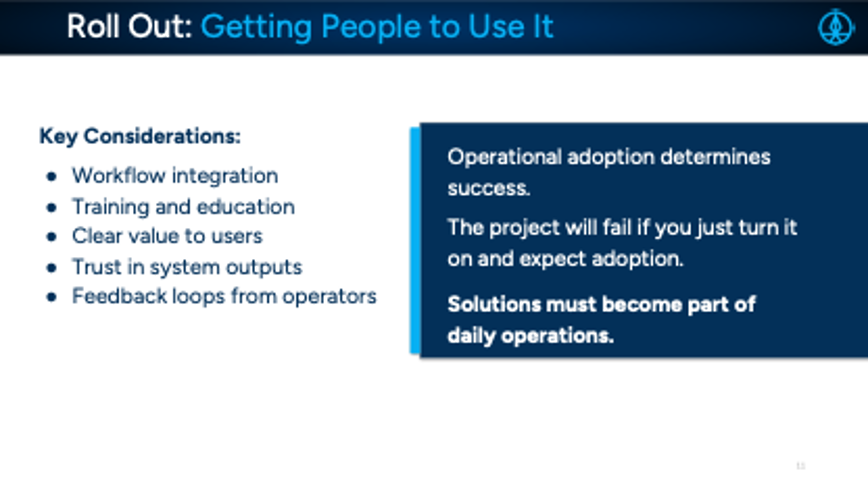
When AI products are rolled out without a clear plan, it is unlikely to gain widespread adoption (see figure 7). In some cases, airlines have turned on a new AI product, only to find that no one uses it. It sat there, mothballed. You need to roll out AI in an orchestrated, planned manner so that practical application, excitement, and adoption can follow.
Figure 7
One way to do that is to limit use to a few people who are really interested in AI. Let them test, use, and play with it. They will give you critical feedback, then share their experience with their colleagues. Adoption will grow in a structured and organic way, gradually gaining more widespread adoption as part of an airline’s daily operations. Other ways to support AI adoption include training and education that clearly lay out its value to users, so trust is built in the new technology. Obtaining user feedback is an essential way of ensuring an AI model is working as intended.
MONITORING PROGRESS
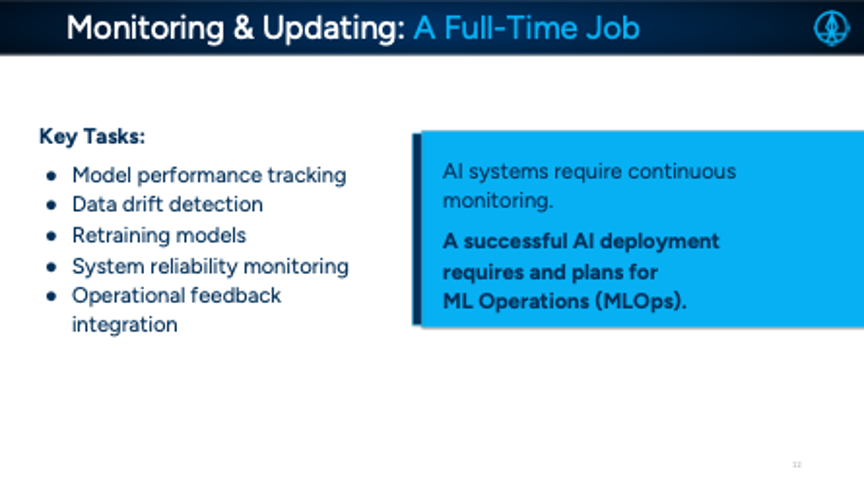
If your AI is given bad information, then you’re going to get bad results, see figure 8.
Figure 8
Monitoring and updating an AI model can be a full-time job. You have to constantly evolve the AI to maintain its accuracy. This includes meeting the changing needs of the airline, advances in aircraft configurations, and changes in computer languages.
RETURN ON INVESTMENT
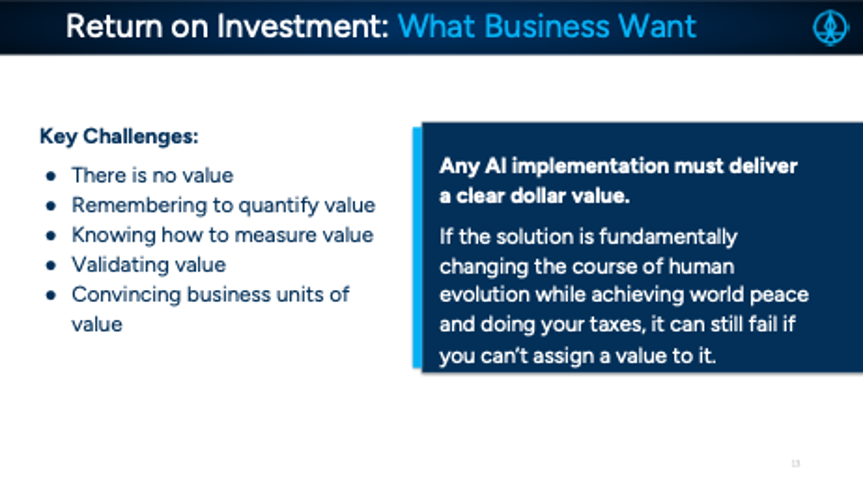
In the commercial world, an AI solution has to add value and deliver an adequate return on investment (ROI), see figure 9.
Figure 9
You need to know how to quantify and measure the value of AI, otherwise you might not convince decision-makers in your organization to deploy the AI solution.
ROI examples
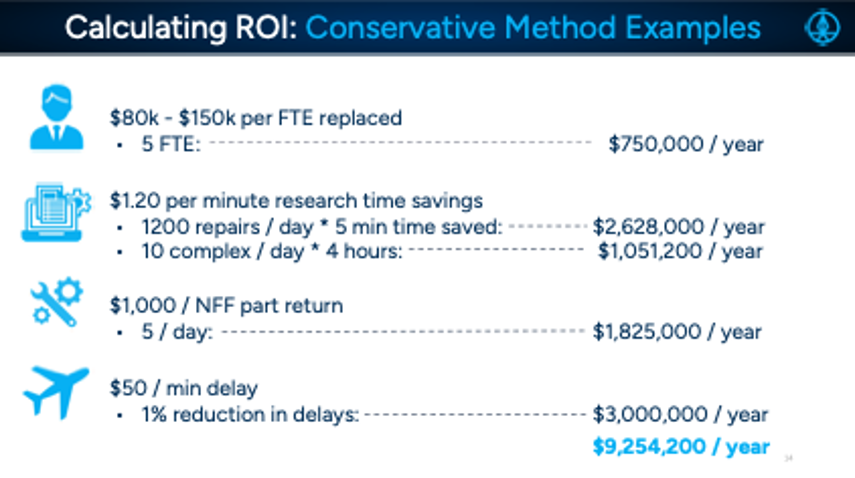
There are cases where companies installed AI without meaningful calculations for ROI, and the AI program was eventually shut down. Despite the AI model saving the business money, the technology investment was wasted because no one had quantified the cost-saving benefits (see figure 10).
Figure 10
Replacing employees with AI is one way to gain an ROI, although not all companies are keen to lose people. Instead, they might look at moving people to other roles that bring strategic value. It’s worth remembering that if you free a person from redundant, boring, and mundane tasks and shift them into more meaningful, exciting, and interesting work, then they are significantly more likely to be more productive.
AI can speed up research tasks, which can quickly add up to significant time and cost savings. For example, a mechanic can use AI tools to reduce the repair time on a job. Another area that brings immediate ROI is on return parts with “no fault found” because you didn’t have critical information at the outset about how to repair the aircraft. The cost of parts returns really adds up! So, too, does the cost of delays that might have been avoided if AI had been deployed to find a solution.
KEY TAKEAWAYS
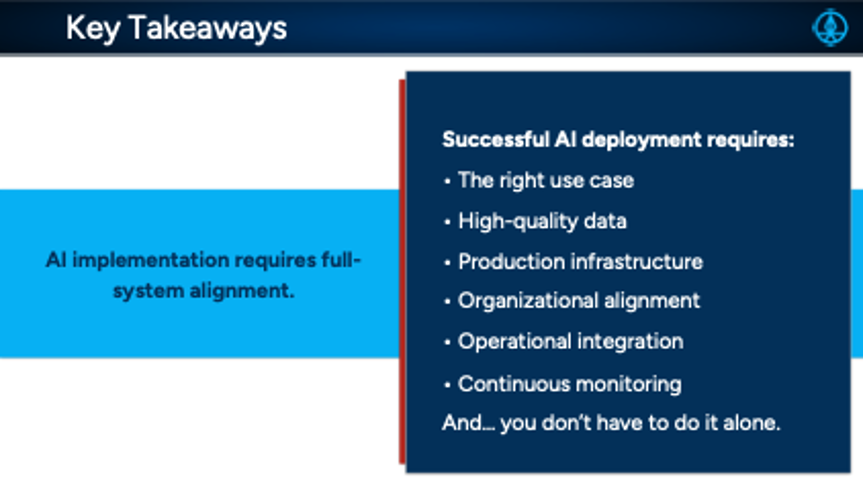
Aviation is an industry defined by margins, reliability, and operational efficiency. Small improvements in areas like dispatch reliability, maintenance turnaround times, and component replacement timing can translate into massive economic benefits. AI can be an enabler for airlines to gain compounding operational advantages (figure 11).
Figure 11
It goes without saying that installing AI is complex. The technology has to work, and the business has to champion the effort. Use cases and ROI must be prepared. It only takes one small thing going wrong for an entire AI project to fail.
Comments (0)
There are currently no comments about this article.

To post a comment, please login or subscribe.