
Articles
| Name | Author | |
|---|---|---|
| CASE STUDY: Improved change management capabilities for Infotel’s Orlando© | Alban Biard, General Manager, Orlando© Suite for TechPubs | View article |
| WHITE PAPER: How to capitalize on AI in aviation maintenance | Cameron Byrd, CEO and Founder, AIXI | View article |
| CASE STUDY: More than paperless: electronic logs delivered efficiency and integration at Air Europa | Francisco de Borja Mas Boned, Juan Miguel Sánchez García and Enrique García-Arcicollar, Air Europa | View article |
| CASE STUDY: Helvetic Airways Moves Beyond Paper Technical Logs | Christian Suhner, Chief Technology Officer (CTO) / Head of Flight Operations, Helvetic Airways | View article |
| CASE STUDY: Atlas Air transforms tech platform to optimize real-time data capabilities | Richard Steer, VP Technical Operations and Austin Wentworth, Director, both at Atlas Air, and Jim Buckalew, CEO, AeroATeam | View article |
| CASE STUDY: American Airlines optimizes maintenance scheduling | Joseph Kunnathusseril, Senior Manager – Aircraft Base Planning, American Airlines | View article |
CASE STUDY: More than paperless: electronic logs delivered efficiency and integration at Air Europa
Author: Francisco de Borja Mas Boned, Juan Miguel Sánchez García and Enrique García-Arcicollar, Air Europa
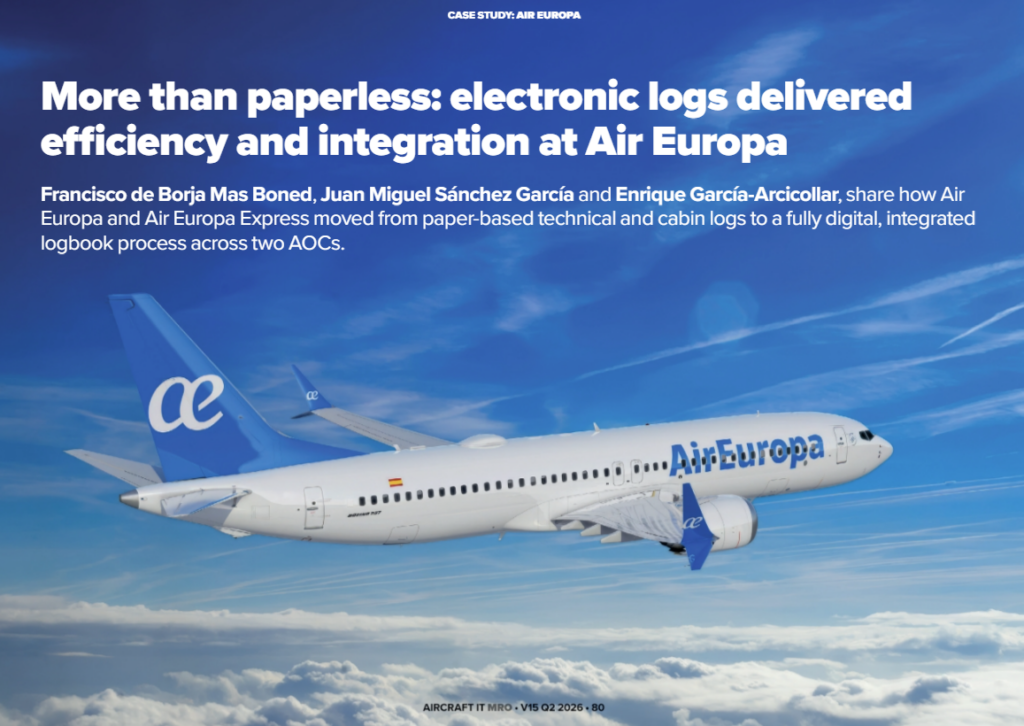
SubscribeFrancisco de Borja Mas Boned, Juan Miguel Sánchez García and Enrique García-Arcicollar, Air Europa, share how Air Europa and Air Europa Express moved from paper-based technical and cabin logs to a fully digital, integrated logbook process across two AOCs.
AIR EUROPA & AIR EUROPA EXPRESS
Air Europa is a network airline operating short-, medium- and long-haul services across Europe, the Americas and the Caribbean. From its Madrid-Barajas hub, the airline connects Spain with Europe and the Americas, carrying more than 12 million passengers a year across more than 60 destinations and four continents (figure 1).
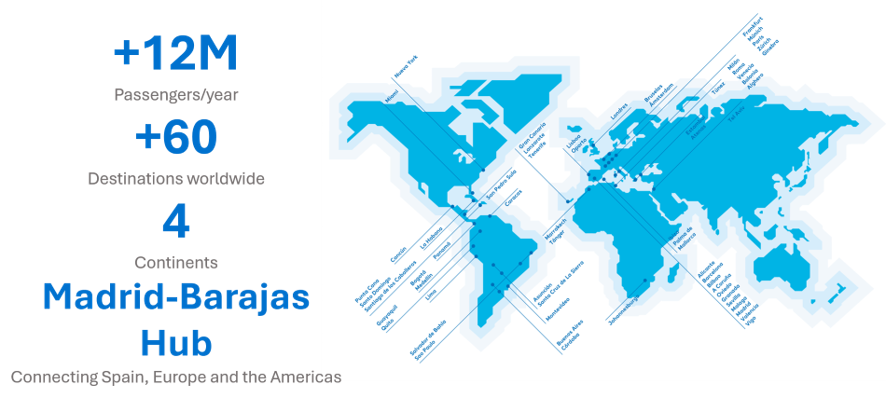
Figure 1
Air Europa Express operates as the regional carrier within the Group, focused mainly on short-haul operations and supported by a simpler and highly efficient operating model. Although Air Europa and Air Europa Express operate under separate Air Operator Certificates (AOCs), both airlines share common maintenance, engineering and digital transformation strategies. This shared operating vision provided the right framework to validate, refine and scale the electronic Technical and Cabin Logbook project across the Group.
The current Air Europa fleet combines short- and long-haul aircraft, see figure 2, including 11 Boeing 787-8 Dreamliners, 18 Boeing 787-9 Dreamliners, 23 Boeing 737-800 aircraft and seven Boeing 737 MAX aircraft. The future arrival of the Airbus A350, with the first aircraft expected in Q2 2028, reinforces the need for scalable digital maintenance capabilities able to support a more complex, connected and data-driven operation.
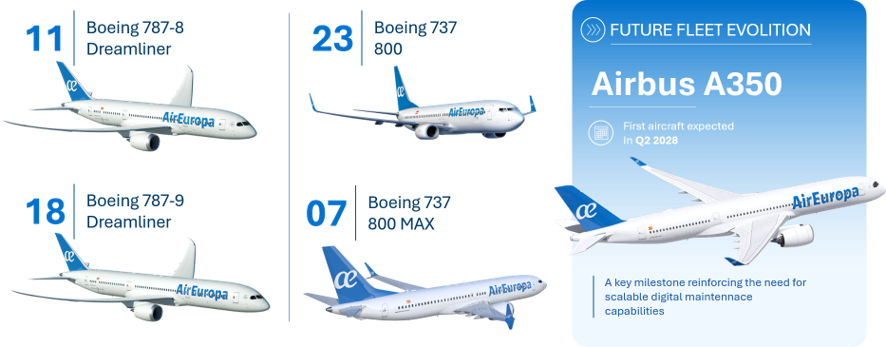
Figure 2
At this scale, aircraft availability, operational reliability and real-time coordination are essential. The question for Air Europa was not whether maintenance should become more digital, but how fast and how deeply the organization needed to transform to support the network, the fleet and the customer experience.
TECH LOG PROCESSES BEFORE THIS PROJECT
Prior to the implementation of the electronic Technical and Cabin Logbooks, both airlines relied on traditional paper-based Technical and Cabin Logbooks. This approach required manual entries by crews, physical handling and transport of documents, delayed data availability and manual transcription into maintenance systems. The main pain points were clear: limited real-time visibility, higher risk of transcription errors, slower decision-making, reduced traceability and inefficiencies in coordination between flight crews, cabin crews, maintenance, CAMO and operational control.
This was particularly relevant because Air Europa’s maintenance transformation had already started several years earlier. In 2019, the Maintenance Division launched a broad transformation program aimed at improving operational efficiency through digitalization, process redesign and the adoption of new technologies. A key milestone in that journey was the implementation of TRAX eMRO and the eMobility ecosystem as the backbone of Air Europa’s maintenance digital platform.
The first major phase of that transformation focused on replacing legacy and disconnected systems with a single, integrated maintenance platform. Before that, the organization had separate systems for logistics, planning, CAMO, reliability and other functions. These systems were not fully connected and did not always use the same definitions, structures or operational language. The objective of the TRAX implementation was to create a common data model and a common operational language. Everyone needed to see the same information, work in the same system and make decisions based on the same data.
The eMRO and eMobility Go-Live took place on 13 July 2021. From that point, maintenance teams progressively moved towards digital ways of working. However, flight and cabin crews continued to operate the Technical and Cabin Logbooks on paper. As a result, maintenance teams were working in a hybrid environment: using digital tools for maintenance execution while still depending on paper Technical Log Pages generated by the flight operation. This created duplication. When the aircraft arrived, information recorded on paper had to be interpreted and transcribed into the digital maintenance system. The implementation of the eTLB and eCLB was designed to close that gap.
THE BUSINESS CASE FOR eTLB
The business case for the electronic Technical and Cabin Logbooks was driven by operational efficiency, safety, traceability and data quality. However, the objective was not simply to digitize an existing form. Air Europa wanted to transform the way technical and cabin information flowed across the operation. By capturing events digitally and making them available in real time, the organization could improve coordination, reduce manual workload, enhance reporting quality and support better operational decisions.
The expected benefits included real-time access to technical and cabin information, improved end-to-end traceability of defects and maintenance actions, reduced manual transcription, stronger data quality, faster feedback between maintenance and crews, and a better foundation for future analytics and predictive maintenance initiatives. The eTLB project was never just about replacing paper. It was about transforming how cockpit, cabin, maintenance and operations connect, collaborate and make decisions in real time.
There was also a customer dimension. Cabin defects and technical events can directly affect the passenger experience. By improving the quality, speed and traceability of defect reporting, the airline can act earlier, prioritize better and coordinate more effectively across maintenance, operations and customer-facing teams. For Air Europa, the eTLB and eCLB were therefore not just a maintenance IT project. They were the next logical step in the Maintenance Digital Transformation Journey: from TRAX implementation to digital maintenance execution, to fully connected technical logbook operations. The electronic Technical Logbook is not where the transformation starts; it is where the transformation becomes visible to the whole operation. In practical terms, this meant moving from paper-based record keeping to an operating model where cockpit, cabin, maintenance and operations could share information and make decisions in real time.
IMPLEMENTATION OF THE PROJECT – CHANGES AND CHALLENGES
This was not only a technology project; it was a controlled operational transformation of one of the most critical records in airline maintenance. The project followed a phased approach and was managed as an operational transformation, not merely as a software deployment. Several factors made the implementation complex. The Technical Logbook is one of the most critical operational records in an airline. It affects aircraft acceptance, maintenance release, defect management, operational continuity and regulatory compliance. Changing this process required coordination across multiple areas: Maintenance, Flight Operations, Cabin Operations, CAMO, IT, Compliance, Training, Safety, TRAX and external maintenance providers. The main challenges were related to user adoption, training at scale, connectivity, contingency management and maintaining uninterrupted operations during the transition.
Air Europa Express as the first deployment
Air Europa Express was selected as the first deployment environment because it provided a more controlled operational context. Its smaller fleet, short-haul operation and lower operational complexity made it the right environment to validate processes, technology, training, support and contingency management in live operation before scaling the model to Air Europa.
The Air Europa Express Go-Live took place on 5 August 2025. The deployment followed a Big Bang strategy, with all aircraft moving to the digital process from day one. This avoided the complexity of running paper and digital processes in parallel during transition and allowed a homogeneous adoption model. The results confirmed the validity of the approach. The system stabilized rapidly, contingency usage remained below 1 percent, and minor issues were detected and addressed quickly through the H24 support model.
Scaling to Air Europa
The second Go-Live took place at Air Europa on 4 November 2025. This was not a simple replication of the Air Europa Express deployment. It was a scaled and reinforced implementation. Air Europa introduced additional complexity: a larger fleet, a wider user population, mixed short- and long-haul operations, Boeing 787 aircraft, international destinations, different connectivity conditions and a more complex operational environment.
The lessons learned from Air Europa Express were systematically incorporated into the Air Europa rollout. Training material was reinforced, contingency procedures were clarified, operational dashboards were improved, support capacity was increased and connectivity planning was strengthened, especially for long-haul operations. The decision to use a Big Bang strategy again was based on confidence gained from the Air Europa Express deployment. Once the model had been validated, avoiding coexistence between paper and digital processes was considered the most effective way to ensure standardization, reduce ambiguity and accelerate adoption.
Change management
Change management was one of the most important workstreams. Digitalizing the Technical and Cabin Logbooks meant changing routines that had been embedded in the operation for many years. The project therefore focused not only on deploying applications, but on creating operational confidence. A key component was the Test User model. Experienced users from flight and cabin operations participated in testing, validation and operational feedback. During Go-Live, they supported other users directly at the aircraft, helping to resolve doubts and reduce friction during the first days of operation.
Training was adapted to the scale of each operator. In Air Europa Express, the smaller user population allowed more direct training. In Air Europa, the larger and more geographically dispersed crew population required a scalable model based on e-learning, video-based content, practical use cases and mandatory assessments. After the Air Europa Express Go-Live, additional emphasis was placed on contingency scenarios, operational examples and the logic of the new digital process. The objective was not simply to show users how to interact with the applications. The objective was to ensure they understood the process, the decision points, the contingencies and the operational implications of the new way of working.
H24 support and hypercare
A dedicated H24 support organization was another critical enabler. This team provided continuous support to flight crews, cabin crews, maintenance personnel and third-party maintenance providers at outstations. Its role went beyond reactive support. The H24 team monitored system performance, connectivity, contingency events, support activity and user behavior. It also coordinated with TRAX and internal system administrators to resolve issues and maintain operational continuity.
During Go-Live and hypercare, this support model helped build trust. Users knew that support was available. The operation knew that risks were being monitored. The project team had real-time feedback on how the deployment was progressing.
Connectivity
Connectivity was one of the most relevant technical lessons. The Boeing 737 operation achieved success rates above 90 percent during testing. The Boeing 787 long-haul operation presented additional challenges, mainly linked to cockpit signal attenuation, mobile network coverage limitations at certain destinations and coverage gaps at specific airports.
Air Europa treated this as an operational risk requiring mitigation. A dedicated Mi-Fi solution was defined for the Boeing 787 cockpit to provide a more reliable connectivity layer for the digital logbook operation. At the same time, contingency procedures remained fundamental. The system was designed with offline capabilities, but the airline also maintained clearly defined paper-based contingency processes to ensure continuity in any scenario where connectivity or application availability could be affected.
Together, these measures allowed the organization to manage the main project risks in a structured way and deliver a stable transition to a fully digital logbook environment across both airlines.
IMPLEMENTATION TIMELINE
The implementation of the electronic Technical and Cabin Logbooks was not a standalone project, but the second major phase of the eMRO and eMobility implementation roadmap defined within Air Europa’s Maintenance Digital Transformation Strategy (figure 3).
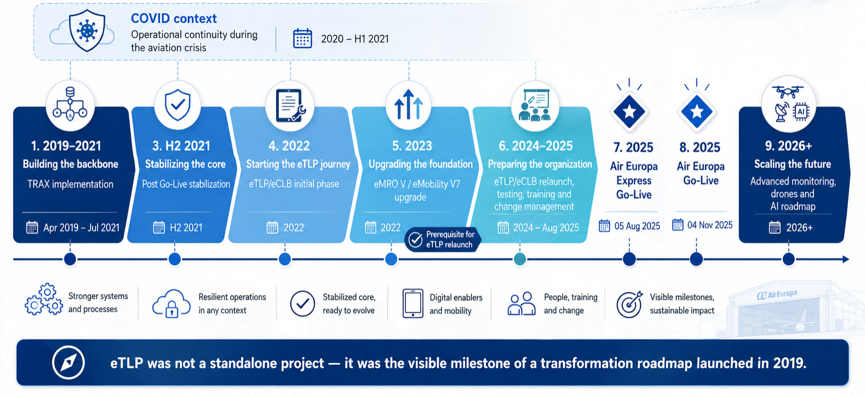
Figure 3
The transformation journey began in 2019, when Air Europa selected TRAX as the backbone of its maintenance digital ecosystem. The period from 2020 to the first half of 2021 was strongly influenced by the COVID context, but the organization continued working on the transformation roadmap. On 13 July 2021, Air Europa completed the Go-Live of eMRO and eMobility for maintenance. This was followed by a stabilization period in which the organization consolidated the new platform, processes and mobile maintenance capabilities.
The initial phase of the eTLB and eCLB project started in 2022. At that point, Air Europa was operating on eMobility version 6.3. As the project progressed, it became clear that several functional adaptations and system enhancements were required to fully support Air Europa’s operational requirements. Throughout 2022, Air Europa and TRAX worked on defining and validating those adaptations. By the end of that phase, TRAX recommended an upgrade to version 7 of both eMRO and eMobility to properly accommodate the required functionality. As a result, the eTLB/eCLB project was temporarily paused while the organization prioritized the upgrade effort. The upgrade was completed and stabilized, creating a stronger technological foundation. The eTLB/eCLB project was then relaunched and moved into readiness, validation and deployment preparation.
The first operational Go-Live took place at Air Europa Express on 5 August 2025. The second Go-Live took place at Air Europa on 4 November 2025. Completing both Go-Lives in less than three months required strong coordination across all operational and technical teams. The next phase, from 2026 onwards, is focused on scale-up and future roadmap activities: using the digital logbook not only as a record-keeping tool, but as a real-time operational data source supporting maintenance, operations and customer experience.
HOW THE eTLB WORKS
In this article, the term electronic Technical Logbook refers to the end-to-end digital process used to capture, manage and close technical logbook information. The Technical Log Page (TLP) remains the final generated record: eTLB and eCLB processes rely primarily on PilotLog, CabinLog and QuickTurn, fully integrated with TRAX eMRO (figure 4)
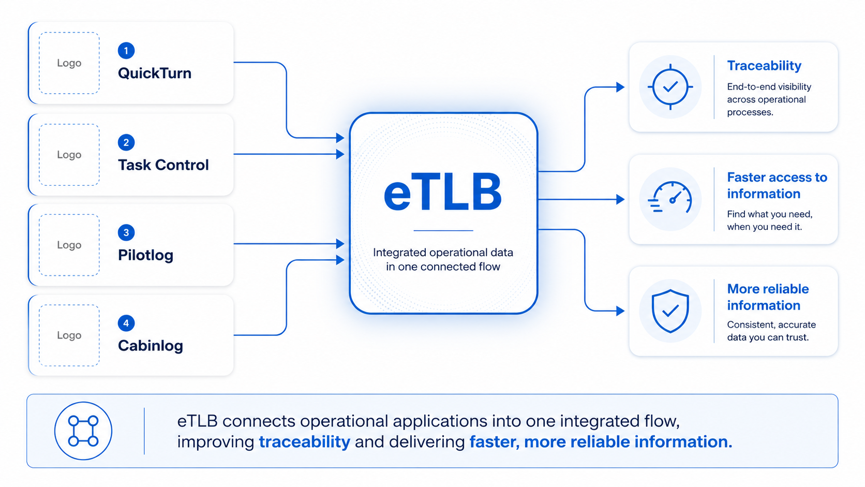
Figure 4
PilotLog is used by flight crews to manage the technical logbook process from the cockpit. It allows pilots to review aircraft status, deferred defects, Notices to Crew, fuel and de-icing information, report new defects, perform aircraft acceptance and close the flight digitally.
CabinLog is used by cabin crews to report cabin defects in a structured way. The application supports cabin layouts, defect catalogues and the attachment of images, improving reporting consistency and giving maintenance teams more accurate information earlier.
QuickTurn is used by maintenance personnel to manage non-scheduled maintenance activity related to defects reported by crews. It supports troubleshooting, defect closure, deferrals, servicing activities and the aircraft release process.
The wider eMobility ecosystem also includes TaskControl for scheduled maintenance activities, but the digital logbook process is mainly supported by PilotLog, CabinLog and QuickTurn.
The process connects cockpit, cabin and maintenance into a single digital workflow. Information entered through the applications is synchronized with eMRO, where it becomes available for maintenance control, line maintenance, CAMO, operational control and other stakeholders. The generated TLP provides the final record, while the operational data is available in the system much earlier than in the previous paper-based model. This is one of the major benefits of the new process: the organization no longer has to wait for paper documentation to be physically processed before acting on the information.
The eTLB also supports offline capabilities. However, operational resilience is built through a combination of digital functionality and clearly defined paper-based contingency procedures. This ensures that, even in cases of connectivity loss or application unavailability, the airline can continue operating safely and maintain the traceability of the technical record.
WORKING WITH TRAX
Working with TRAX was a key success factor throughout the project. TRAX provided the technological foundation through eMRO and eMobility, but the collaboration went beyond standard software implementation. The project required continuous adaptation, feedback, issue resolution and operational alignment.
One of the most important areas of collaboration was solution adaptation. Air Europa’s processes, operational logic and regulatory requirements had to be reflected in the system configuration and application behavior. This required close work between Air Europa’s project team, operational users and TRAX specialists. Feedback from Test Users and operational teams was systematically incorporated into the refinement of processes and application behavior. This iterative approach ensured that the solution evolved based on real operational experience rather than theoretical assumptions.
TRAX’s involvement during Go-Live was particularly valuable. Having TRAX resources closely aligned with Air Europa’s project team enabled faster issue resolution, direct communication with technical experts and greater confidence during stabilization. Training was primarily managed internally by Air Europa, with content developed to reflect company-specific procedures and operational reality. TRAX supported this effort by providing technical expertise, clarifying system behavior and supporting the preparation of training materials when required.
The success of the project came from the combination of TRAX’s technology and Air Europa’s operational ownership. Air Europa led the internal transformation: process definition, training, change management, support organization, regulatory coordination and deployment governance. TRAX provided the platform, technical expertise and support required to make that transformation possible.
This is the essence of a strong partnership: technology, operational knowledge and execution working together.
technical problems.
Because the eTLB and eCLB affect aircraft technical records and operational continuity, regulatory engagement was central from the beginning. The project was approached as a joint operational and regulatory initiative, not simply as a technological deployment. The approval process included operational validation, safety assessment, updates to company manuals and procedures, definition of contingency processes and evidence of system behavior under real operational conditions.
A key success factor was maintaining a transparent and proactive relationship with AESA (Agencia Estatal de Seguridad Aérea / Spanish Aviation Safety and Security Agency). Air Europa kept the authority informed about the implementation strategy, the challenges identified, the mitigation measures defined and the way training and change management would be executed. Training and user adoption were also part of the regulatory discussion. The authority was informed about how training would be delivered, how knowledge assimilation would be assessed and how operational readiness would be monitored before and after Go-Live.
After each deployment, structured review sessions were used to present operational indicators such as system stability, contingency rates, adoption levels and support activity. The approval of the system in the first AOC facilitated the extension to the second, supported by operational evidence, performance data and lessons learned from the initial deployment. This structured, transparent and data-driven approach allowed regulatory approval to progress efficiently while ensuring compliance with safety and operational requirements.
LESSONS LEARNED
With a project of this scale and operational impact, it is unrealistic to expect every aspect to be perfect from the beginning. A transformation of this nature does not happen in isolation; it takes place inside a live airline operation where operational priorities always come first (figure 5).
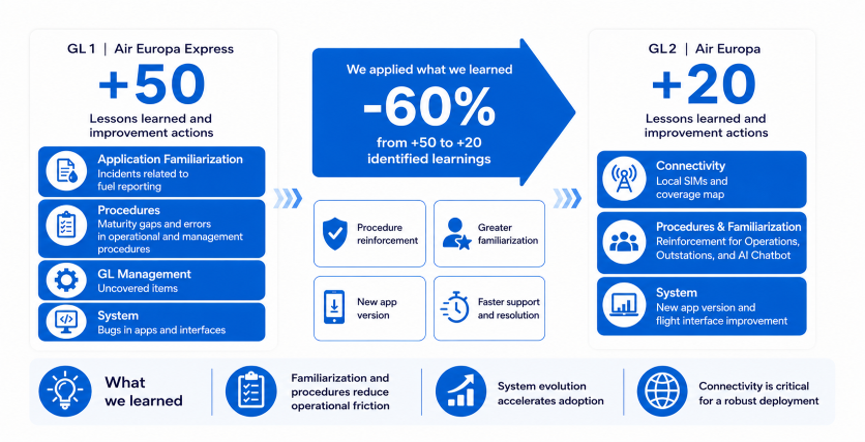
Figure 5
The first lesson is that change management must be treated as a core project workstream from the very beginning. Training, communication, Test Users, support and operational confidence were as important as the applications themselves.
The second lesson is that phased deployment was the right strategy. Starting with Air Europa Express allowed the organization to validate the model in a more controlled environment, capture lessons and apply them before scaling to Air Europa.
The third lesson is that training must focus not only on tool usage, but also on operational logic. Users need to understand the process, the decision points, contingency scenarios and how their actions affect the wider operation.
The fourth lesson is that connectivity must be addressed as an operational enabler. The short- and medium-haul operation performed strongly, while long-haul operations required additional focus and mitigation. The Boeing 787 experience reinforced the importance of testing under real operational conditions and preparing specific mitigation actions.
The fifth lesson is that support must be close to the operation. The H24 support model helped reduce uncertainty, accelerate issue resolution and build user confidence during Go-Live and stabilization.
The sixth lesson is that digital transformation creates better data, but better data only creates value when the organization is ready to use it. The eTLB and eCLB now provide a foundation for real-time visibility, but the next step is to turn that visibility into operational intelligence.
Overall, the phased approach proved highly effective. Starting with a controlled environment, capturing lessons learned and then scaling the solution allowed the organization to manage risk, maintain operational continuity and deliver a stable and sustainable digital logbook implementation across both airlines.
OUTCOMES AND RESULTS
The results of the project demonstrate that the deployment achieved both operational stability and user adoption. Across the program, Air Europa performed more than 750 test flights in Air Europa and more than 1,100 validation flights across both operators. During the first month of fully digital operation after the deployment across both companies, approximately 5,400 flights were operated digitally. Contingency usage remained below 1 percent, confirming the robustness of the operating model and the effectiveness of the support and monitoring structure.
The Boeing 737 operation achieved success rates above 90 percent during testing and the Boeing 787 experience helped identify and address connectivity constraints through the dedicated Mi-Fi mitigation strategy. User feedback was also positive. Internal adoption indicators showed a strong perception of the tools, with NPS (Net Promoter Score) results of +63 for PilotLog and +62 for CabinLog. These results are significant because they show that the project delivered more than system availability. It delivered operational trust.
Crews adopted the tools naturally. Maintenance teams gained earlier visibility of technical and cabin defects. Operations had better traceability. The organization moved closer to real-time decision-making. The customer impact is also relevant. CabinLog improves the ability of cabin crews to report defects in a more structured, accurate and timely way. This creates better visibility of cabin issues and enables maintenance teams to prioritize and act on them more effectively. Cabin defects that previously could be delayed, insufficiently described or manually processed can now be reported with better quality and faster availability. That improves traceability and supports quicker corrective action. In that sense, the eTLB and eCLB are not only maintenance tools; they are part of a wider operational capability that supports reliability, punctuality and customer experience.
NEXT STEPS AND FUTURE PLANS
The next steps for the project focus on fully leveraging the data generated by the eTLB and eCLB as a real-time operational asset, rather than treating the digital logbook solely as a record-keeping tool. The first objective was to eliminate paper and stabilize the digital process. That has been achieved. The next objective is to use the information generated by the system to improve operational performance. Real-time technical and cabin defect visibility opens new opportunities for advanced pre-troubleshooting, earlier preparation of materials, tooling and personnel, faster maintenance response and better coordination between maintenance operations and crews. Connectivity will continue to be a critical enabler. The ability to report events in flight, access that information immediately on the ground and act on it in real time creates new opportunities for operational efficiency and customer impact.
Another key focus area is continuous improvement of the applications themselves. Flight and cabin crews are the primary users of the system and represent a constant source of operational feedback. Incorporating their experience into future enhancements will remain a priority, ensuring that usability, efficiency and alignment with real operational needs continue to evolve. The future roadmap is built on the same foundation that enabled the eTLB and eCLB deployment: TRAX, data, automation and mobility capabilities. This is where the project moves from digital deployment to operational trust, and from operational trust to operational intelligence.
SUMMARY
The implementation of the electronic Technical Logbook and electronic Cabin Logbook at Air Europa and Air Europa Express represented a major operational transformation. It changed the way cockpit, cabin, maintenance and operations connect, collaborate and make decisions. It completed a transformation journey that began in 2019 with the implementation of TRAX as the backbone of the maintenance digital ecosystem.
The project was successful because it combined technology with operational ownership. It was not only about implementing applications. It was about redesigning processes, preparing users, supporting the operation, managing risks and building confidence across two AOCs. Technology enables organizations to become more efficient, faster and more connected. However, technology alone does not deliver transformation. People implement it, adopt it and make it work in real operations.
The commitment of crews, Test Users, maintenance teams, operational departments, support teams and partners was decisive. Completing two Go-Lives in less than three months required exceptional coordination and dedication. For Air Europa, the eTLB and eCLB are not the future. They are the new reality: digital, connected, more traceable and more efficient. This project shows what can be achieved when technology, people and purpose are fully aligned.
Comments (0)
There are currently no comments about this article.
To post a comment, please login or subscribe.