
Articles
| Name | Author | |
|---|---|---|
| CASE STUDY: Improved change management capabilities for Infotel’s Orlando© | Alban Biard, General Manager, Orlando© Suite for TechPubs | View article |
| WHITE PAPER: How to capitalize on AI in aviation maintenance | Cameron Byrd, CEO and Founder, AIXI | View article |
| CASE STUDY: More than paperless: electronic logs delivered efficiency and integration at Air Europa | Francisco de Borja Mas Boned, Juan Miguel Sánchez García and Enrique García-Arcicollar, Air Europa | View article |
| CASE STUDY: Helvetic Airways Moves Beyond Paper Technical Logs | Christian Suhner, Chief Technology Officer (CTO) / Head of Flight Operations, Helvetic Airways | View article |
| CASE STUDY: Atlas Air transforms tech platform to optimize real-time data capabilities | Richard Steer, VP Technical Operations and Austin Wentworth, Director, both at Atlas Air, and Jim Buckalew, CEO, AeroATeam | View article |
| CASE STUDY: American Airlines optimizes maintenance scheduling | Joseph Kunnathusseril, Senior Manager – Aircraft Base Planning, American Airlines | View article |
CASE STUDY: Improved change management capabilities for Infotel’s Orlando©
Author: Alban Biard, General Manager, Orlando© Suite for TechPubs
Subscribe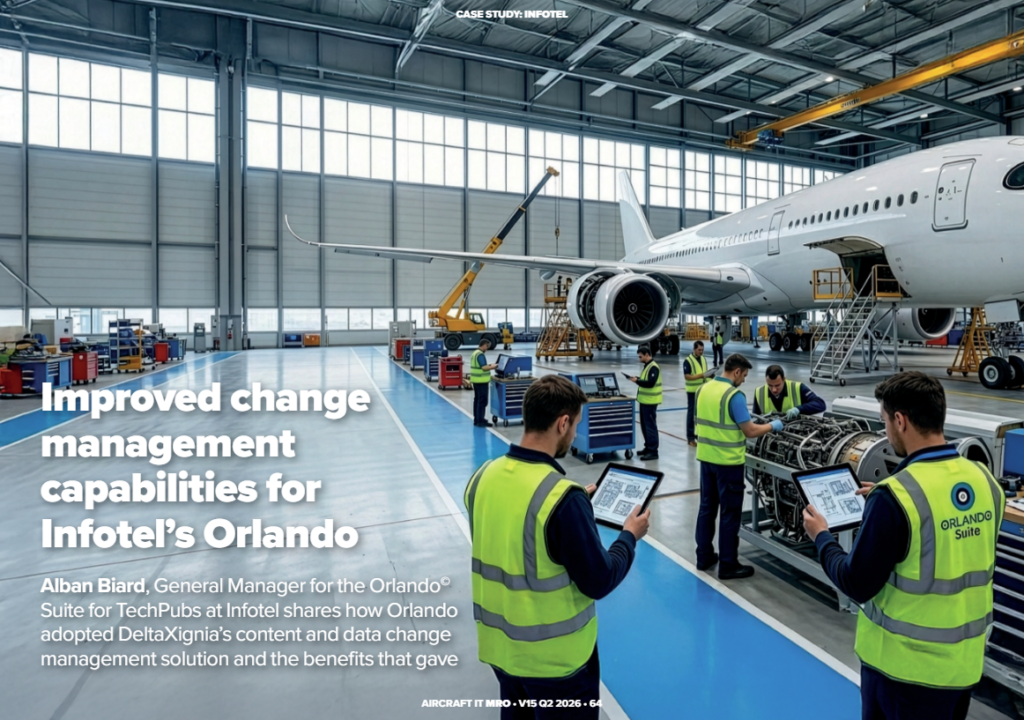
Alban Biard, General Manager for the Orlando© Suite for TechPubs at Infotel shares how Orlando© adopted DeltaXignia’s content and data change management solution and the benefits that gave
Before we get onto the main subject of this case study, how Orlando© from Infotel gained improved DeltaXignia content and data change management capabilities, I’ll first introduce readers to Infotel and Orlando©.
INFOTEL AND ORLANDO©
Infotel is made up from two main entities. The first is Infotel, a group that includes several brands and is mainly an IT services provider based in France with offices in the UK, Canada and the US as well as Morocco and India., Infotel’s first customer as an IT service provider was Airbus, working with the aviation and aeronautics business. We also have a strong partnership and customer relationship with Air France where Infotel is a service provider within the Air France KLM group. We know aviation very well.
Thanks to this aviation DNA and the fact that we have a second entity, which is a software publisher, ten years ago, we created an entity called Orlando©, the part of the business that I manage. Orlando© aims to deliver a software called Orlando© Suite for Tech Pubs and it is because of this that we have, for some time, worked with what was DeltaXML when we first worked together, but which has since become DeltaXignia to better reflect its growing capabilities beyond structured formats, such as XML, HTML and JSON, to unstructured formats such as Office and pdf.
The Orlando© Suite for tech pubs was designed for airlines, and we work mainly in the aviation business to manage documents as a document management system that covers the entire life cycle of manuals from generation and storage, through management and revision management right up until a manual is viewed by the final users. There are seven modules for that and, looking a little wider, there are two other modules addressing compliance and safety issues; nine modules to cover all the scope. Our goal is to have the widest market footprint we could have, in pursuit of which we offer this product not only to airlines but also to airports, MRO’s and entities that need to manage both documents and compliance. This is why Infotel and Orlando© are working with DeltaXignia.
CHALLENGES AND PAIN POINTS BEFORE DELTAXIGNIA
Considering the processes used to deal with identifying changes in documentation, before the project with DeltaXignia, the major pain points that we experienced with that were related to the work on revision management. We used to cover all that workflow and its processes by ourselves in a manual process. We decided to work with DeltaXignia because we wanted to have a clearer and more identifiable comparison between versions after a change. We later realized that there was also a related solution from DeltaXignia with the ability to perform a merge between two or more versions of a manual or document. At first we had done that by ourselves, by a strong algorithm checking both XMLs and highlighting where the differences were. But we have now implemented Merge from DeltaXignia to ensure that we can be very precise, not only identifying differences between modules, but also within the content. This is a key asset we have added to Orlando©. It’s not sold to all our customers because not all of them use the full scope of Orlando©. Some of them only use the consultation part, some of them only use the compliance part, as mentioned above. But for those that want full coverage of revision management and identification of all the modifications that may have been performed, whether one day ago, two years ago or five years ago, we use the capabilities of DeltaXignia.
THE BUSINESS CASE FOR IMPLEMENTING DELTAXIGNIA SOLUTIONS?
We have a team working on the implementation and coverage of the technical features in Orlando© and one member of that team is dedicated to our Merge module where we have several features that are directly embedded in the tool and several features that are directly linked to DeltaXignia, which is integrated into Orlando©’s revision management. The main business case is to cover the editing plus revision management in all of the Orlando© product for all of those customers that have the need. We work with DeltaXignia to ensure that customers needing content change management have the best capacity available. The business case was to embed DeltaXignia’ solutions into the Orlando© suite.[ED1]
THE IMPLEMENTATION
This project has been running over several years and the relationship with DeltaXignia has covered a similar timescale. When Orlando© was created in 2016, we first worked through three years of significant development investment, without engaging any customers. We wanted to ensure the quality and capability of any features we wanted to include with Orlando©. During that time, we considered DeltaXignia and some of its competitors as candidates to integrate with Orlando©; but, at that time, we were not yet ready to take that step. It was during 2018 that we first worked on this implementation by having three to four contributors only working on change management during revision and ensuring that we could really embed these elements into Orlando©. It’s not so easy to set the timeframe out but it has been quite long. All that said, to integrate with Orlando© has taken less than a year, but we have been working together with DeltaXignia for more than eight years. So, it’s been a long-term relationship, and a quick implementation once we had decided on that step.
AN OVERVIEW OF DELTAXIGNIA CONTENT AND DATA CHANGE MANAGEMENT
Let’s look at the compare and merge capabilities of DeltaXigina and how they addressed the pain points that I mentioned above. At its core, DeltaXignia specializes in scalable content and data change management solutions that empower enterprises within aviation and other highly regulated sectors with full visibility and control over how content evolves across systems and versions. In addition, the ability to clearly visualize and interpret change is essential to making that control meaningful for users. That’s why we wanted to have graphical elements showing the change within content that could be easily communicated to our customers. So, when a difference is identified between two XML elements, we wanted to be able to clearly highlight these differences between them.
Thanks to our work with DeltaXignia, that can now be done in Orlando©; users can identify exactly the differences between two XML files both versions of the same original, and where one has been modified, users can see what the differences are and where they can be found. We use Compare mainly to check the differences between two XMLs and, because it’s quite new, we have been using Merge since 2024 to further strengthen Orlando©. We used to perform merges by ourselves, meaning we put the XML elements into the original XML document, and we were able to identify modules where there were differences. This process was time-consuming and less reliable. Where DeltaXignia has proven very useful is for merging more accurately and checking where we could use it not only for comparing modules against modules, but also content against content. This is the key benefit we have seen by using Merge in the integration of DeltaXignia into Orlando© and it did not really require any process changes within our product; it has been quite smooth. We have integrated COTS (Commercial Off The Shelf) software before, although we don’t use that much of it, but there were topics which we realized would not best be addressed only by developing an algorithm. Those topics have typically been where we have worked with DeltaXignia and that’s also why it has not been difficult for us to work with the existing components from them. We have been used to working and integrating with COTS for many years. If we had any questions, we had answers from DeltaXignia very quickly. There were no difficulties regarding the processes or even the technical part of the implementation.
THE IMPLEMENTATION TIMELINE
This implementation was part of the Orlando© product development team’s work. As for the timeline, the first implementation of Compare took less than six months to cover what we wanted. Implementing Merge took between two to six months. At the end we had all the features we had wanted to integrate with Orlando©. The number of people working on the project depended on where we were with the stages of our phased approach. Sometimes we could gather numerous resources on one subject and potentially on the Sprint. But there were between two and four people working for three to six months to ensure that the integration was well performed. Now, the only work is maintenance because the integration and interaction between the tools is something that’s already part of Orlando©
Overall, the implementation worked very well. We only needed communication exchanges with a few people in DeltaXignia. There was one person who was our focal point there who we could contact very easily. Training was based on about three half day sessions of about two hours, to ensure that we have well understood and worked with the DeltaXignia solution.
LESSONS LEARNED
At the beginning, we didn’t know about Merge We were only really interested in Compare, but we are very happy now to have both Compare and Merge. So much so that we wonder whether it would have been useful to have identified the need to have Merge from the beginning. Then, instead of having it in two phases, maybe we could have done the implementation in one phase. So, perhaps we could have done better with the benefit of hindsight but, overall, it was very clear and smooth.
We’ve seen good results, mainly with regard to Merge. The fact that we could be very precise on how we merge two versions of the same XML document has been very powerful. As far as Compare is concerned, it’s something we already knew, so we are familiar with the features, but it has not been so powerful as Merge: that has really had a big impact and quickly.
NEXT STEPS
Looking to the future, I think that we might have to consider AI to check how we could handle the differences revealed by Merge and Compare. As all our customers are considering it and because some of our work is currently linked to AI, we have to consider it. The integration has been really well carried out and our relationship with DeltaXignia is very good; they are very professional. Overall, I would say that the main element in the future is how we could be more AI integrated in both systems. This direction also reflects DeltaXignia’s approach to AI, using it to bolster their core Compare and Merge capabilities, providing insights while ensuring decisions remain human-led.
Comments (0)
There are currently no comments about this article.
To post a comment, please login or subscribe.