
Articles
| Name | Author | |
|---|---|---|
| CASE STUDY: Improved change management capabilities for Infotel’s Orlando© | Alban Biard, General Manager, Orlando© Suite for TechPubs | View article |
| WHITE PAPER: How to capitalize on AI in aviation maintenance | Cameron Byrd, CEO and Founder, AIXI | View article |
| CASE STUDY: More than paperless: electronic logs delivered efficiency and integration at Air Europa | Francisco de Borja Mas Boned, Juan Miguel Sánchez García and Enrique García-Arcicollar, Air Europa | View article |
| CASE STUDY: Helvetic Airways Moves Beyond Paper Technical Logs | Christian Suhner, Chief Technology Officer (CTO) / Head of Flight Operations, Helvetic Airways | View article |
| CASE STUDY: Atlas Air transforms tech platform to optimize real-time data capabilities | Richard Steer, VP Technical Operations and Austin Wentworth, Director, both at Atlas Air, and Jim Buckalew, CEO, AeroATeam | View article |
| CASE STUDY: American Airlines optimizes maintenance scheduling | Joseph Kunnathusseril, Senior Manager – Aircraft Base Planning, American Airlines | View article |
CASE STUDY: Helvetic Airways Moves Beyond Paper Technical Logs
Author: Christian Suhner, Chief Technology Officer (CTO) / Head of Flight Operations, Helvetic Airways
Subscribe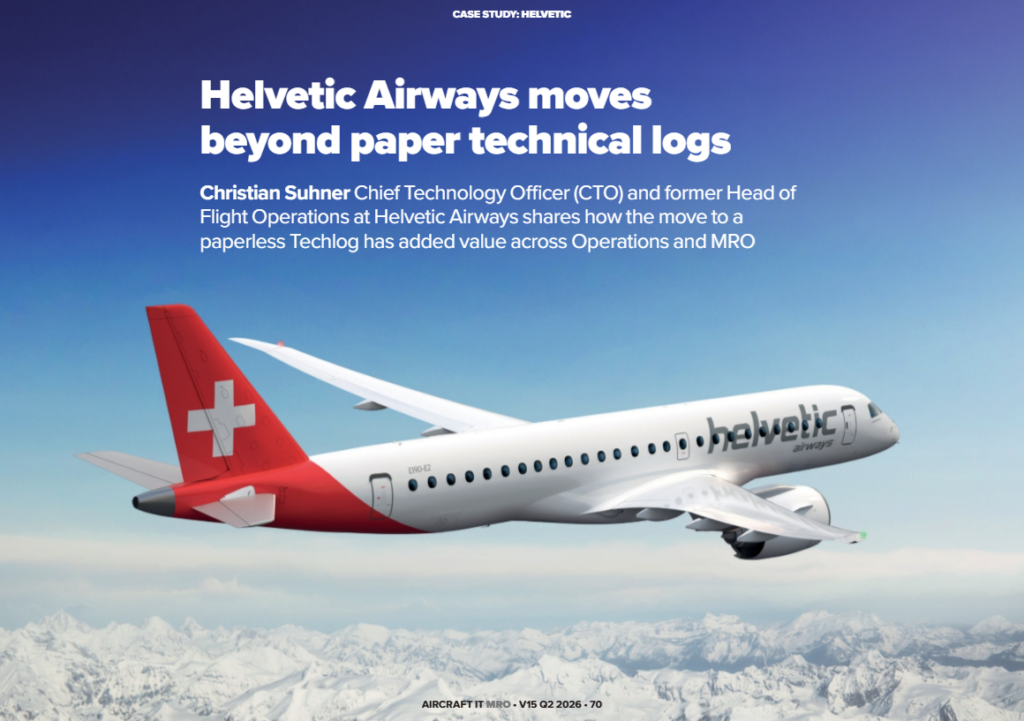
Christian Suhner Chief Technology Officer (CTO) and Head of Flight Operations at Helvetic Airways shares how the move to a paperless Techlog has added value across Operations and MRO
At the heart of this case study is the story that Swiss airline, Helvetic Airways, has gone live across its entire fleet with the REDiFly eTechlog. Since go-live, the system has logged more than 40,000 sectors, managed over 4,500 defects and practically eliminated the 30-60 monthly log errors that previously required manual correction and cross-checking across teams. But before we go any further, I’d like to introduce readers to Helvetic Airways.
HELVETIC AIRWAYS
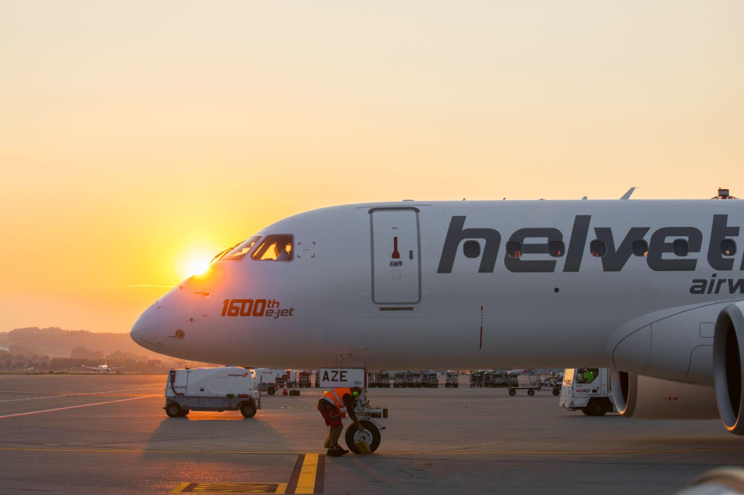
As a Swiss airline headquartered at Zurich Airport, Helvetic Airways operates scheduled and charter flights across Europe with a fleet of 20 Embraer aircraft: E190, E195, E190-E2 and E195-E2. Helvetic is known for its high operational standards, modern fleet, and commitment to continuous innovation in aviation services. It is also known for its agile operations and strong digital vision. The decision to modernize technical logbook processes was part of a broader paperless maintenance initiative. It was recognized that the paper TechLog was posing increasing operational risks to a modern airline in an increasingly complex and regulated environment.
THE BUSINESS CASE FOR CHANGE
Before the eTechlog rollout, Helvetic’s paper-based technical log was generating around 60 errors every month. Transcription mistakes, missing signatures, incomplete records and unresolved defects were a constant drain on engineering time, each one requiring manual correction, follow-up and cross-checking across teams. Audit preparation was time-consuming and inconsistent, with records that were difficult to validate and trace. Beyond the workload, the paper process created a visibility gap. Defect information wasn’t available to the MCC until physical handover, limiting the ability to plan ahead and increasing the risk of delays on the ground. Data was being entered manually into AMOS, duplicating effort and introducing further error risk with every transfer.
Together, these issues introduced real compliance risk, delayed defect closure and pulled engineering resources away from higher-value work. The decision to go paperless was driven by three clear needs:
- Eliminate recurring log errors and the manual correction burden they created;
- Remove duplicate data entry and streamline handovers between teams;
- Give the MCC real-time visibility to plan ahead and reduce turnaround delays.
It was on that basis that we made the decision to implement the REDiFly eTechlog.
IMPLEMENTATION: FROM PAPER TO A DIGITAL SOLUTION
The Helvetic eTechlog rollout followed an 18-month phased approach, beginning with scoping and IT definition in early 2023 and concluding with full go-live in Q3 2024 as seen in figure 1.
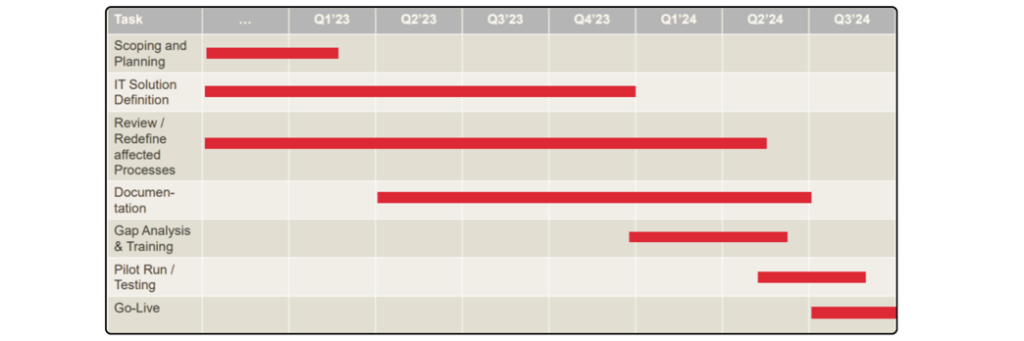
Figure 1
- Q1 to Q2 2023: Project scoping and IT solution design initiated alongside process reviews.
- Q2 to Q4 2023: Detailed documentation developed as affected processes were redefined.
- Q1 to Q2 2024: Training and gap analysis carried out to prepare users and teams.
- Q2 to Q3 2024: Pilot runs conducted, followed by a controlled fleet-wide go-live.
Training, rollout and support
Rolling out a new system across flight operations and maintenance required careful planning to ensure confidence, and minimal disruption. Helvetic focused on accessibility and clarity, combining structured training with flexible, on-demand resources to support every user group. More than 580 iPads were deployed to 180 Pilots, 320 Cabin Crew and 80 Mechanics, ensuring the system could be used seamlessly across all operational environments from day one.
We used blended training formats. Pilots and MCC teams received training through a combination of online modules, and live walkthroughs, tailored to each role’s workflow. Materials included digital quick guides and video support; also, a full library of step-by-step video tutorials and reference guides was made available through the IT support center, giving users access to help at any time. The rollout process was staged in order to build familiarity, with parallel operations allowing teams to gradually integrate the eTechlog into real-world workflows. This approach ensured strong adoption from the start and minimal disruption to daily operations.
To support the transition, Helvetic implemented a multi-layered framework covering redundancy, fallback access and dedicated technical support throughout the parallel run phase. Over three months and more than one thousand flights, crews ran both the paper ATL and eTechlog simultaneously, ensuring operational continuity while confidence in the new system grew. In the event of device failure, backup access was available through web and desktop clients, with spare iPads held in Zurich for rapid replacement. A dedicated support channel with REDiFly provided round-the-clock assistance for the duration of the rollout.
THE REDIFLY eTECHLOG
REDiFly’s cloud-based eTechLog platform replaces paper technical logbooks with a streamlined digital system, giving pilots and engineers shared operational visibility of flight and maintenance data. Going live with the eTechlog has been a major milestone for Helvetic Airways. The system adapts to our processes, rather than the other way around, making it easier to collect and manage technical data. It has strengthened our operations’ data quality, security, and reliability across the network.
Helvetic’s rollout of the REDiFly eTechlog marks a major shift away from paper-based processes, giving pilots and maintenance teams a faster, more accurate way to manage aircraft defects, flight records, and technical updates. Before the implementation, those pilots and maintenance teams were both curious about the change and, at the same time, were looking forward to it. There were issues at the beginning, especially with the process which, initially, took a long time to load information and change aircraft, especially at busy times such as when there is a change of aircraft at short notice. We worked on that and have adapted quickly as has REDiFly to improve loading times and so on. That issue was mainly in the parallel running phase where both systems were running.
In fact, the regulator wanted a parallel phase for a minimum of one thousand flights and we agreed to that. During that time, as mentioned above, we had to complete both the paper TechLog and the new digital electronic TechLog which was okay for a standard flight when there wasn’t any defect to enter but when there was an AOG with a technical defect when crews were in contact with OCC and MCC, and had to do everything together in parallel, that was tricky and at the end, there was a relief, especially for crews, when we could get rid of the paper. Overall, the parallel run was a success. Pilots and engineers now manage data entirely through a modern digital platform, eliminating delays and errors associated with traditional paper processes.
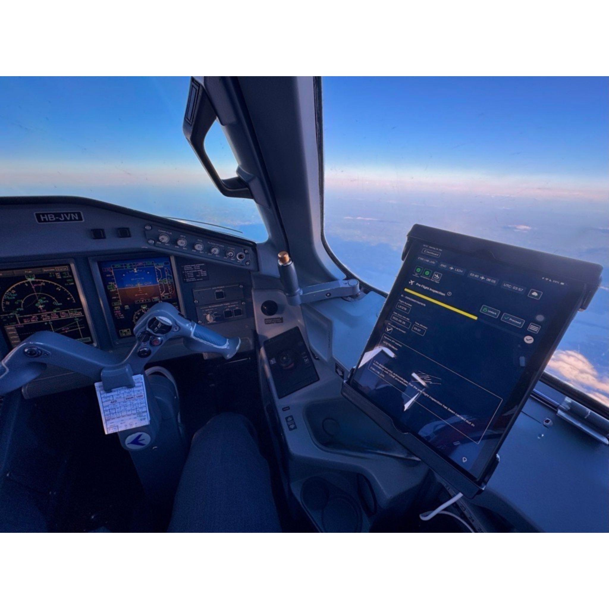
REDiFly supports both pilot-assigned and aircraft-assigned deployment models depending on the airline’s EFB strategy, operational governance model, and workflow preferences. The platform supports both configurations, giving operators the flexibility to choose what fits best. This flexibility allowed Helvetic to align the rollout naturally with existing cockpit workflows and procedures. At Helvetic, the pilot-assigned model also creates natural cockpit redundancy. Both the commander and first officer carry their own device, each holding the same operational data. If one device becomes unavailable, the second continues as operational master, with the cabin device available as a further fallback before paper procedures are required. Beyond redundancy, pilots can review live aircraft status before boarding, IT manages all devices centrally via MDM, and crews develop speed and accuracy using a familiar device. Across more than 580 deployed iPads covering pilots, cabin crew and mechanics, zero device-related faults were reported.
The REDiFly platform’s cloud-based architecture design also supports Helvetic’s IT strategy by reducing the need for in-house infrastructure and enabling secure, scalable access across the network. A core design principle of the platform is operational continuity. The eTechlog operates from locally stored data on each device, meaning pilots can access aircraft status, record defects and complete workflows regardless of network availability, with data synchronizing automatically once connectivity is restored. As part of the deployment of eTechlog across our fleet, Helvetic also supported pilots and maintenance teams through a structured onboarding and training program. The eTechlog system captures, stores, and synchronizes key operational and technical data throughout each flight cycle (see figure 2).
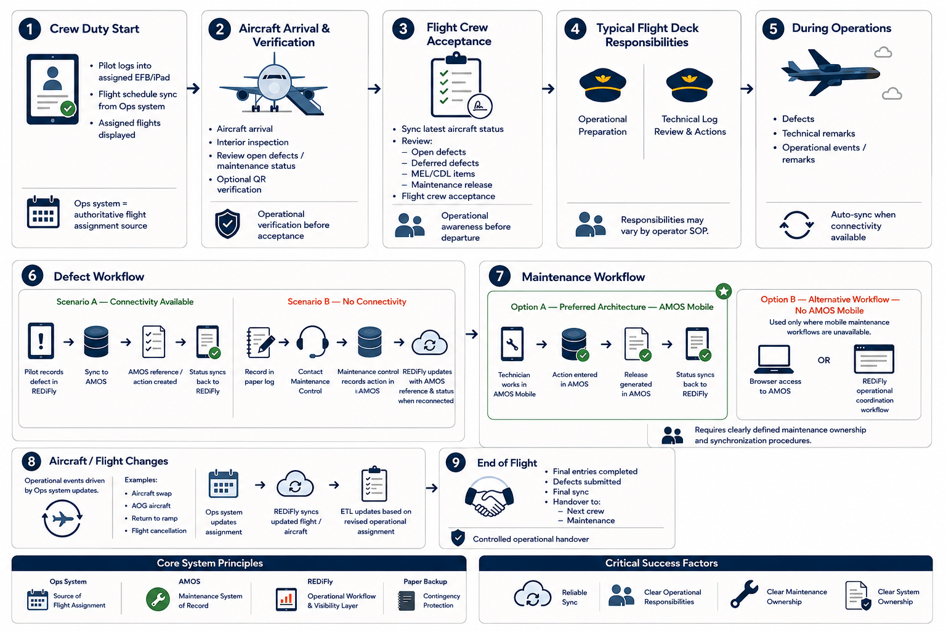
Figure 2
Key Data Captured in REDiFly includes aircraft status, open work orders, deferred MEL items, defects, briefing card notes, and previous cabin reports. It carries flight information, flight times, cycles, fuel burn, preflight inspections, aircraft acceptance, service log, fuel uplift/defuel and de-icing data. The system also supports a dedicated cabin log, providing clear separation between cabin crew reporting and airworthiness-related items. All data is synchronized with the REDiFly Command Centre, a centralized, Azure-hosted database, when network connectivity is available. The application is deployed through a controlled process via managed iPads, ensuring standardization and data integrity across the fleet.
CONFIGURATION, CUSTOMIZATION AND INTEGRATION
REDiFly tailored its user interface to Helvetic’s operations mapping the data from the paper ATL. The application offers multilingual support and flight-status-driven workflows. Flight crews were provided with intuitive, pre-populated forms and autofill features. Data fields are prefilled from connected systems such as the flight schedule; validations prevent incomplete entries, and key calculations are automated. The result is a faster, more intuitive process with fewer manual steps and fewer errors.
Helvetic’s eTechlog is fully integrated with AMOS and WinOps using secure two-way OpenAPI/REST interfaces. The integration is built to ATA Chapter 17 and Spec 2000 standards, meaning data flows automatically in both directions — operational data from the cockpit into AMOS, and maintenance updates, release status and deferred item information back into the eTechlog — ensuring all teams are always working from the same record. This setup eliminates delays, double entry, and ambiguity across engineering, flight crew, and operations.
We have moved from paper (figure 3.1)…
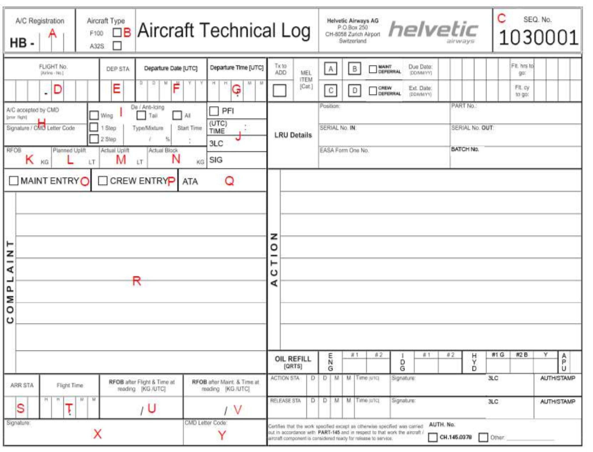
Figure 3.1
… to a comprehensive digital solution (figure 3.2).
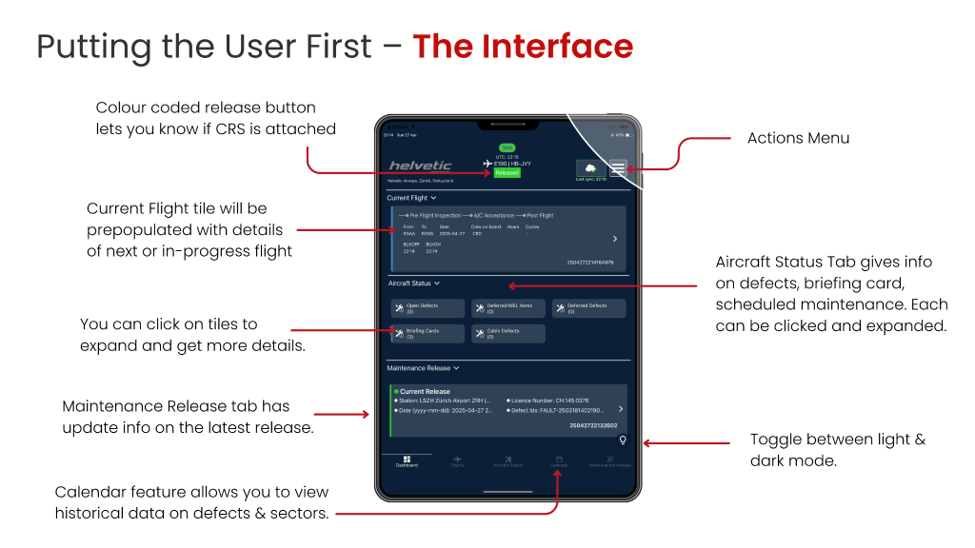
Figure 3.2
The eTechlog has been integrated with existing operational software, including WinOps (flight operations) and AMOS/AMOS Mobile (maintenance) as in figure 4.
[[INSERT WinOps – REDiFly – AMOS Diagram.png HERE]]
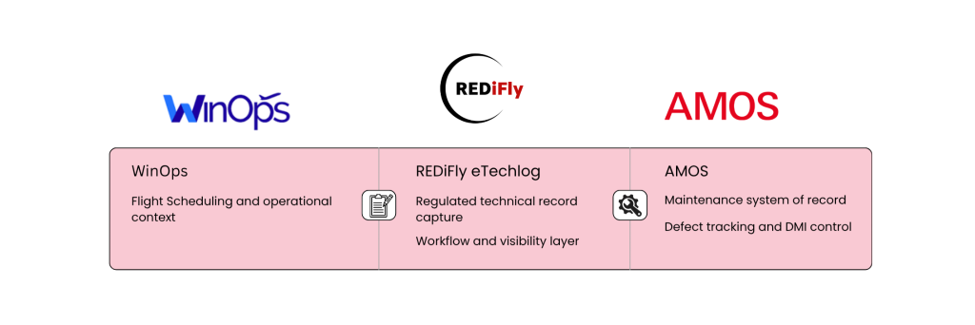
Figure 4
Defects, rectifications, deferred items and release status updates synchronize between REDiFly and AMOS/AMOSmobile, helping flight crews, MCC and maintenance teams work from the same aircraft status. Preloaded flight data from WinOps, including routing and crew information, is reflected into the pilot app to reduce manual entry and support dispatch readiness. REDiFly acts as an operational execution and synchronization layer around existing systems, preserving AMOS as the maintenance system of record while closing the cockpit-to-ground workflow gap.
At Helvetic, this means a pilot logs a defect in REDiFly, it syncs automatically to AMOS, maintenance works and closes the defect within AMOS, and the release status is then reflected back into the eTechlog. Maintenance governance remains entirely within AMOS throughout.
Together, these integrations have reduced admin overhead, improved defect handling, and created a unified, up-to-date view of aircraft health, laying the foundation for real operational savings. It gives flight and maintenance teams real-time visibility into aircraft status, scheduled maintenance requirements, and technical reporting data (figure 5).
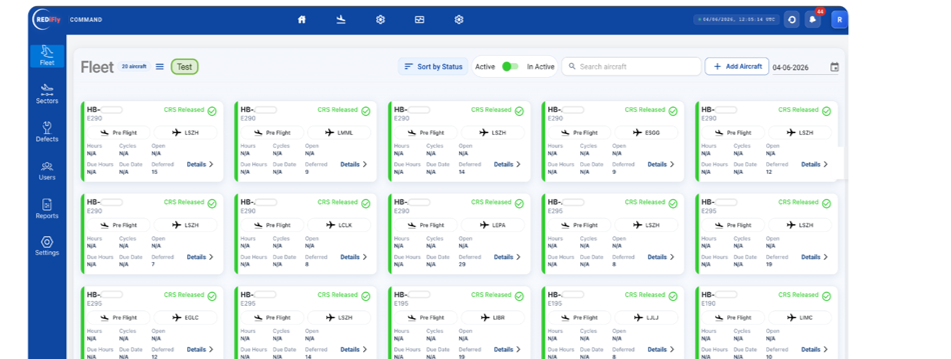
Figure 5
Helvetic’s REDiFly eTechlog operates alongside AMOS and WinOps as part of an integrated maintenance and flight operations ecosystem. AMOS remains the maintenance system of record, WinOps remains the flight operations source, and REDiFly provides the cockpit execution and visibility layer. This allows journey logs, technical data, and operational information to remain synchronized without disrupting existing system ownership. Background and manual sync options support continued use during degraded connectivity, while REDiFly and Helvetic’s IT team monitor availability and sync integrity.
Helvetic’s eTechlog implementation streamlined several high-friction workflows by removing manual steps, improving data accuracy, and enhancing visibility for both cockpit and maintenance teams. Key feature sets were designed to reduce workload.
Live CRS and status indicators provide real-time aircraft status with visual green/red indicators, giving flight crew and MCC instant clarity on aircraft readiness (figure 6.1).
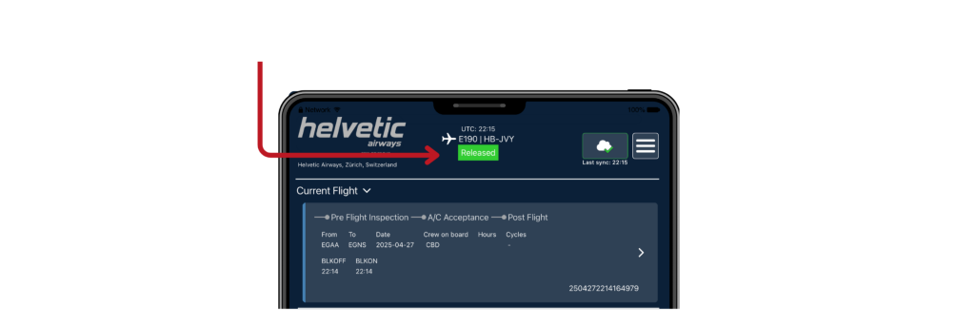
Figure 6.1
Smart MEL Management guides crews through deferral limits and follow-up actions in-app, ensuring consistency and reducing manual input (figure 6.2).
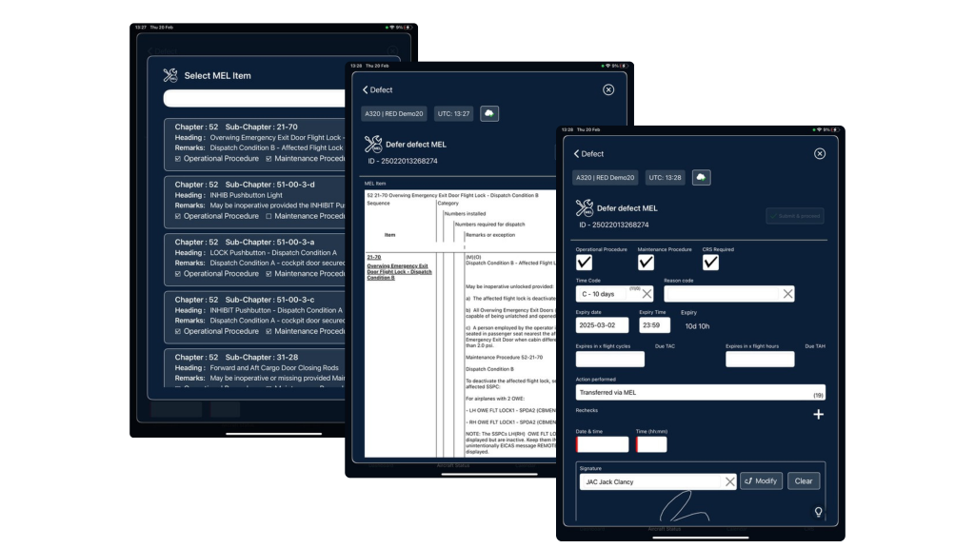
Figure 6.2
Defect image capture allows defects to be logged with annotated photos and overlays, giving MCC clearer context and reducing no-fault-found maintenance (figure 6.3).
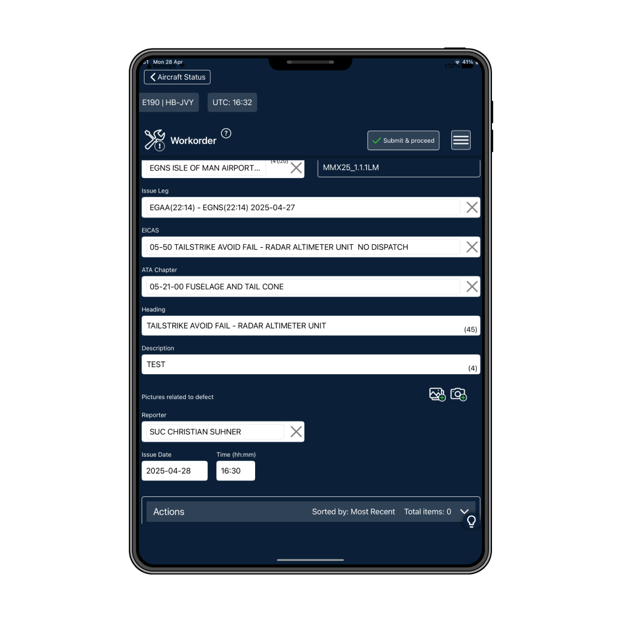
Figure 6.3
CONTINGENCY PROCEDURES
Helvetic implemented a layered contingency plan covering REDiFly, AMOS, connectivity, and device failure scenarios. The eTechlog supports full offline operation, with synchronization once connectivity returns. Backup procedures include paper ATL fallback, redundant pilot devices and structured MCC workflows. For third-party maintenance, controlled parallel procedures allow signed paper evidence to be captured and reconciled into AMOS. These safeguards support continuous operations without forcing a dependency on one system being available at all times.
The platform is hosted in an ISO 27001-certified environment, with Microsoft SSO, role-based access, and MDM controls allowing remote lock and wipe of crew devices. These safeguards align with FOCA (Federal Office of Civil Aviation, Switzerland), EASA cybersecurity guidance and EASA Part-IS requirements.
Helvetic’s eTechlog implementation includes clear, predefined procedures to ensure uninterrupted operations during system disruptions. Whether due to device failure, connectivity loss, or third-party system issues, the process allows crews to continue logging, syncing, and maintaining compliance with minimal disruption. Key scenarios and mitigations include:
- No Connectivity / Server Unavailable: Flight data and technical entries can continue in REDiFly offline, with paper ATL fallback available where required. Synchronisation resumes when connectivity is restored.
- Device Failure: If one pilot device is unavailable, the second crew device can continue the workflow (same with the cabin device if there is one). If all operational devices are unavailable, the paper ATL process is used.
- AMOS (MRO system) Unavailable: REDiFly continues supporting cockpit operational workflows and aircraft status visibility while maintenance governance remains anchored in AMOS.
- Third Party Maintenance Actions: Paper procedures may be used in parallel where required. Signed evidence is captured and reconciled through MCC and AMOS according to Helvetic’s approved procedures.
A key consideration in our contingency planning was ensuring that operations could continue regardless of which system was unavailable. Because REDiFly operates independently from AMOS and WinOps rather than being tightly coupled to them, the platform retains the capability to temporarily support defect deferment, release workflows and operational scheduling if primary systems are unavailable. All data is retained locally on each device and reconciles automatically once systems are restored. In practice this means the operation continues without manual intervention regardless of which upstream system experiences an issue.
FOCA’s successful approval of eTechLog reflected the solution’s compliance with Tier 1 regulatory standards. Helvetic achieved FOCA approval through a structured rollout, including three three-month dual runs across more than one thousand flights with full parallel use of the paper ATL and eTechlog. A formal risk assessment was submitted addressing technical, operational, and compliance risks.
Approval was backed by a Human-Machine Interface review, along with updates to OM-A 8.1.11 and CAME 1.1A, submitted as part of the FOCA governance package. Cross-functional teams from CAMO, Flight Ops, and IT worked closely with REDiFly and IAS, with regular check-ins held with FOCA throughout the approval process.
RESULTS AND OUTCOMES
In the first six months since implementation, Helvetic has recorded measurable improvements across operations, system stability, and crew experience.
- Error Reduction: Paper-based log errors (30-60/month) have been fully eliminated, improving data accuracy and reducing engineering follow-up workload.
- Device Stability: With more than 580 operational iPads deployed across pilots, cabin crew and mechanics, the rollout proved stable and manageable at airline scale.
- Operational Efficiency: Increase in defects with informational character (i.e. self-resetting defects), increases the awareness for repetitive defects and could initiate preventive maintenance.
- System Integration: Controlled two-way synchronization with AMOS and WinOps removed manual rekeying, improved defect traceability and supported a connected operational workflow without changing system-of-record ownership.
- Turnaround Readiness: The MCC has live visibility of inbound defects, allowing pre-emptive task planning and faster line maintenance decisions.
Pilot Feedback: REDiFly’s interface is intuitive and easy to use. Continuous synchronization means logbook data is instantly available in AMOS, WinOps, and our other connected systems, allowing us to stay focused on the flight, not the paperwork.
WHAT’S NEXT
With the eTechlog now fully embedded in daily operations, Helvetic is focused on extending its digital maintenance ecosystem. With the cabin log now live, the next step is full integration of cabin reporting into a unified crew experience, with flight plans, eTechlog and documentation accessible through a single EFB app interface. A native iOS eTechlog is also available, with deployment at Helvetic planned to deliver faster performance, lower-latency data sync and improved reliability for iPad-based operations. Looking further ahead, structured elog data will be used to identify recurring defects earlier, enabling more proactive maintenance planning across the fleet.
Going live with the REDiFly eTechlog has been a major milestone for Helvetic Airways. To summarize: the system adapts to our processes, rather than the other way around, making it easier to collect and manage technical data. It has strengthened our Operations’ data quality, security, and reliability across the network. We’re excited about what the future holds with REDiFly.
Helvetic’s move to the REDiFly eTechlog shows that digital technical log operations are about more than replacing paper. The real value is continuous operational resilience: a more resilient operational environment where crews, MCC and maintenance teams remain aligned while existing systems such as AMOS and WinOps continue to perform their established operational roles.
Comments (0)
There are currently no comments about this article.
To post a comment, please login or subscribe.