
Articles
| Name | Author | |
|---|---|---|
| CASE STUDY: JetBlue Airways is on a fuel-saving journey using data analytics and pilot apps | Chris Lum, Director and System Chief Pilot, JetBlue Airways | View article |
| CASE STUDY: Amelia takes flight to reduce contrails | Adrien Chabot – Chief Sustainability Officer, Amelia | View article |
| CASE STUDY: From paper to digital charts at KLM | Emiel Snippert, EFB Project Manager / First Officer, KLM | View article |
| CASE STUDY: Breeze moves to AI-enhanced weather intelligence | Garrett Urry, Manager of Flight Dispatch, Breeze Airways | View article |
| CASE STUDY: Data-Led Fuel Efficiency | Luke Towler, Fuel Efficiency Systems Manager, Jet2.com | View article |
| CASE STUDY: Delta’s journey to a unified Content Management System | Jennifer West, Manager of Flight Ops Publications, Delta Air Lines | View article |
CASE STUDY: JetBlue Airways is on a fuel-saving journey using data analytics and pilot apps
Author: Chris Lum, Director and System Chief Pilot, JetBlue Airways
Subscribe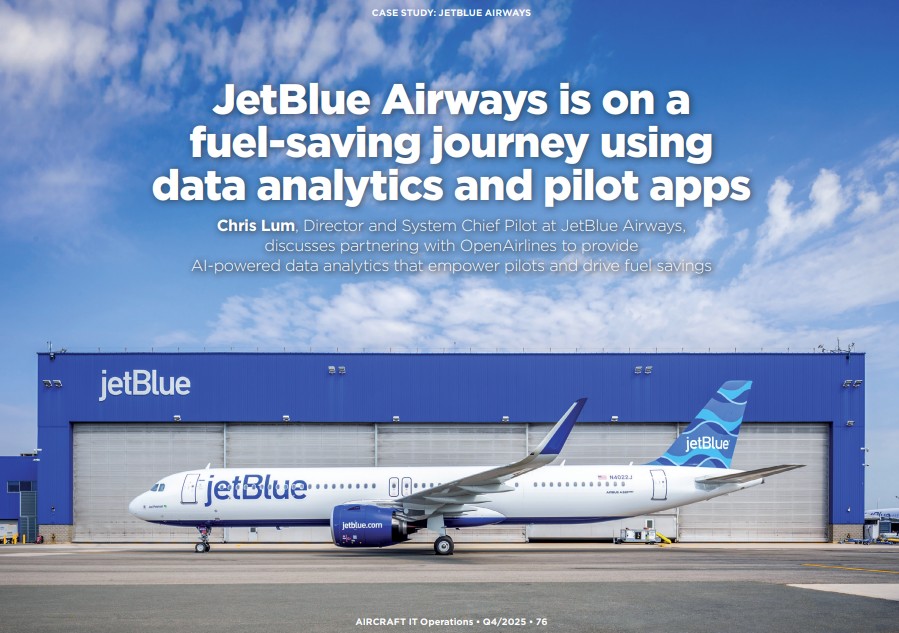
Chris Lum, Director and System Chief Pilot at JetBlue Airways, discusses partnering with OpenAirlines to provide AI-powered data analytics that empower pilots and drive fuel savings
JetBlue Airways is on a fuel optimization journey in partnership with OpenAirlines. Our pilots are using the SkyBreathe® MyFuelCoach app to operate aircraft more efficiently.
JETBLUE AIRWAYS
Before we look at the steps to achieve this, it’s important to begin with a little background on where JetBlue Airways comes from. We are a relatively small airline that started in 1999, with our first revenue service in 2000.
After leaving Southwest Airlines, our founder, David Neeleman, had a dream to create a new airline. He set up JetBlue in New York, flying a couple of routes up and down the East Coast into upstate New York. Over the last 25 years, JetBlue has grown to a fleet of nearly 300 aircraft, including the Airbus A320, A321 and A220.
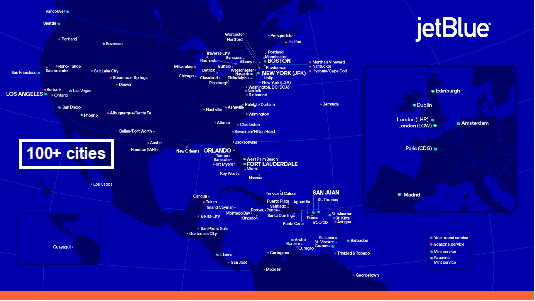
Figure 1
As figure 1 shows, we now serve over 100 destinations in North America, South America, the Caribbean and Europe. The VFR (Visiting Friends and Relatives?) market on the East Coast is our bread and butter, with transatlantic expansion a recent focus, along with growth in the greater Boston area.
CHALLENGE TO OPTIMIZE FUEL
Fuel is critical when it costs $100 a barrel, but when the price drops, the focus on optimizing fuel burn tends to wane. As a growing airline looking to make its presence known on the East Coast post-Covid, we saw we were going to be larger than we had initially envisaged, so it was clear that we needed a standalone fuel optimization group.
Leading the strategy
For many years, fuel optimization lived in various areas of the business, including the system operations center, dispatch or flight operations. It was now time to define a strategy and create a team solely responsible for optimizing fuel burn. Our CEO decided the best place for this new team was in flight operations. Around 2021, I raised my hand to take ownership of developing our very first fuel optimization team, which includes Fernando Hernandez, Senior Manager of Fuel Optimization, Katherina Polanco, Manager of Fuel Optimization Airports, and Julien Lopez, Fuel Optimization Analyst.
Making better use of data
What I found out very quickly, even prior to getting the position, was that we didn’t really know how optimal we were in using fuel. We have some of the most advanced aircraft in the industry, and, as we fly them, tens of thousands of data points are coming off the aircraft. But we didn’t necessarily know what they were telling us. The business was data-rich and analytics-poor. I am not an IT person and had no idea what the data points were telling us – it was just ones and zeros.
A KEY PARTNER
An important step was to find a partner to assist us in taking all this rich data and turning it into something meaningful that we can use. Not only to educate pilots, but also to educate the airline on how we can operate more efficiently. We began looking for a partner and were introduced early on to OpenAirlines and their SkyBreathe® tool.
An extended journey
OpenAirlines has been a critical partner in helping us to take the ones and zeros and turn the matrix of data we have into something that enables us to become as optimal on fuel as possible. Our journey with OpenAirlines’ SkyBreathe® product was rather extended, as it takes time to go through the RFP (Request for Proposal) process and to get the financing involved in bringing it on board. In total, we spent about two years getting the contracts worked out and into a position where we could begin implementation.
IMPLEMENTING SKYBREATHE®
Looking at the timeline in figure 2, you can see that we began the formal implementation of SkyBreathe® in October 2022. Throughout the process of bringing the contract in and getting to the point of implementation, OpenAirlines and JetBlue worked hand in hand. That meant we didn’t have to wait for the ink to dry on the contract before we started working towards our fuel optimization solution.
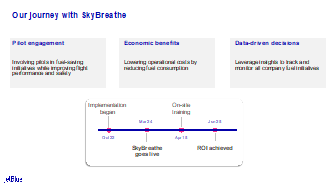
Figure 2
Initially, we held an in-person session at our headquarters in Long Island City. This involved fleet captains, everybody from the IT team who needed to be involved, Dispatch, and all facets of JetBlue that would interact with SkyBreathe®, along with OpenAirlines and their implementation team.
The critical step for us was ensuring that the way we operate the aircraft, our Standard Operating Procedures (SOPs), were translated into SkyBreathe®, so that we could provide our pilots with real, meaningful data. OpenAirlines was so helpful in ensuring that we were placing all our SOPs into the program, so we could give our pilots meaningful data that encouraged them to use the app, figure 3. OpenAirlines spent time with our subject matter experts (SMEs) to get it right.
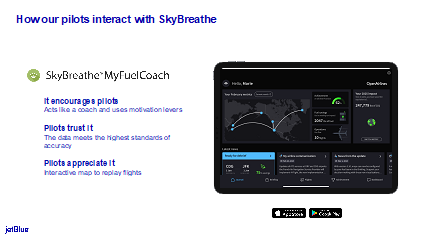
Figure 3
If you are interested in this product, I would say spend time having the SMEs around, so that you get it right the first time and you don’t have to try to fix it after you’ve launched. Meaningful and accurate data is what’s going to make this product work for your airline.
Creating a baseline
Moving forward, we launched a go-live of SkyBreathe® in March 2024. At this stage, it was not so much about getting the app out to the pilots but bringing the SkyBreathe® Analytics software into JetBlue. This allowed us to begin putting our historic data into the program so we could establish a baseline on how we operate our aircraft. It also meant we could test that the app was working and that the way we communicated with staff about the changes was appropriate.
On-site training
In April 2025, we launched a go-live training event with OpenAirlines for users at our main training center in Orlando. This involved everybody who we needed to ensure was comfortable with data accuracy before we pushed the go-live button. Analysts from various teams ran their own queries, determining areas of opportunity using the app based on our prior historical data.
Shortly afterwards, we launched our EFB (Electronic Flight Bag) test group for the app. At JetBlue, we have a very robust communications, navigation, surveillance and technology team who are responsible for putting iPad applications together for pilots and ensuring they run smoothly. The team utilizes information from pilots who are the designated beta testers for our apps. We ingest their feedback into our system to determine whether the applications that we show the pilots are working or not.
SKYBREATHE® MYFUELCOACH FOR PILOTS
The next step was to launch the SkyBreathe® MyFuelCoach app for about 300 pilots in the test group (figure 4), which was a little nerve-wracking. Typically, OpenAirlines recommends that only a small subset of a pilot group tests its apps. However, we were bullish, and for good reason. We have trained our pilots very well. We know that they are going to provide meaningful and accurate feedback, which is why we wanted to launch it to a wider group of pilots.
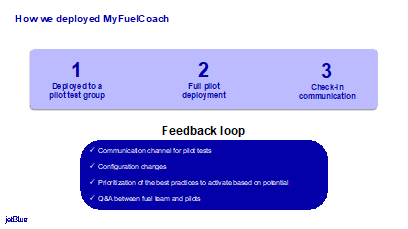
Figure 4
We spent approximately 25 days with the EFB test group looking at the app and provided no training as the app is incredibly intuitive. OpenAirlines offered us an abundance of training tools, including videos for the pilots.
Optimal flying
The goal of SkyBreathe® MyFuelCoach isn’t to have the pilot interacting with it while they’re operating the aircraft, but to learn from it. I believe pilots are ‘Type A’ people, and the reason that I love this app is that pilots don’t want to be bad pilots. They don’t want to waste fuel for no reason, at least not JetBlue pilots. They want to fly the aircraft optimally. And as Type A personalities, they want to pit themselves against each other.
From our perspective, we want them to know what they’re doing well. And we want them to know what they’re not doing well, so that the next time they get on the airplane, they fly in a more optimal way. The app provides information for pilots in almost real time. It’s critical that the pilots trust it, and that’s why we spent so much time on the implementation process making sure that information from aircraft was correctly entered into the system.
Here’s an example: If I start an engine at two minutes and 10 seconds into the taxi, when I start my second engine, I want to know that SkyBreathe® is telling me that I started it at two minutes and 10 seconds, not one minute and 30 seconds. If this didn’t work the first time for the pilot, then they would never open the app again. It’s got to be accurate 100 percent of the time.
REGULAR COMMUNICATION
In June 2025, we went to full deployment and increased our communication with pilots. We are in a beneficial position with me as the System Chief Pilot also owning fuel optimization, because I do nothing but communicate with pilots.
I email them every week and send one-off emails directly to people who have the biggest impact on our fuel burn, so I can continue to beat the drum of optimization. Additionally, OpenAirlines have created the option of a push alert sent to the pilots. If pilots haven’t opened the app in a certain amount of time, they’ll get an alert saying, ‘Hey, we haven’t seen you in a while. Check in with us, see how you’re doing on your flights.’
ADAPTING JETBLUE’S SOP
If you had looked at our SOP prior to February 2025, it would have read: ‘Use single engine taxi when you can’. We revised the SOP based on the data that we were seeing to: ‘Use single engine taxi, unless you can’t single engine taxi for whatever reason’. As a result, we saw a significant increase in single engine taxi, engine out, taxi out. Our SOP is making us a better airline from a fuel optimization standpoint because we know what we’re doing, and we see how it translates down the road.
PILOT ENGAGEMENT
As figure 5 shows, three months after deployment, we saw 30,000 unique check-ins from pilots. We have roughly 3,200 active pilots at any one given time. It is incredible to see that much engagement from the pilot group. They are checking it after almost every flight. Nearly every day, pilots are going on the app and looking to see how they are doing and where they rank.
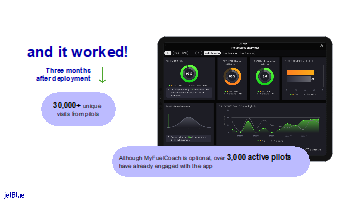
Figure 5
EVIDENCE OF SUCCESS
You can see in figure six that we began in January 2025 at roughly 19 percent engine out, taxi out performance. However, bear in mind we use JFK and Boston airports and are flying in and out of the Caribbean with short taxis, which makes it a challenging environment to be able to do engine out, taxi out.
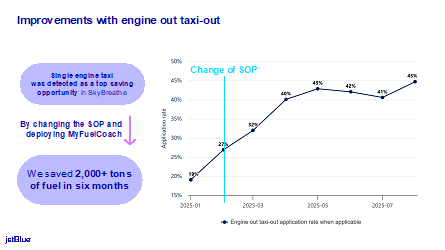
Figure 6
I was astounded to see the change from February as we progressed through our new SOP and the launch of SkyBreathe® MyFuelCoach. In March, we started to go live, and by late May and early June, we had launched the app to the entire pilot group. We went from 19 percent to 45 percent engine out taxi out compliance and saved nearly 2,000 tons of fuel in six months with SkyBreathe® MyFuelCoach. It makes an incredible difference in how pilots operate aircraft on a day-to-day basis, with single engine taxi, both in and out. It is a huge opportunity for saving fuel and to see such a drastic change in performance is wonderful.
BUILDING PILOT TRUST
As I said above, it is critical to build the trust of the pilots. They need to make sure that the information they’re getting is correct, so they are less reliant on things like adding fuel because they don’t feel like they’re getting enough.
We saw a significant decrease in captain-added fuel after launching the app, figure 7. Captain-added is when the captain says, ‘Hey, can you throw on another 300 pounds of fuel? I’m just not comfortable with where I’m at with the ability to see what the aircraft is actually burning in the various phases of flights’.
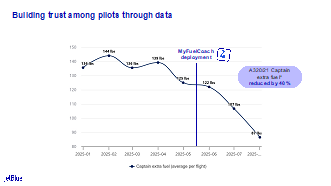
Figure 7
We are teaching crews to trust more in what our dispatchers are doing and decreasing the amount of fuel that they’re adding on an average flight. We went from roughly 136 pounds and peaked at 144 pounds of captain-added, down to about 87 pounds in the most recent data.
The pilot knows when they don’t need the engine, so as soon as they get the cool-down time, they shut down the engine. In figure 8, you can see that we were about 44 percent compliant with engine out taxi in after launching the app, and have now reached 54 percent compliance.
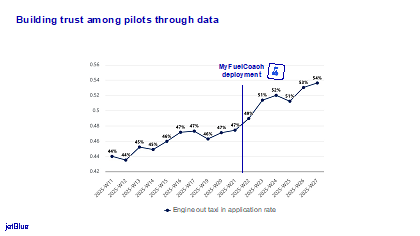
Figure 8
As figure 9 shows, in July, we saw roughly $300,000 in savings just from engine out taxi in, and that’s just one of the 16 best practices that we’re tracking. It’s significant and we are excited to see the product take shape.
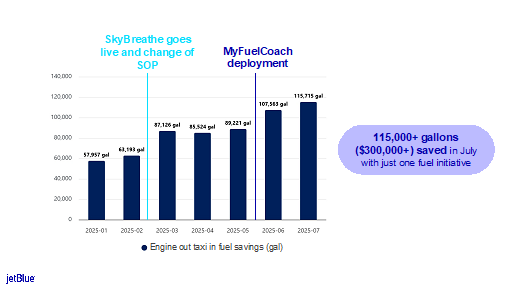
Figure 9
MAKING OPTIMAL DECISIONS
A major communication initiative for us is holding webinar ‘pocket sessions’ with our pilots. One of the most significant feedback points we get – and that our customer service rep at OpenAirlines has been wonderful in helping us with – is pilots telling us that the app says, ‘I didn’t do it right. It’s showing that I didn’t save 124 pounds. That’s not fair. I did everything I could. It shouldn’t say that I didn’t do something’.
But we are not asking the pilots to be perfect. We have to communicate that it’s not about you doing it wrong. It’s about showing you where the opportunity may have been. I put it up there in a pocket session that, ‘You’re not Chuck Yeager, nor do you need to be’ and now everybody is using the phrase. Clearly, there are times when the captain needs to make a decision that requires them to utilize a process or a procedure where fuel burn is going to be needed or more fuel burn than would be optimal, and that’s okay. That’s why they’re the captain. That’s why they need to make those decisions.
The goal is to show them the opportunity and show them where they took advantage of the opportunity. It’s saying, ‘Here’s where you could have saved a little more gas had you operated the aircraft differently. Maybe you couldn’t, because of any number of reasons, but you’re the captain. You made the decision to operate it in the way you did’.
Timely information
The flight example I referred to above was one I made. I was the captain, and I’m not Chuck Yeager. I missed 124 pounds of potential fuel saving and that’s really what we need to make sure that everybody is aware of: nobody’s going to operate the aircraft perfectly. The other reason I’m highlighting my recent flight is that after I landed I went to the hotel and, when I woke up at 6am, I pulled up the app to see my flight data. It is as close to real time as you could ask for. If you can show pilots what they did yesterday, they’re going to pick up the app again today and tomorrow and the next day.
Delays in information are, therefore, a challenge that we’re working really hard on. The reason yesterday’s flight is available today is our Collins AID (Aircraft Interface Device) on board the aircraft, which provides real-time data as soon as we land. We send that data to OpenAirlines, and they turn it into meaningful analysis. As we get more aircraft on board with Collins AID, we will have access to even more real-time information.
GETTING UNIONS ONSIDE
One question I am regularly asked is, ‘How did you get this past the unions?’ We have been working with aircraft data for years and got ahead of this very early. There is a letter of agreement with the union that basically says we can never use any data coming off the aircraft for any sort of disciplinary action. It very specifically carves out what we can use data for, one of them being operational performance.
The data is ours to use as we see fit; there are no handcuffs whatsoever on it. The association didn’t come out and give me big hugs about it, but they certainly didn’t fight me about it, and I’ll take that as a win as they are not pushing back. They are not telling pilots, ‘Don’t use this’, but instead they are saying, ‘Be the captain. Make good decisions. Use it as you see fit’.
That is a huge win in my book. I would highly recommend building that relationship with unions early. If you are looking at utilizing aircraft data for fuel saving, pilots need to know that they’re not going to get in trouble for it. By the same token, I can’t use it to reward them, because if I do, pilots might say, ‘Wait a minute, if you can reward me for this, you can also discipline me for it.”
Ultimately, we have to trust our pilots to use the app. So, it is very encouraging that data from OpenAirlines shows pilots are continuing to interact with the app.
Comments (0)
There are currently no comments about this article.
To post a comment, please login or subscribe.