
Articles
| Name | Author | |
|---|---|---|
| CASE STUDY: JetBlue Airways is on a fuel-saving journey using data analytics and pilot apps | Chris Lum, Director and System Chief Pilot, JetBlue Airways | View article |
| CASE STUDY: Amelia takes flight to reduce contrails | Adrien Chabot – Chief Sustainability Officer, Amelia | View article |
| CASE STUDY: From paper to digital charts at KLM | Emiel Snippert, EFB Project Manager / First Officer, KLM | View article |
| CASE STUDY: Breeze moves to AI-enhanced weather intelligence | Garrett Urry, Manager of Flight Dispatch, Breeze Airways | View article |
| CASE STUDY: Data-Led Fuel Efficiency | Luke Towler, Fuel Efficiency Systems Manager, Jet2.com | View article |
| CASE STUDY: Delta’s journey to a unified Content Management System | Jennifer West, Manager of Flight Ops Publications, Delta Air Lines | View article |
CASE STUDY: Delta’s journey to a unified Content Management System
Author: Jennifer West, Manager of Flight Ops Publications, Delta Air Lines
Subscribe
Jennifer West, Manager of Flight Ops Publications at Delta Air Lines describes the journey from chaos to clarity and work in progress
In this case study I’m going to share with readers our journey from a legacy to a modern, digital Content Management System (CMS) at Delta Air Lines. But first, to set the scene, a little bit of background and the context in which the change is taking place.
DELTA AIR LINES
Delta Air Lines Flight Ops Publications includes a team of technical writers, who oversee the pilots’ training and standards manuals along with the common manuals for all fleets. There’s also a team that handles our content management system, as well as a group of people who handle our manual services team. They still handle printed material on board the aircraft, in the simulators and in the training centers. This case study focuses on how Delta Air Lines is transitioning from a current content management system, that’s in the process of being wound down and removed from a platform, to implementing a new content management system. You’ll see how we’re bringing along over 100,000 users at Delta Air Lines, and how we’ve gone from content chaos, think figure 1, to clarity.
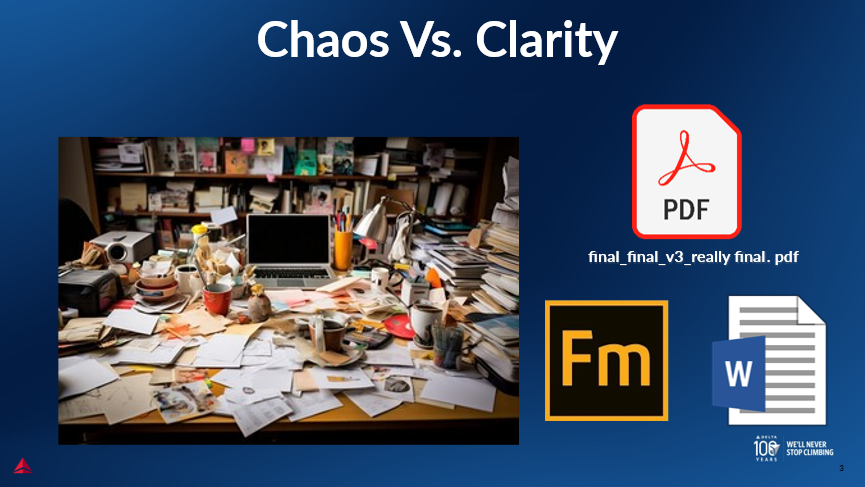
Figure 1
A Content Management System might not, at first sight, seem the most exciting part of an airline but it is a critical component in maintaining an efficient and compliant operation. This case begins with Word docs and PDFs and how we deliver knowledge to those that need it most, our pilots, our frontline teams and ultimately our customers.
Let’s illustrate the problem with a story. It’s the middle of the night on a long-haul flight. The pilots need a quick reference; they open the manual, and suddenly it’s like zooming into a Renaissance painting. ‘Page, 347, column two, font size, hope…’ That’s when it really hit us. The critical issue wasn’t about how we were reading the information; it was about how we were using it and how the structure facilitated using it; how useful was it. And, as readers will know, in Flight Operations, usefulness is safety. We had a CMS, but it really wasn’t universal. Some people were operating in the digital world, while other departments were still operating in frame maker, Word docs, or even in digital but pushing out rogue PDFs, with strange titles like ‘Final underscore, final v3 underscore, really Final dot PDF’ see figure 1.
Readers who are still operating in PDFs will know the pain points. But, for those of you who have already made that transition to the digital world and are editing and pushing out content, you know the difference. It’s like the difference between learning to ride a bike and then learning to fly a jet. Once you’ve experienced it, you cannot imagine going back. Yes, PDFs are linkable and searchable, but they’re static; snapshots locked in time. They don’t update quickly, and they do not scale across teams. PDFs, to me, are like fax machines, technically still around, but why? And that’s how our content was. It was like a sock drawer after laundry day; everything was there, just not where you needed it. So, when we were told Aerodocs, our old CMS, was sun setting and coming to end of life, with the platform no longer available after March 2026, we knew the clock was ticking as in Figure 2.1, and we had to think about making the change.
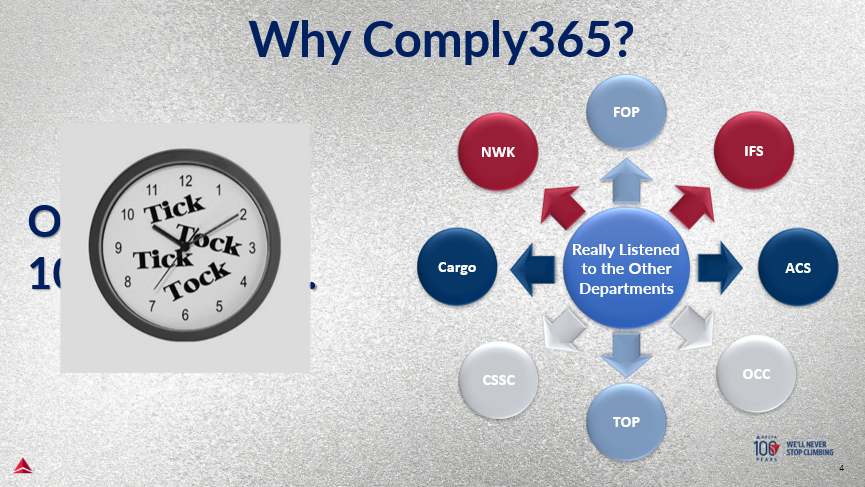
Figure 2.1
There was no time to sit around forever and evaluate our options. We really had to act quickly and launch an RFP (Request for Proposal) to get a clear vision of what Delta Air Lines really needed. That’s when we took the time to really listen to every department; Tech, Ops, OCC, In flight, ACS; we met with and asked every one of them, what were their pain points and what do they need out of a content management system? That feedback shaped our requirements and informed a full evaluation as a result of which, we selected Comply365 – figure 2.2.
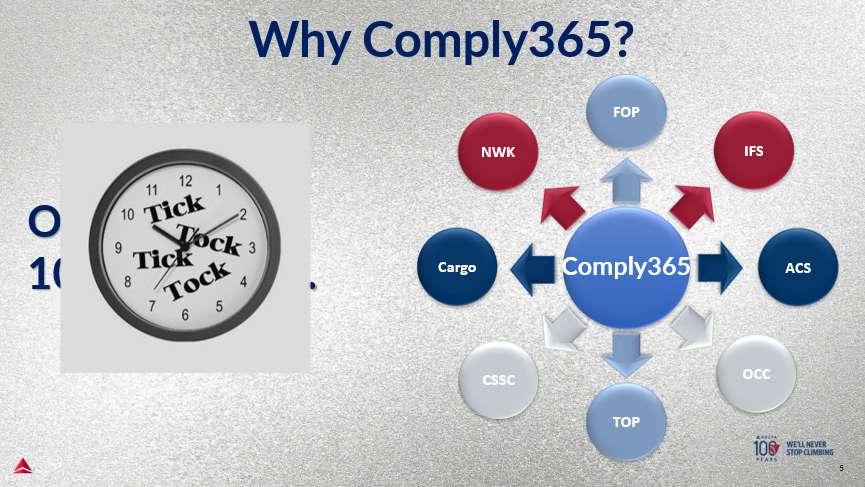
Figure 2.2
This was more than just about Flight Operations. It was about supporting 100,000 users across Delta and in the years ahead. We knew that we needed a system that could handle structured authoring and governance plus scale across multiple departments with very different needs. It had to support compliance tagging and how it ties back and builds back to regulations, and we wanted to deliver adaptive workflows that adjust to the role, the aircraft or the scenario. In short, we wanted one single source of truth for these departments; one standard, one Delta. Comply365 stood out to us as more than just a vendor. They stood out as being ready to be a partner, ready to move at our scale and at our pace.
FROM XML TO HTML
Our old CMS was an XML authoring solution. It gave us structure, compliance and consistency. Aerodocs let us reuse content, update it once, and flow it everywhere it was referenced. It even made editing fairly straightforward. So, it was a bit of a learning curve for my team to learn how to author in HTML. It’s still ‘what you see is what you get’, but it just feels different, and things that were there to us before, like that shared content, aren’t just quite there yet with the new system. But here is why we are making the transition anyway.
HTML positions us to scale outside of Flight Operations. It’s easier for non-technical authors to adopt, and then with compliance tagging, adaptive workflows and future integrations with AI, it sets us up for where we need to be in the future. It’s taken training and a lot of patience with a few bumps along the way but, as readers know, like with any new aircraft type, once you get it checked out, you realize its value. Already we’re seeing faster times, and the pilots have seen faster times complying with, navigating to and within publications, and loading documents. Viewing all outstanding documents with compliance has been a lot better for us, and that’s because of HTML. HTML is powerful, it’s modular, it’s adaptive, it’s alive. It’s intuitive editing for authors. It’s interactive delivery for users and it’s got built-in compliance tagging and governance at scale. That’s what we kept pushing to these other departments. Yes, operating with and pushing out PDFs tells the recipient where something is, but HTML actually takes them to it, as illustrated in figure 3.
Figure 3
HTML enables us to go deeper and helps us to look to see how we’re holding to that axiomatic principle of ‘always know thy customer’. With HTML, information isn’t just delivered, it listens, it represents a fundamental change, turning manuals from static documents into living, interactive systems of knowledge.
THE MIGRATION AND GAINS
When we began migrating, several departments were already in Aerodocs. Comply365 helped us convert our XML files from the old system into the new system, and got us up and running fairly quickly. Within five months, they helped us convert over 180 documents and around 71,000 pages as shown in figure 4.1.
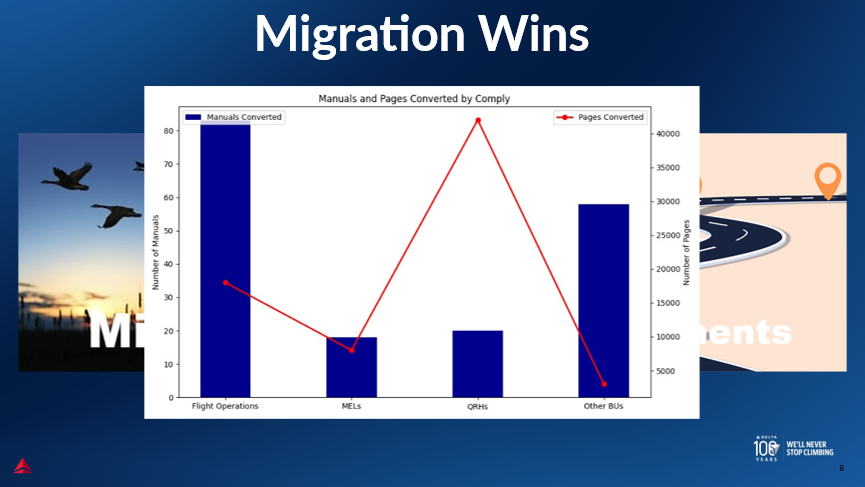
Figure 4.1
A huge win for Flight Operations was that Comply365 helped us to migrate over 5.1 million pilot bookmarks and annotations. Think about that. Every highlight, every note, every bookmark, every pilot’s personal way of doing work was preserved, and one of them had over 7000 alone. That wasn’t just data migration; that was us respecting how the pilots interact with their manuals every day and, for them, that was huge – see figure 4.2.
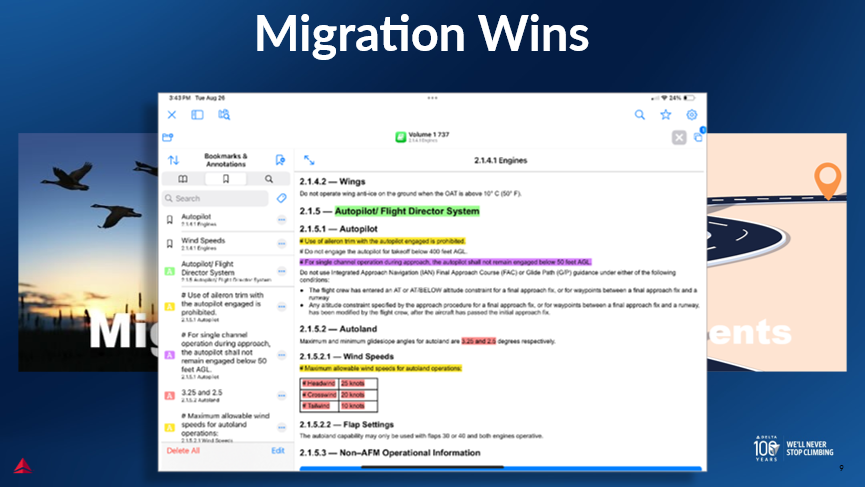
Figure 4.2
Equally important was that we avoided disruption to the operation. Pilots could keep flying and interact with the manuals that they relied on every day. Given the scale of this migration, that was so critical for us.
As knowledge of all this becomes known around the business and as other departments learn about what we’re doing with Comply365 and how we’re doing with the migration, those other departments want to be in the program as we’ve illustrated in figure 4.3.
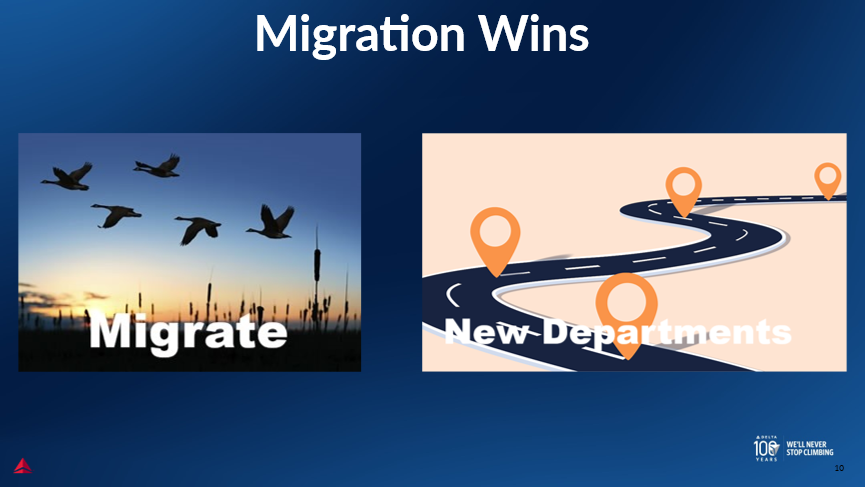
Figure 4.3
Our priorities are clear right now. First, we migrate everyone that is currently in the old system into the new system, and then we slowly start bringing in the other departments, and establish a roadmap that scales. The expansion looks different for each department. Inflight has already evaluated the solution and made the deal, and they are looking to support over 30,000 Flight Attendants within Comply365 with interactive, accurate manuals. But Tech Ops were still evaluating at the time of writing; they’re waiting to decide what they want to do, and that’s fine. Every department moves at their own pace. But here’s what we’ve already gained in Flight Operations.
Organized authoring means faster updates, fewer edits and reusable building blocks. Compliance tagging gives us something critical; provenance. It can show not only what changed, but why it changed, and how that ties back to regulations. And, as readers will know, for auditors, that is gold. For safety, that is reliability. Equally important, we keep full historical revisions. Every version is preserved, so no more wondering what changed at any point in time. And that traceability isn’t just good practice, it’s essential in aviation. In fact, it gives us what I like to call a compliance panopticon – a circular view of everything around. Not surveillance, but assurance, a full view all the time so that nothing slips through the cracks. The word panopticon comes from prison design, a full view for a guard standing in a tower overlooking everything. Sometimes, when the auditors show up, that’s how we feel. But instead of keeping us locked in, this type of view keeps us safe and compliant. We also have adaptive workflows that transform static checklists into living processes. They adjust by role, by aircraft and by situation; embedding diagrams, notes, cautions, warnings, right where they are needed. And we even have smart tools within Comply365, such as the Airbus comparison tool that allows us to ingest multiple Airbus manufacturer revisions and compare them to our customization to help make decisions faster and push that content quickly to our pilots. That’s essential in our applications such as the eQRH (electronic Quick Reference Handbook) and OLB (Operational Library Browser).
WORKING WITH COMPLY365
As already stated, our relationship with Comply365 is a partnership. They are working with us at our scale and at our complexity, including continuing to build those certain things, like shared content that we relied on. That’s how we know this platform isn’t just meeting today’s needs; it’s building for tomorrow. And, what does tomorrow look like? HTML today is powerful, but paired with AI, it has the power to be truly transformational as shown in figure 5.
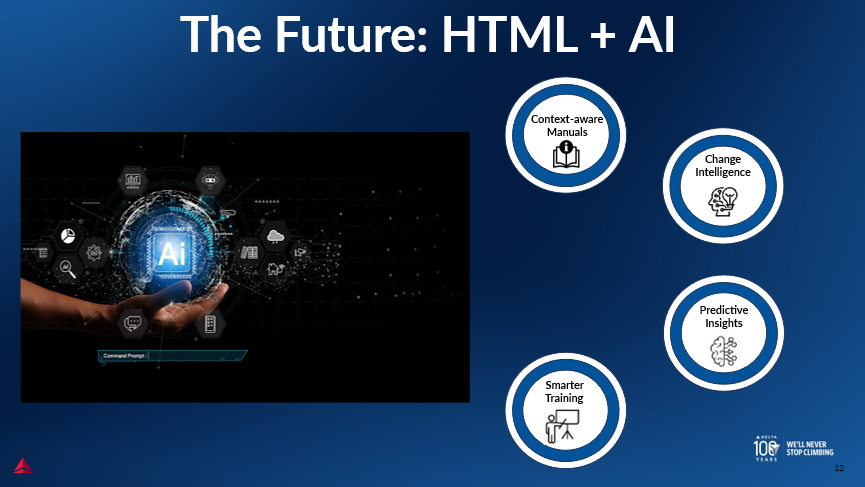
Figure 5
At Delta Air Lines, we envision a future where the CMS doesn’t just hold manuals but will also think alongside you. You’ll have context aware manuals, a system that knows the aircraft you’re on, the role you’re in, the phase of flight, the airport, the weather you’re at. It will have change intelligence, highlighting what’s changed since your last flight for predictive insights. AI can analyze what crews are searching most and flag where guidance could be clearer. It offers the prospect of smarter training. If it sees repeated searches, it will push that to our training departments before it becomes an issue. Here’s how we know how it could happen: we have been exploring AIDs (Aircraft Interface Devices), where the aircraft’s system connects through the CMS, or through our onboard Wi-Fi connection, sending real time updates to the flight deck. This is the vision for us, a feedback loop where real-world usage drives smarter information, and smarter information drives safer operation. This, to us, is not science fiction. This is where we believe Delta Air Lines and the industry can go, HTML gives us that foundation, and AI gives us the opportunity to turn information into something that’s alive, adaptive and proactive, and this is where we see Delta Air Lines heading, with HTML and AI working hand in hand with AIDs and Wi-Fi connectivity. AI, interpreting the context, HTML, delivering it dynamically, together creating this transformational ecosystem. It’s not just reactive, but anticipatory, and this way, we can allow computers to do what they’re good at; curating and delivering and then allowing our pilots to do what they’re good at, making decisions and offering feedback. Pilots are professionals, they notice everything. If a comma is misplaced, if a page loads slowly, if something looks clunky, they will let us know. So, when we deliver information, it better be clear, it better be effective, and it better be well organized. That is why this vision matters to us. This isn’t about someday; this is about building toward it now, step by step.
Where are we headed now? More migration, more innovation, more adoption. At Delta Air Lines, we are building a CMS with Comply365 that is flight deck ready. Our next challenge is to make it context aware, predictive and adaptive to scale across all divisions. That is where Delta Air Lines is headed. One system, one standard, one Delta.
We have found this transformation an inspirational experience, and I hope that others among the readers will find our story at Delta Air Lines interesting enough to look into the possibilities for their own airline to also modernize their publications.
Comments (0)
There are currently no comments about this article.
To post a comment, please login or subscribe.