
Articles
| Name | Author | |
|---|---|---|
| CASE STUDY: JetBlue Airways is on a fuel-saving journey using data analytics and pilot apps | Chris Lum, Director and System Chief Pilot, JetBlue Airways | View article |
| CASE STUDY: Amelia takes flight to reduce contrails | Adrien Chabot – Chief Sustainability Officer, Amelia | View article |
| CASE STUDY: From paper to digital charts at KLM | Emiel Snippert, EFB Project Manager / First Officer, KLM | View article |
| CASE STUDY: Breeze moves to AI-enhanced weather intelligence | Garrett Urry, Manager of Flight Dispatch, Breeze Airways | View article |
| CASE STUDY: Data-Led Fuel Efficiency | Luke Towler, Fuel Efficiency Systems Manager, Jet2.com | View article |
| CASE STUDY: Delta’s journey to a unified Content Management System | Jennifer West, Manager of Flight Ops Publications, Delta Air Lines | View article |
CASE STUDY: Breeze moves to AI-enhanced weather intelligence
Author: Garrett Urry, Manager of Flight Dispatch, Breeze Airways
Subscribe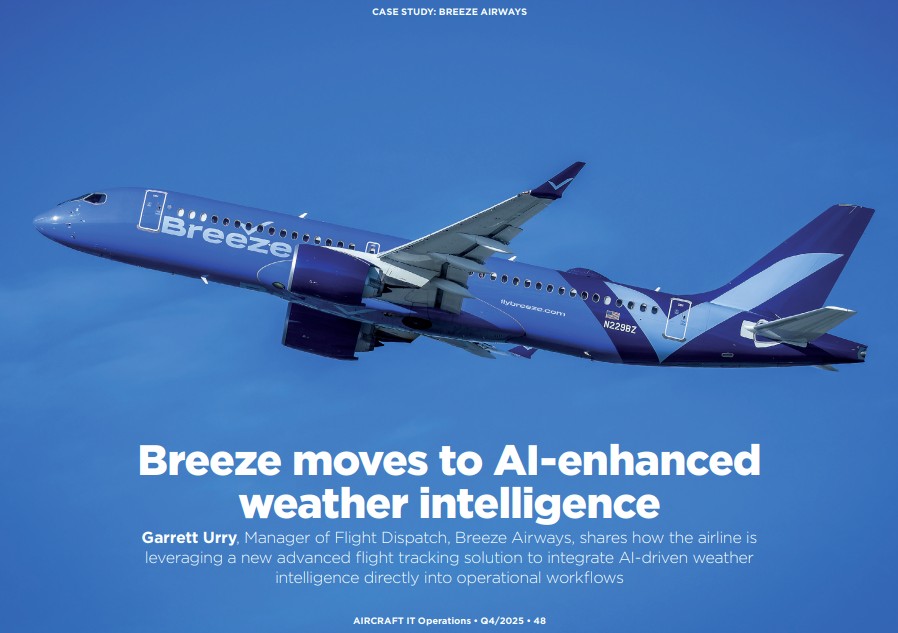
Garrett Urry, Manager of Flight Dispatch, Breeze Airways shares how the airline is leveraging a new advanced flight tracking solution to integrate AI-driven weather intelligence directly into operational workflows
When the opportunity for this article came up, I jumped at the chance to share with Aircraft IT readers some of what we’ve done at Breeze Airways, as a young airline keeping to our service promise of being a Seriously Nice™ carrier. But we’ll start by going back to look at some of the challenges faced by our dispatchers as shown in figure 1.
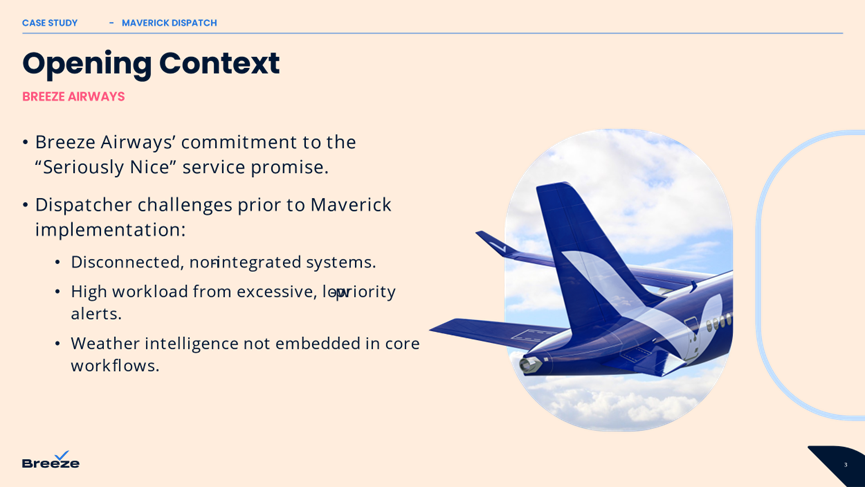
Figure 1
Some of the challenges that we were facing within the Operations Center were a lot of disconnected and non-integrated systems, which created needless workload due to unnecessary alerting and related issues from our dispatch perspective. The other thing that we were missing within our systems was an embedded weather intelligence workflow that was really tailored into the ASD (Aircraft Situational Display), as a single system to relieve that workload and the pressures experienced by our Dispatch and Operations teams. An objective we were trying to accomplish when we went out and started looking for a solution was to reduce that system fragmentation.
MULTIPLE SCREENS AND CONSTANT CHANGE
As you’ll know, if you’ve ever worked within an Operations Center, dispatchers have to deal with a lot of things at once. I checked on one of our dispatchers and counted the number of screens he had up. He was moving around between 22 different open tabs; so, we wanted to reduce that to as little screen hopping as possible as suggested in figure 2.
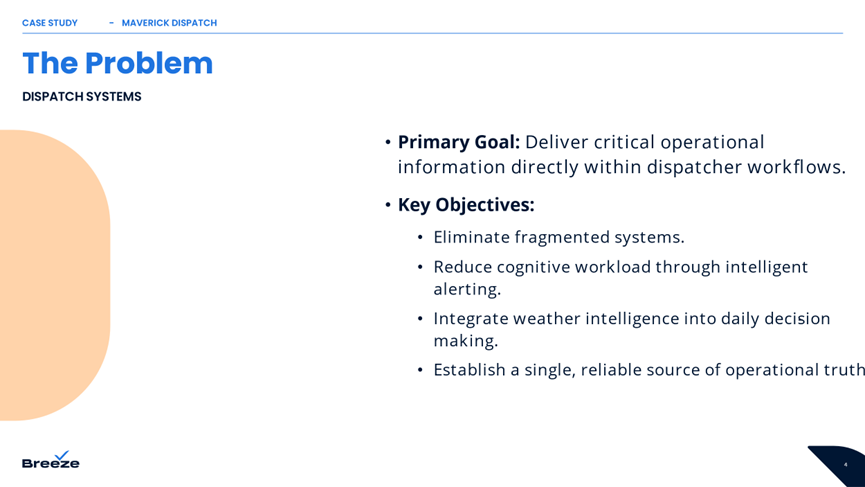
Figure 2
That would be a big accomplishment. The more screens we can reduce, the better. Also, there is the issue of the cognitive load; the constant changes in the environments that we operate in can be overwhelming. We wanted to find a way to reduce that cognitive load for dispatchers and then integrate that weather intelligence directly into the ASD. That was really important to help with the reduction of fragmentation, lower the cognitive load, tie everything in together and also create a single source of truth. Regardless of the specific programs, everybody was on their own system to track our flights, whether it was the stations, our Tech Ops teams or our Operations team. Everybody was using their own program, so being able to consolidate that into a single source of truth was really important for us.
A SOLUTION AND ANSWER
The solution that we were able to find was to stay with The Weather Company and move over to their new product, Maverick Dispatch, as shown in figure 5.
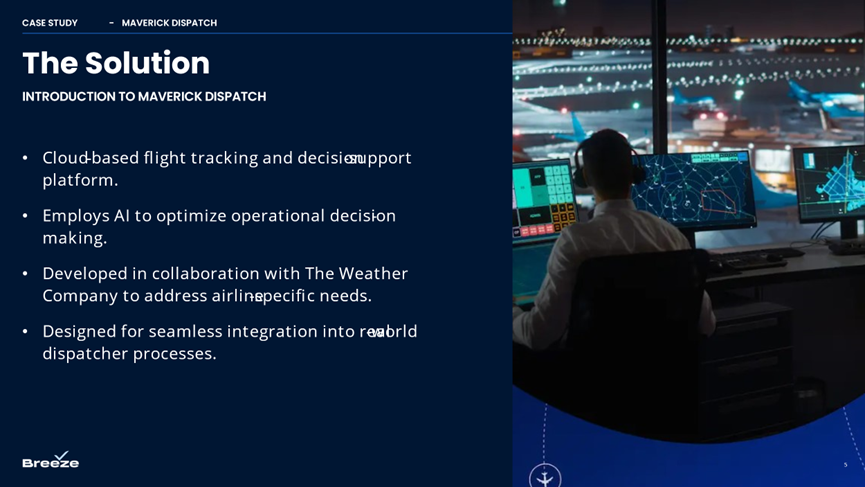
Figure 3
Fusion, from The Weather Company, which we were already using, is a very robust app but it’s an app. Now that The Weather Company has converted Fusion into a cloud-based system, Maverick Dispatch, that can be accessed from a web browser rather than an app, it really opens it up. For Breeze, it opens the door to allowing all of our different teams throughout the operation to have that single source of truth.
We wanted a strong collaboration with the vendor and our relationship with The Weather Company has been just that. One thing that we have learned is, if it ain’t broke, don’t fix it; just evolve it. Fusion has been at the forefront in aviation for many years, and, as stated above, the program itself is robust. The challenge was how to evolve that into the next steps. The Weather Company team has been able to take a lot of our advice and evolve those products as they’ve migrated them from their app-based Fusion to Maverick Dispatch and then on to forward-thinking innovation, growing and improving the product. It has some interesting and useful key features.
KEY FEATURE: ENHANCED WEATHER VISUALIZATION
Some of the features that I’d like to focus on include the GRAF Turbulence Layer, seen in figure 4.
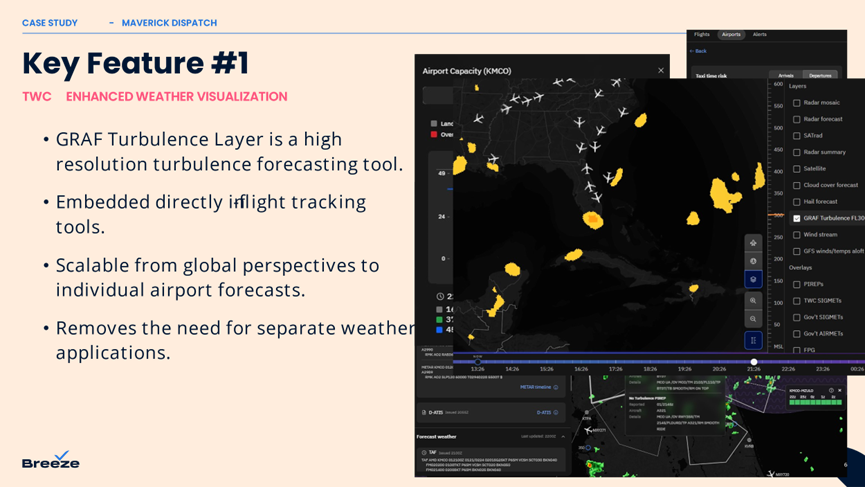
Figure 4
The high-resolution turbulence product delivers a high-fidelity view of where turbulence is forecast to be at any given time over the next 24 hours. It refreshes every 15 minutes worldwide, and is super accurate. With GRAF Turbulence in Maverick, we’ve been able to track our safety reporting for turbulence-based events. Using it, we went from 0.81 reports per 1000 flights down to 0.62 in just a matter of three months. So, we’re seeing a great reduction in turbulence and safety related events, and their costs.
Also, looking at the ATC (Air Traffic Control) demand tool, weather trends, taxi time risk, and dynamic taxi times, all of these tools are allowing us to stay in front of those crew-based issues, whether it be crew timeouts, flight delays, or staying in front of the air traffic control initiatives; all of those things have greatly reduced the cognitive load. Being able to look at a flight and know immediately the percentage chance that we’re going to be caught up in a flow-constrained area, or that there’s extended taxi times in a particular airport, helps us stay ahead of the curve and relay information very quickly down to our front-line users.
As well as turbulence information, GRAF also warns of thunderstorm risks in terminal airspace and is one of the drivers of TrACR, as shown in figure 5.
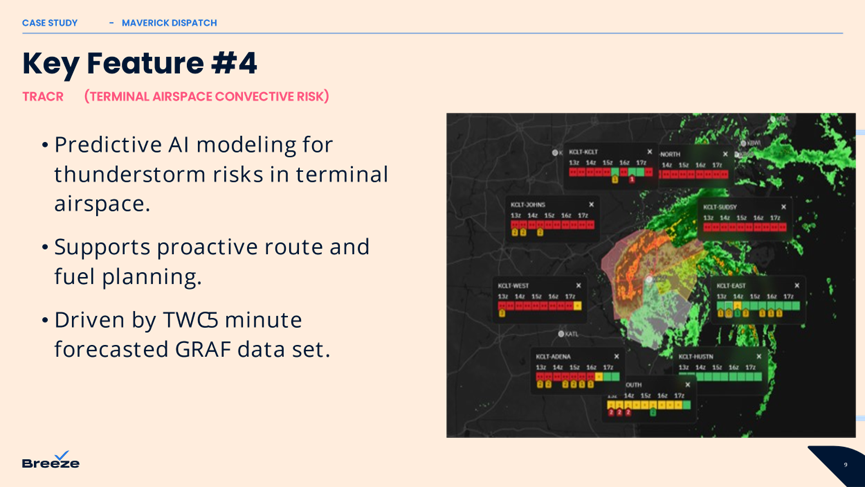
Figure 5
TrACR is a predictive tool that evaluates thunderstorm risk in arrival and departure corridors hours in advance. It enables our dispatchers to proactively adjust routings or fuel plans to avoid known choke points before they become a problem.
In the past, we had to dig deep into the archives of ATC in order to find this information and it was limited to a handful of airports across the United States. Breeze primarily flies to secondary and tertiary airports, so the data that we needed wasn’t there for the majority of our flights. The Weather Company has been able to create tracker models that allow us to see gate arrival and departures and the probability of convective activity for each one of those gates. That enables us to stay ahead of reroutes and things of that nature. For example, if ATC intends to create flow into an airport, it enables us to get ahead of that, route our flights into the gates that are forecast to be open at our time of arrival, and avoid the reroutes and the holding stacks. It’s been great to have that tool available, even for our smaller airports, as they continue to develop the product out.
The consolidated alert dashboard, as shown in figure 6, has been a great tool in helping us stay ahead of the game with the number of alerts that come in.
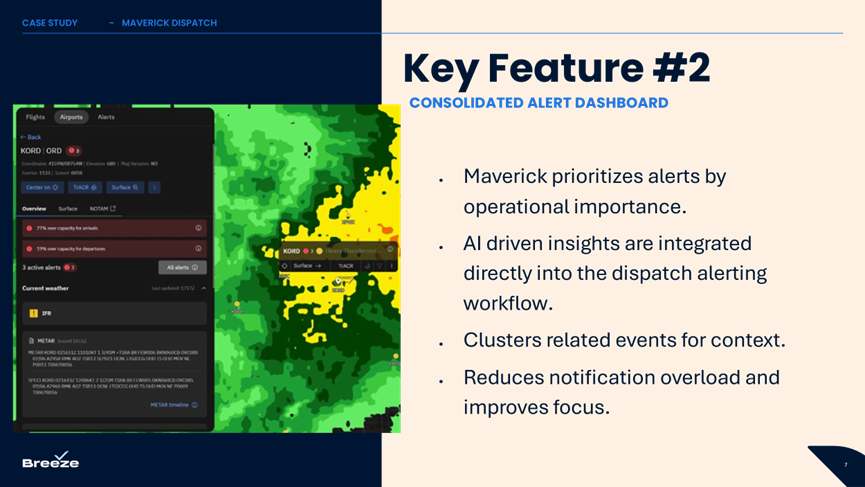
Figure 6
As mentioned above, dispatchers are constantly inundated with different alerts; weather alerts, Air Traffic Control impacts, and things of that nature. Consolidating that into a more bite-sized amount of information on a per flight basis has been excellent in reducing and improving our efficiency. It also has helped reduce our alert fatigue. The great thing is that the admin can go in and set a foundation of admin-based alerts for the entire Operations floor. And then, even better than that, the user can go in and tailor the alerts that they want to see, which allows dispatchers to highlight where maybe they notice, or have had feedback that there is a struggle in a certain area; they’re able to tailor an alert to assist them in catching those issues.
There are also smart NOTAMs leveraging AI to prioritize and silo alerts as shown in figure 7.
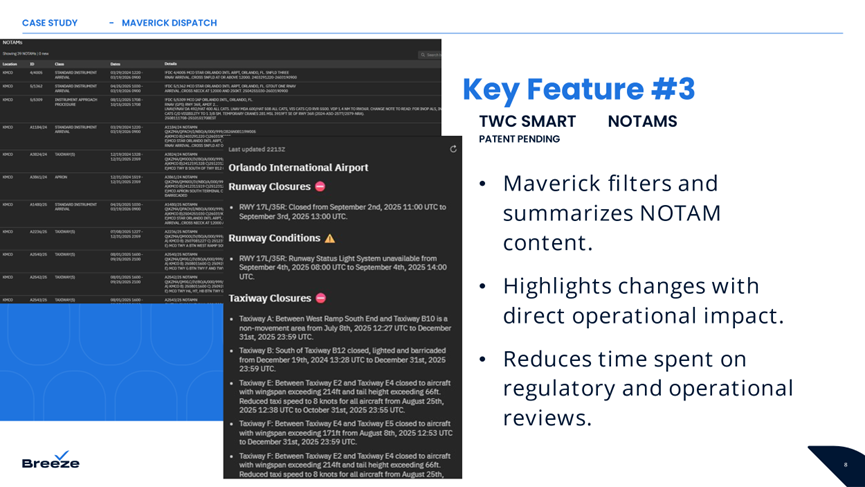
Figure 7
For a dispatcher, maybe only 15 percent of the NOTAMs that they see actually pertain to their flight. When they’re handling anywhere from 20 to 30 flights on their desk a day, looking at airport NOTAMs for all of those is a bit overwhelming. Being able to reduce the number of NOTAMs that dispatchers are really focused on, and being able to funnel and channel their energy into only looking at NOTAMs that pertain to their flights is important and has enabled dispatchers to be much more efficient in being able to parse out NOTAMs.
Unified cloud access, being able to bring everybody into a single source of truth, has been extremely beneficial – figure 8.
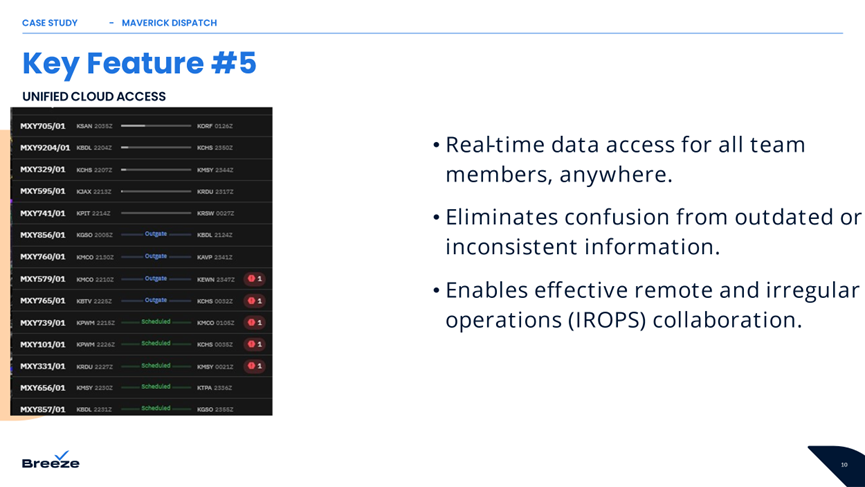
Figure 8
Having the Tech Ops teams, IT, and our Operations team all working with a single source of truth allows us to have a unified vision and collaborate more efficiently to ensure that we’re running an on-time operation. Making sure that the information regarding a flight is being sent out to all of the different teams involved and that we are all reading the same weather, the same flight information, has really improved our productivity.
THE IMPACT ON BREEZE’S OPERATIONS
The main impact has been to support efficiency; just on the dispatch desk, we’ve been able to reduce the cognitive overload, the alert fatigue and swivel chair integrations, with the results as shown in figure 9.
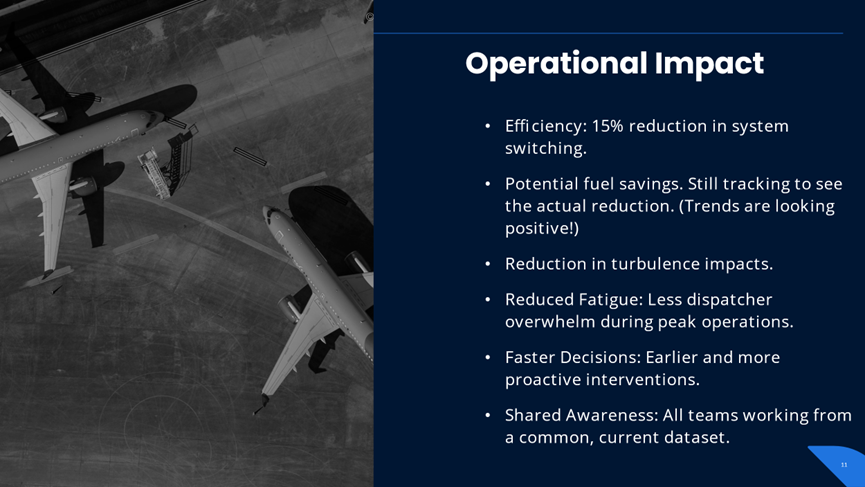
Figure 9
It allows a dispatcher to take more load on their desk, which has allowed me to reduce the additional headcount requests that we’re submitting each year. Because we can increase the number of flights on their desks and what they’re able to handle, we’ve been able to reduce system switching by 15 percent which is massively beneficial for the company. Even though we’ve increased the number of flights per dispatcher, it’s safer because we have the proper tools and proper equipment to increase the efficiency and the information is being displayed to our dispatchers on a timely basis.
Being able to use that GRAF Turbulence, that’s just one small example of where we have seen the direct safety impact and the reduction of turbulence related safety events; also, being able to get ahead of significant weather events. For instance, with Hurricane Milton, we were able to not only stay longer and run our flights closer to the hurricane, but we were also able to come back into MCO, much sooner than the other operators and help our customers have a little bit more consistency and a safer operation. They were able to get back in and get to their homes and start repairing their homes and things of that nature.
Teams across the company, using that single ASD, has brought that unified vision for the airline, increasing the productivity and then, of course, savings. When we couple the AI-driven insights, we’re starting to see notable fuel savings. Right now, we’re sitting at about a 0.8 percent fuel savings in the six short months that we’ve been using the product. And it’s expected to continue to increase as we roll out more and work with The Weather Company more on some of the AI-driven fuel initiatives. I anticipate that continuing to grow and bringing even more of those fuel savings and benefits into our operation.
LESSONS LEARNED
As you might expect with the implementation of any new solution, we learned a few lessons from the process, which you can see in figure 10.
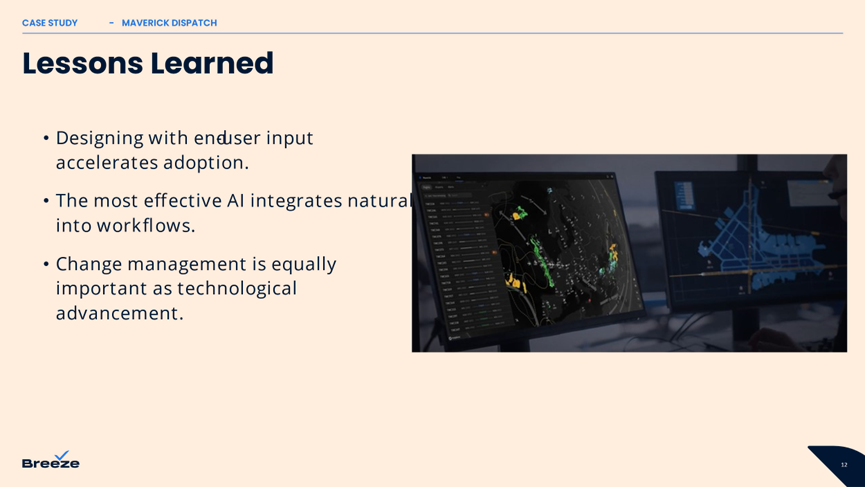
Figure 10
Working with The Weather Company, we were able to get a solution that fits Breeze’s operational model; so, co-development definitely beats off-the-shelf for us. We were able to shape Maverick to our workflow, not the other way around. That’s why adoption was fast and enthusiastic. We also learned that AI works best when it’s invisible. The magic is in how seamlessly it integrates. Dispatchers don’t think, ‘I’m using AI now’; they think, ‘I’m getting the info I need, faster’ and, of course, that’s what really matters. Finally, we re-affirmed what we already knew: change management matters as much as the tool. We invested in training, feedback loops, and early wins to build confidence in the new system. Technology alone doesn’t change behavior: trust does.
LOOKING TO THE FUTURE
The changes will not stop with the implementation of Maverick and our future with the system is still evolving as you’ll see in figure 11.
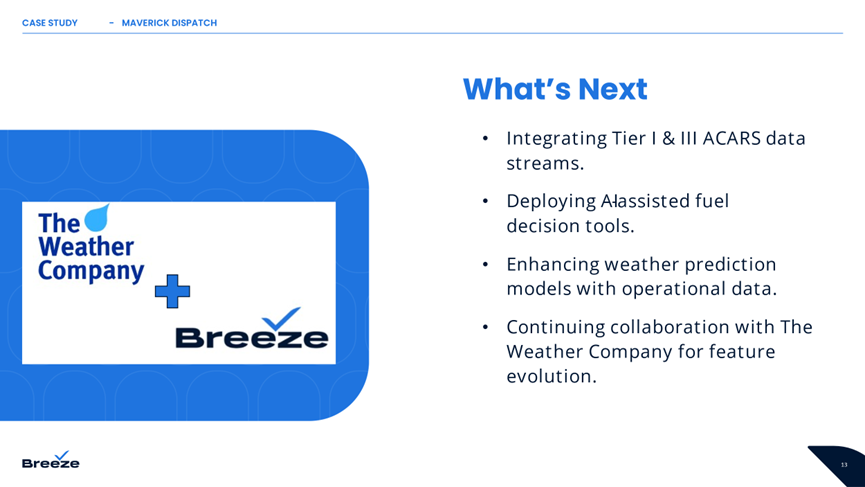
Figure 11
We are strengthening our operational capabilities at Breeze by doing a full integration with The Weather Company, including ACARS data and things of that nature. That’s going to massively increase our capability and further increase the efficiency of the product itself, especially when you talk about AI-driven fuel optimization tools. The Weather Company is looking at multiple fuel-driven optimization tools that are really going to enhance the product, also enhancing our weather models and operational insights. That’s been massively beneficial since we’ve been with The Weather Company, as with Hurricane Milton, mentioned above. The product they offer is, in our experience, the best in the industry and has delivered something like 98 percent accuracy with our weather reporting and forecasting, which is industry leading. Being able to have that integrated into a much more seamless ASD is really going to continue to drive that operational efficiency. Being able to stay ahead of the weather is extremely important to our operation, especially because weather-driven impacts are the majority of the issues that we face as an airline.
And then, of course, we’re going to continue the collaborative efforts with The Weather Company to make sure that the product continues to develop. Not only is it a massive UI/UX type enhancement to their Fusion product, but it has a much simpler workflow and is more user friendly. One of the issues that we faced with Fusion was that it’s a large system; we wanted to reduce that into a much more manageable and easier-to-train system. The Weather Company has been working with us on how to make it more user friendly and how to continue to enhance the product and put that relevant data in front of our dispatchers.
As I mentioned above, at Breeze, we like to say that we’re nice people flying nice people to nice places. And the partnership that we’ve shared with The Weather Company has been just that. They really exemplify that collaborative relationship principle. I’ve never worked with a company that has had more of an appetite to really ask questions, take the feedback, and, sometimes the criticism, and then immediately action it. With some of the integrations that we’ve requested, they’ve been able to quickly turn them around within a sprint cycle and given us a product that is not only what we were looking for, but with enhancements to really make it special.
Using that embedded AI intelligence really allows us to keep to our promise of being that Seriously Nice™ airline. It makes the airline safer and more optimized, and again, it is a more consistent product for our Operations team. And then again, our mission is to strengthen our operational excellence so that we can provide that superior experience to our guests and make sure that everything that we’re doing within the operations center is directly translated out to our guests and their experience out on the flight line.
Comments (0)
There are currently no comments about this article.
To post a comment, please login or subscribe.