
Articles
| Name | Author | |
|---|---|---|
| CASE STUDY: Launching an electronic logbook at easyJet | Philip Hyde, Implementation Project Manager, easyJet | View article |
| CASE STUDY: A change for the better at World2Fly | Alvaro Coromina Sanz, IT and Innovation Director, World2Fly | View article |
| CASE STUDY: Digitalizing Scheduled Maintenance: WestJet’s Production Control success story | James Homeniuk, Manager eMRO Platform, WestJet | View article |
| CASE STUDY: from data silos to insight | Andres Kjerulf, Director of Airworthiness, Texel Air | View article |
| CASE STUDY: From prediction to action at KLM Cityhopper | Robin Duteweerd, Fleet Manager, KLM Cityhopper | View article |
CASE STUDY: from data silos to insight
Author: Andres Kjerulf, Director of Airworthiness, Texel Air
Subscribe
Andres Kjerulf, Director of Airworthiness at Texel Air shares a successful transformation of data capabilities
In this case study I want to share with readers Texel Air’s journey with EXSYN Aviation Solutions to making better use of data and to give you a rundown of what we’ve accomplished so far. But first, a few words about Texel Air.
TEXEL AIR
The airline was formed fourteen years ago in Bahrain and has been operating as a niche cargo operation for much of that time. However, we’ve expanded quite a bit in the last four years, adding aircraft to our AOCs: we also opened up a second AOC in New Zealand. We now have five aircraft in Bahrain plus there are six aircraft flying in the Australasia area. When we established the second AOC, it was mainly a ‘copy and paste’ of the Bahrain operation. The CAMO and Engineering Department in Bahrain supports both AOCs and, with our future operation, the maintenance support functions will be based there.
THE DATA CHALLENGE
Our challenge here is that while, during every sector flown, we capture huge volumes of data on aircraft, engine, APU, flights, defects, delays, fluid uplifts, fuel/oil consumption, sector events and more, harvesting all this data was a cumbersome process. The other part of the challenge is that Texel has implemented four systems in the last four years which all use data (figure 1).
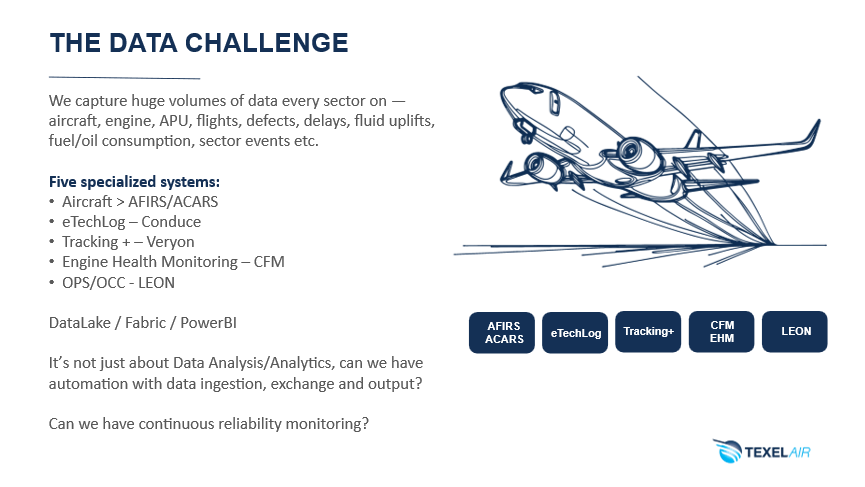
Figure 1
In order to better manage all this data and functions, we decided to go fully, or as much as possible, digital and that has been our journey these last four years. It started with the eTechLog from Conduce which we implemented in about three months. Then there was our maintenance system, Tracking+, from Veryon, and now flight ops has been implementing the Leon system. With all the data being generated, we had to think about how to collect it all (figure 2).
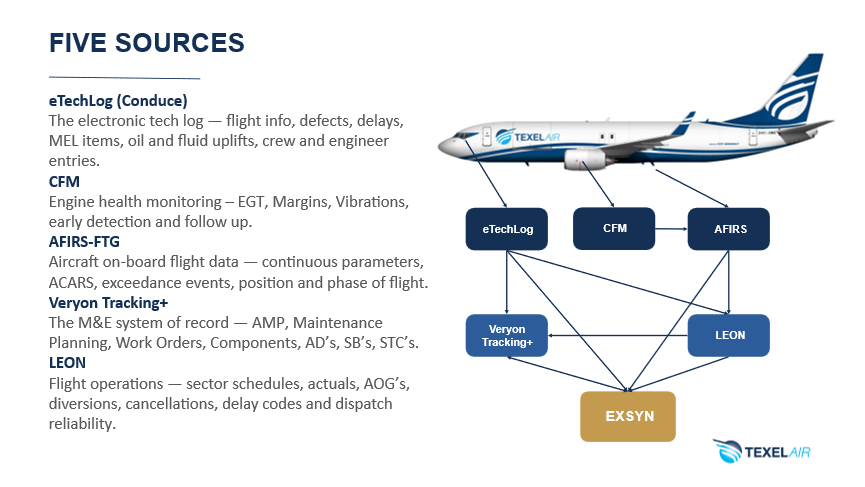
Figure 2
Of course, you can go the route of using data lakes and Fabric or Power BI’s, but we are a fairly small airline and don’t have the capacity inside the company to have that knowledge or to get it, or to get the right people with the right capabilities.
We decided, with the systems that we do have, that although they might be individually specialized and all need data input, whenever and wherever there is a single data entry, it would be more efficient if that data could be internally transmitted to different systems that might use it, which meant sharing. Whether that’s by building connections or through APIs or whatever means possible, we did not want that data to have to be entered separately into each different system. The decision we had to make was, where should data be entered and how can we distribute that data around the different systems? And then, how are we going to translate that raw information into usable information with which we can work?
That’s when we went out to seek for a partner for doing that, and I’m very happy that we found EXSYN for that; we wanted one system that connecting to all solutions. But it’s not just about exporting the data and doing something with it; there’s a whole lot more that EXSYN offered, which interested us as well as all the ingestion of data.
CHOOSING THE RIGHT PARTNER
We were impressed by the different apps that EXSYN offers and by the phase-in approach to implementation. Being a small airline, we started out buying our own aircraft, and from different operators or lessors in different parts of the world. The quality of some records was challenging but then others, such as leasing companies, handle records well. However, having a structure for when we’re ingesting an aircraft into the fleet, having phase in; that was one of the issues that we wanted to address – see figure 3.
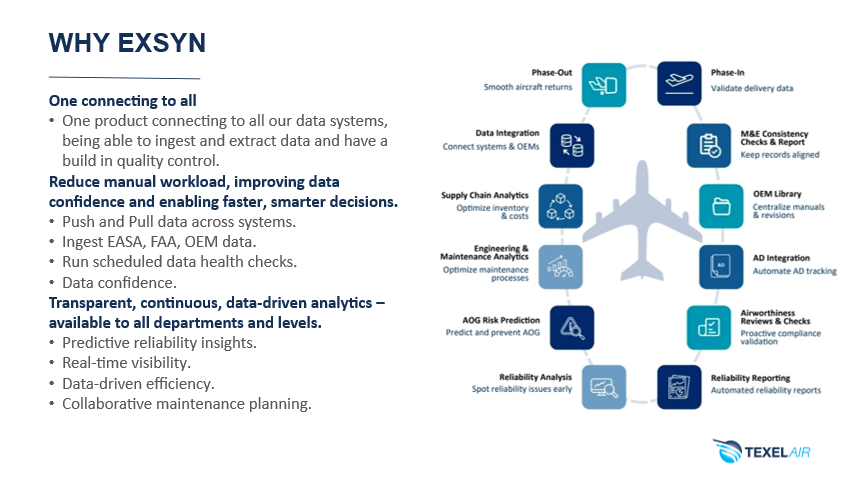
Figure 3
Maintenance engineering, contingency checks and reports is the area which was a learning curve for everyone involved because what the system is doing is health checks on the data itself. We run health checks every day or every week, and they tell us that there are X number of errors in the data, so we need to go and have a look at that. It’s not just about correcting it, but it’s about preventing it. Those are also things that we used to do manually before; when the data was not correct, we’d have to go back and talk to people. But now, with the EXSYN tool it’s clear to everyone entering data, if they’re doing it correctly or not, and the effect that will have downstream.
Another valuable thing is the OEM library for keeping the manuals; the Maintenance manuals, the IPC (Illustrated Parts Catalog) data and, importantly, the service bulletins (SBs). That data is now ingested into our maintenance system, so that we can take advantage of it from there. The same goes for the ADs (Airworthiness Directives). EASA and FAA publish ADs by email, but we want to know how we can analyze the documents in a digital version, so that we can build a library of ADs in our systems. What EXSYN Nexus also does is that, through these checks that it runs, it also then checks if you have all the ADs which are applicable to your aircraft, components, and everything else, that’s a very good tool when we’re scouting an aircraft and seeing if everything is covered.
I won’t go into detail of each and every App on the platform, but I will mention the Phase-Out because that is something that matters for us. As mentioned above, we started out buying our own aircraft, but we do lease some aircraft so we recognize the need to keep track of the return conditions which, if neglected, could bite you in the end. Now, we can put in all the conditions of lease agreements into the system and then can run the diagnosis which will say whether we are within the liabilities on return conditions from the lessor. That will be very valuable for us at ends of leases.
IMPLEMENTATION
At Texel Air, as already mentioned we have implemented four systems in the last four years. So it was refreshing to find a vendor who provides services like implementation and, of course, they really know their implementations (figure 4).
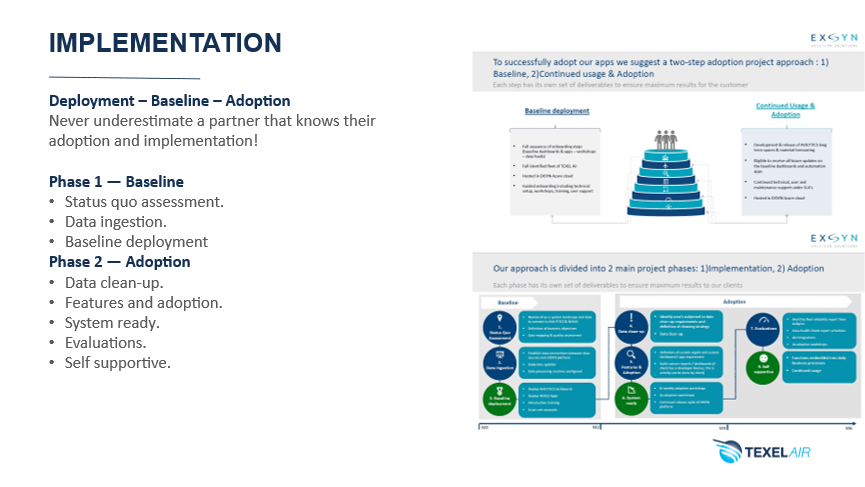
Figure 4
My advice, if you are looking for a provider, is to research how they approach the implementation and everything else, because it is not as easy as they say. It takes longer than they promise, but when we approached EXSYN a year ago, this was one of the factors we were talking about. Our implementation started at the beginning of December 2025, and we were just about to go-live at the time of writing in June 2026, which was as promised.
Integration
Some of the biggest benefits from this implementation were the workflow schedules which came with the system (figure 5).
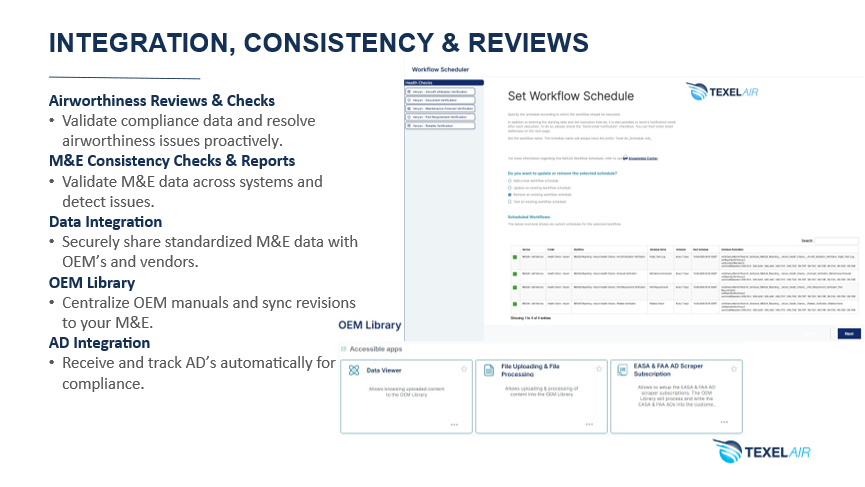
Figure 5
We run checks out of the OEM library on the data, and we are able to produce detailed reports. For the ADs, we are aiming, with the tool, to get to the component level, which has previously been hard with our maintenance system, so we will integrate that in greater detail. On the flight data from the aircraft, with AFIRS or ACARS, we ingest the UIs from the aircraft onto the device (figure 6).
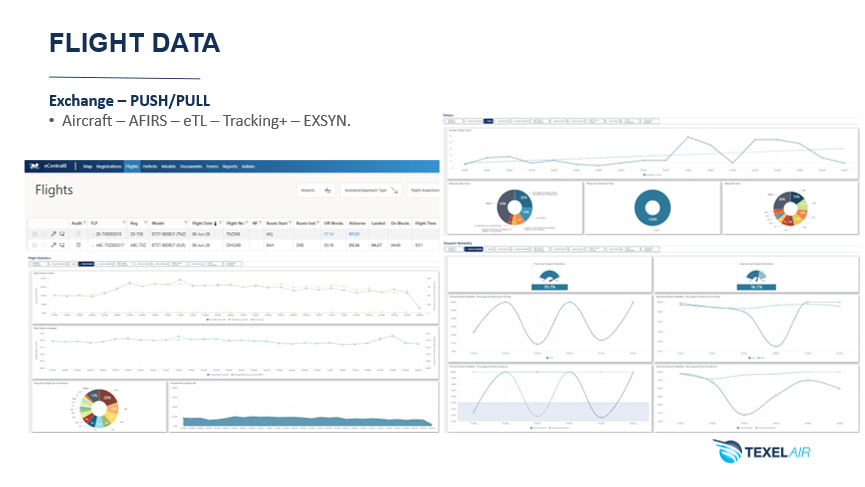
Figure 6
When pilots close their flight, all they have to do is verify that the data is on their devices and whether or not they agree with it; or they can add to it. That’s why there are the blue marks on the on the first one and, if they accept it, then it goes from the tech log into the maintenance system, where it’s picked up by EXSYN. Where you see the dip on the operational performance is the period we had in March this year with a big dip in on-time performance Bahrain when the war with Iran started.
Defects
Defects are handled in much the same way. The visuals that come with the system are quite straightforward and easy to grasp (figure 7).
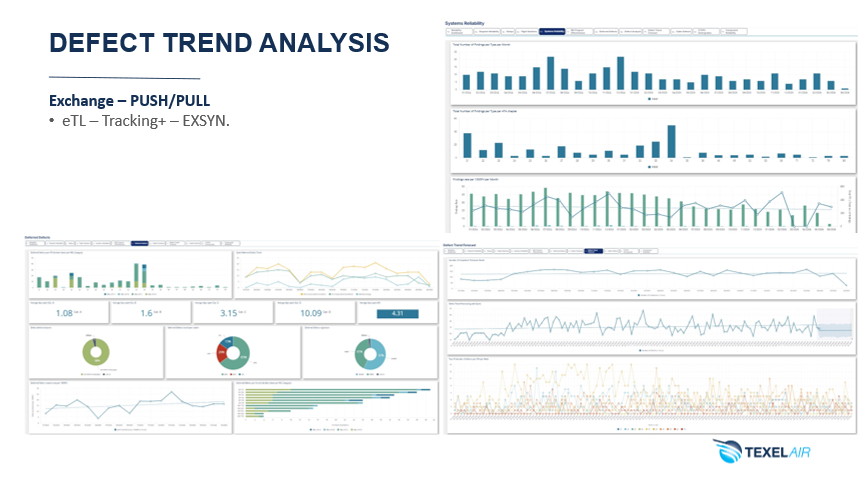
Figure 7
This is the overview of MEL (Minimum Equipment List) items, and where we track how long they stay open. Here we can also see the aircraft that have been sitting around for too long on the ground, they do tend to suffer defects quite a lot in the first six months of operation with Texel Air. That’s indicated by the graphs on the right; we see that information come to life.
Component reliability
One strength of the system is how deep you can drill into the data and how complete the system is (figure 8).
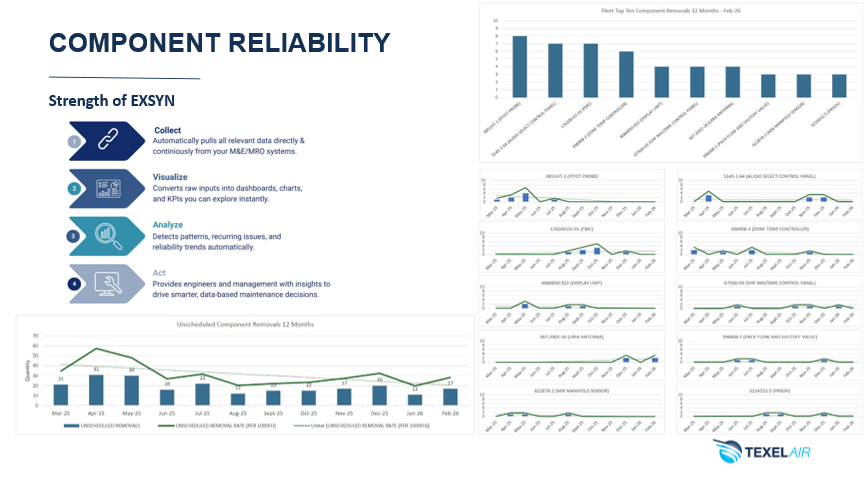
Figure 8
Looking at data on Component reliability; there is collection, visualization analysis, and we can create tasks and act on issues that we run into. Although small, we do have two AOCs and, in the Australasia area, we have one aircraft in New Zealand plus five aircraft in Australia; but we also have a mixed fleet as EDTO (Extended Diversion Time Operations) and non-EDTO (figure 9.1).
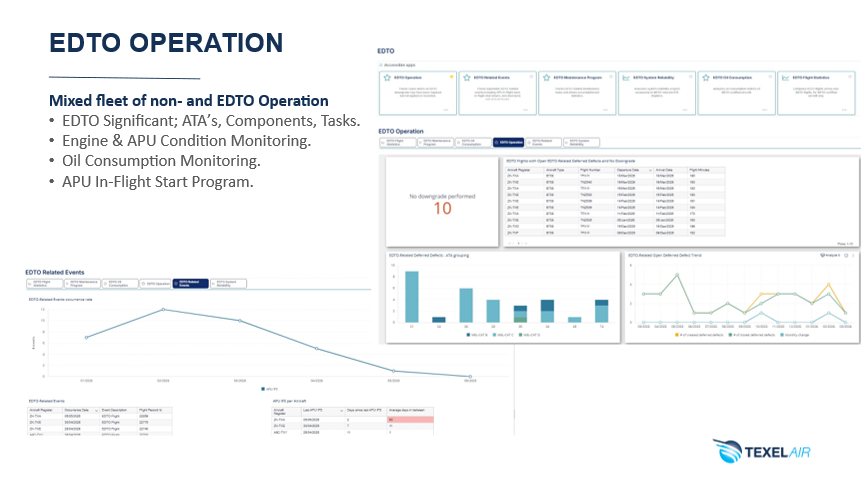
Figure 9.1
We have nine Boeing 737-800 BCFs and are the first operator of the 800 BCF with an ETOPS (Extended Twin engine Operations ) certification. For that, we worked with EXSYN to extract the EDTO data and create a set of separate dashboards. There, we can say, for the EDTO significant items, if it’s ATAs, components, or EDTO tasks, as for the engine and the APU, all the oil consumption, we can run those separately from the data itself. That gives regulatory oversight, because there’s a different set of rules of what needs to be done in New Zealand than in Bahrain,. One says that for in-flight APU starts, you need to do that every 30 days if you don’t do an EDTO flight. The other one says you need to run your APU all the time.
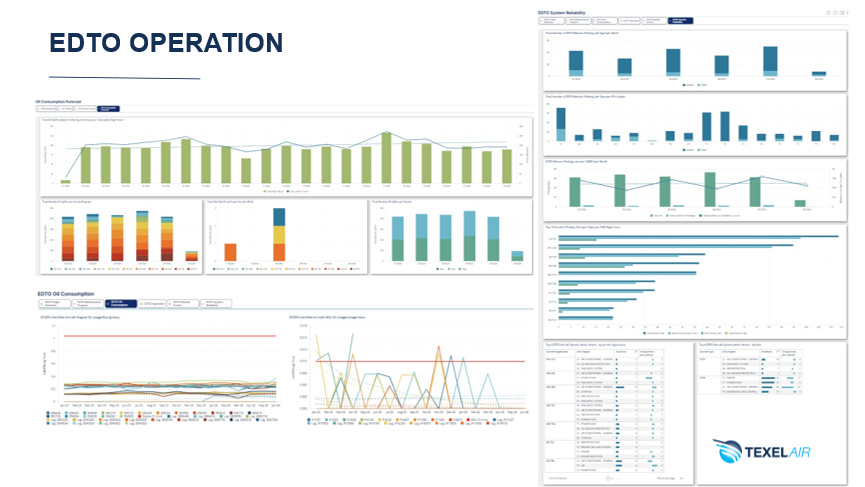
Figure 9.2
Figure 9.2 illustrates more into the EDTO operation by itself. As for both the defect on significant items by itself, and with the tracking of the oil consumption and the alerts.
WHAT CHANGED FOR TEXEL AIR
The partnership with EXSYN has enabled us to develop a number of capabilities faster and learn from the experience already built in to the EXSYN platform.
Operational outcomes
We have gained significant time savings with reporting cycles that took days now run in hours. Consistent, trustworthy data that engineering and safety teams can act on with confidence is a further gain as is stronger oversight with earlier visibility of trends and events that matter. Finally, we have gained
Cost savings from less manual rework, fewer duplicated tools, and lower audit preparation effort.
Lessons learned
EXSYN has brought us deep aviation and data expertise; their tooling is reliable and proven, plus integration was smooth with no disruption to operations. On our side, we tightened data ownership and built clearer processes around reporting and follow-up. The partnership helped us to mature internally with better discipline around data quality, governance, and decision-making.
WHAT COMES NEXT
Following go-live there are a number of further developments planned to get the maximum value out of our systems. We’re looking to implement automated health checks as well as EASA and FAA AD integration and OEM Data ingestion. Aircraft, Engine and APU, health and data monitoring are planned as is Continuous Reliability Monitoring. Engineering, Maintenance and Inventory Data Analysis and Data Analytics are part of the future as is Airworthiness Review with a Push-of-a-Button. We to put a local Agent/Assistant on each CAMO employee’s desk.
In conclusion, I would say that the lasting legacy of this implementation for Texel Air is that what was once a system implementation is now a capability. The next chapter is about mastery.
Comments (0)
There are currently no comments about this article.
To post a comment, please login or subscribe.