
Articles
| Name | Author | |
|---|---|---|
| CASE STUDY: Launching an electronic logbook at easyJet | Philip Hyde, Implementation Project Manager, easyJet | View article |
| CASE STUDY: A change for the better at World2Fly | Alvaro Coromina Sanz, IT and Innovation Director, World2Fly | View article |
| CASE STUDY: Digitalizing Scheduled Maintenance: WestJet’s Production Control success story | James Homeniuk, Manager eMRO Platform, WestJet | View article |
| CASE STUDY: from data silos to insight | Andres Kjerulf, Director of Airworthiness, Texel Air | View article |
| CASE STUDY: From prediction to action at KLM Cityhopper | Robin Duteweerd, Fleet Manager, KLM Cityhopper | View article |
CASE STUDY: A change for the better at World2Fly
Author: Alvaro Coromina Sanz, IT and Innovation Director, World2Fly
Subscribe
Alvaro Coromina Sanz, IT and Innovation Director at World2Fly shares the airline’s journey from paperless to truly digital: how World2Fly is unlocking the power of operational data
For many airlines, digital transformation begins with replacing paper. For World2Fly, however, that was only ever the starting point. From its inception, the airline recognized that simply removing paper from the cockpit would not deliver the operational efficiencies that modern airlines require. Instead, the objective was to create an environment where operational data could be captured once, shared automatically and used intelligently throughout the organization.
Today, World2Fly provides an excellent example of how an airline can leverage electronic technical logbooks as the foundation for a truly digital operation. By integrating eTechLog8 into a wider ecosystem of interconnected systems, the airline has transformed operational data into a strategic business asset, supporting maintenance, flight operations, finance and long-term decision making.
A DIGITAL AIRLINE FROM DAY ONE
World2Fly occupies a unique position within commercial aviation as part of a large vertically organized tourism operator (figure 1).

Figure 1
Established in May 2020, during the global pandemic, World2Fly entered service in June 2021 without ever operating a paper technical logbook. Rather than replacing existing legacy processes, World2Fly was able to design its operational philosophy around digital technology from the outset. This decision reflected a broader organizational belief that technology should become an integral part of every airline process, rather than simply digitizing existing paperwork. The distinction may appear subtle, but it fundamentally changes how information flows throughout an airline.
Many organizations proudly describe themselves as paperless because paper documents have been replaced by tablets or PDFs. This often means that the paper has disappeared whilst the underlying processes of organizing and storing data remain unchanged. Information is often still manually transferred between departments. Data is still copied into multiple systems, often manually in what can be referred to as ‘analogue paperless processes’. If engineers, flight operations and finance teams continue to enter identical information manually into electronic systems, removing paper doesn’t remove the inefficiency.
World2Fly wanted something different. Our objective was to ensure operational information was captured only once before being distributed automatically throughout the airline’s digital ecosystem.
PAPERLESS IS NOT THE SAME AS DIGITAL
The difference between paperless and digital becomes clearer when considering a typical operational workflow. An example of an electronic paperless process would be a pilot completing a technical report on a tablet using a PDF form. Although no paper is involved, the completed document must still be retrieved, interpreted, and manually entered into maintenance systems, either by humans or operational software. A workflow that is genuinely digital captures structured data at the point of entry before automatically distributing that information across every connected system that requires it.
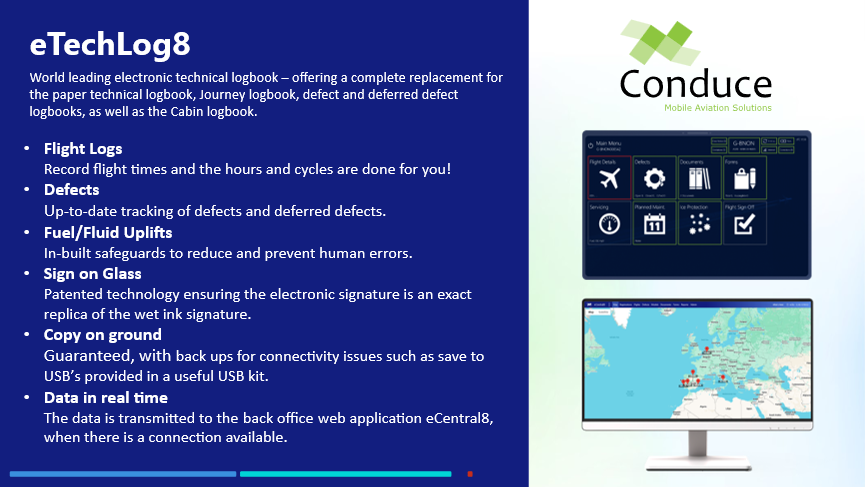
Figure 2
Arrival times, technical defects, maintenance actions, fuel uplifts and operational events are recorded once before being synchronized throughout the organization. This is why World2Fly chose Conduce eTechLog8 (figure 2 above).
WHY DATA QUALITY MATTERS
Capturing operational data only once delivers benefits far beyond administrative efficiency. Traditional paper-based processes introduce multiple opportunities for human error throughout the lifecycle of operational data. Historically, paper technical logbooks would pass physically between flight crews, engineering teams, Maintenance Control and finance departments, with information often being re-entered into multiple systems along the way. Simple transcription errors, missing decimal points or omitted fields could have significant operational and/or financial consequences, while every additional manual process delayed the availability of critical information. High-quality analysis becomes extremely difficult when the underlying data is inconsistent.
Recognizing that better operational decisions rely on better quality data, World2Fly sought to improve the data process itself, not simply replace paper with a digital equivalent. This philosophy strongly influenced the airline’s selection of eTechLog8. Rather than acting just as an electronic replacement for paper, eTechLog8 uses workflow-controlled processes to guide users through structured data capture. Operational parameters can validate entries as they are made, expected ranges can trigger warnings when values appear abnormal, mandatory information cannot be omitted inadvertently and calculations are performed automatically to reduce manual workload whilst improving consistency.
THE ROLE OF THE DATA WAREHOUSE
Central to World2Fly’s digital strategy is the use of a dedicated data warehouse. A data warehouse is an external database that consolidates information from multiple interconnected operational systems into a single environment for analysis. Unlike live operational software, the warehouse allows organizations to query and analyze large volumes of information without affecting day-to-day system performance. However, the effectiveness of any data warehouse depends entirely upon the quality of the information entering it. Poor quality inputs simply create poor quality analysis. Whilst no digital system can eliminate human error entirely, technical controls significantly reduce opportunities for mistakes before information enters the wider operational environment, creating cleaner, more reliable data that supports both day-to-day operations and long-term strategic decision making as in figure 3.
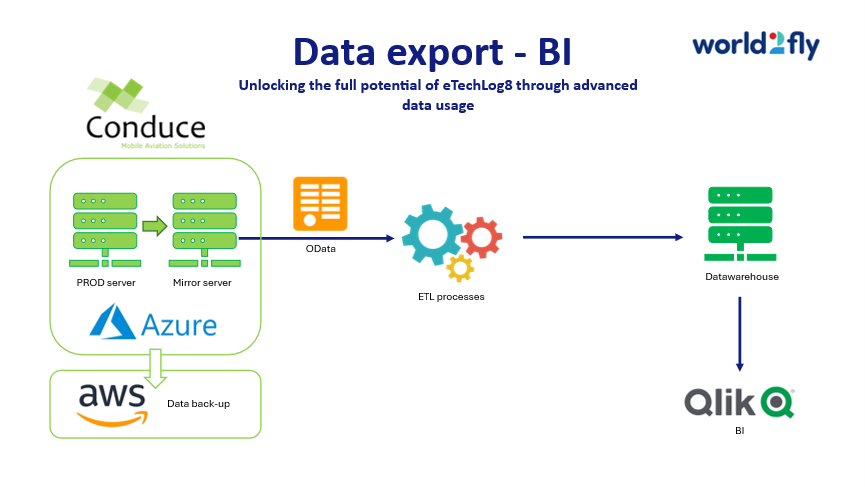
Figure 3
Because eTechLog8 captures structured operational data from the outset, World2Fly can populate its data warehouse with consistent, validated information gathered directly from flight operations and maintenance activities. Combined with information from other operational systems, this provides an exceptionally rich source of business intelligence as you can see in figure 4.
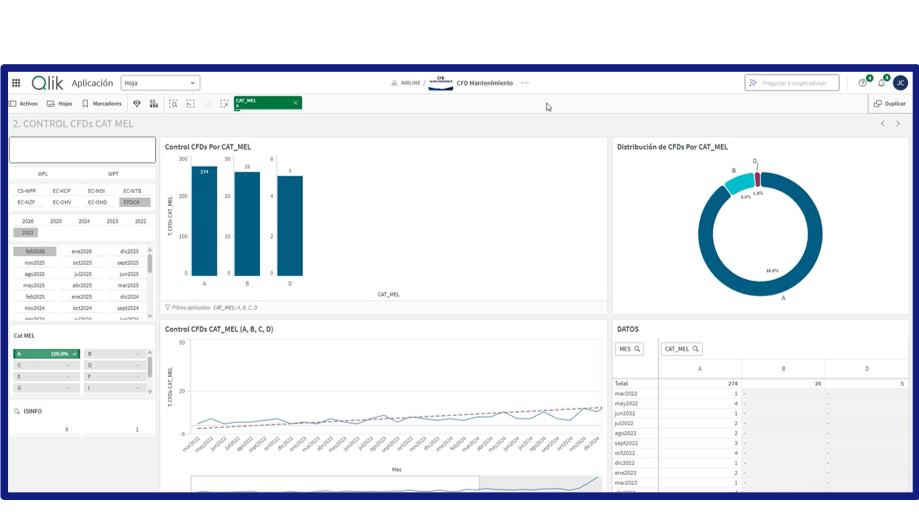
Figure 4
The airline currently uses Qlik BI to analyze this information, although similar business intelligence platforms such as Microsoft Power BI could perform comparable functions. Once high-quality operational data becomes available across multiple systems, entirely new opportunities emerge for predictive analytics, cost forecasting and operational optimization.
For example, managing Carry Forward Defects (CFDs) presents a common example. Historically, identifying trends across recurring defects could be a time-consuming process requiring engineers to manually interrogate multiple systems. With data consolidated into the warehouse, recurring technical issues become much easier to identify. Engineering teams can query the mirrored data, analyse defect trends by aircraft, ATA chapter or operational phase, helping prioritise maintenance activity and supporting reliability improvement programmes. Rather than relying solely on individual technical events, engineers can identify broader patterns that may otherwise remain hidden. This provides valuable insight into both fleet reliability and maintenance planning.
For World2Fly, this represents the true value of digital transformation. eTechLog8 is no longer simply replacing paper. It has become the foundation upon which operational intelligence is built.
TURNING DATA INTO OPERATIONAL INTELLIGENCE
Capturing high-quality operational data is only the beginning. The real value comes from how that information is used.
By combining data from eTechLog8 with information from flight operations, ACARS and other operational systems, World2Fly has developed a comprehensive data environment that supports decision making across multiple departments. Engineering, Maintenance Control, Flight Operations and Finance all benefit from access to timely, accurate information, enabling them to move from reactive decision making to proactive operational management.
One of the strongest examples of this approach is the airline’s management of fuel and oil consumption.
FUEL MANAGEMENT AND COST FORECASTING
Fuel represents one of the largest operating costs for any airline. Even small improvements in forecasting accuracy can deliver significant financial benefits (figure 5).
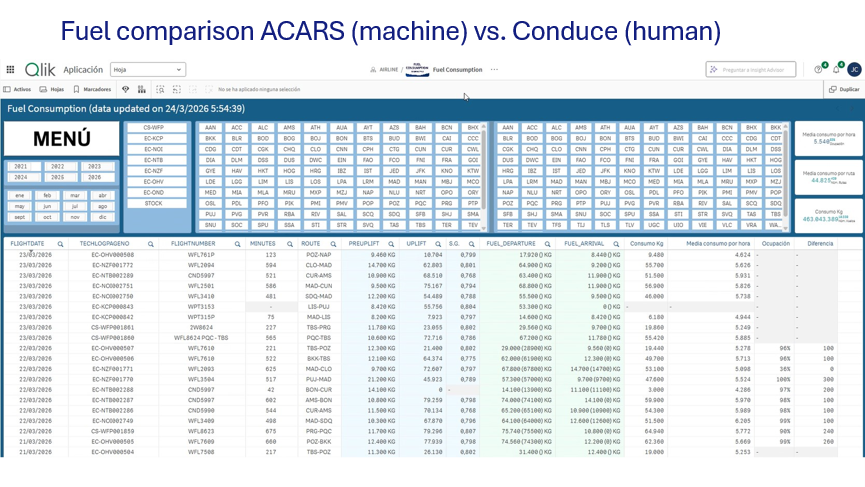
Figure 5
Fuel uplift data is recorded directly within eTechLog8 during routine flight and maintenance activities. Historically, this process has been vulnerable to a range of manual errors. Differences between liters and kilograms, misplaced decimal points or an additional zero entered in error can dramatically alter recorded fuel quantities and create considerable challenges during invoice reconciliation. The consequences extend well beyond administration. Incorrect fuel data can affect operational reporting, cost forecasting and supplier invoicing.
To minimize these risks, eTechLog8 incorporates several safeguards, including assisted calculations, soft validation warnings and the ability to capture photographs of fueling receipts directly within the application. These controls help ensure that information is accurate from the point of capture. Once synchronized, the fuel data is transferred into World2Fly’s data warehouse, where it is compared with ACARS information. This allows the airline to validate fuel uplift figures, analyze fuel burn on individual aircraft and monitor long-term consumption trends across the fleet. The validated information is then transferred into the airline’s Direct Operational Cost Control software, providing Finance with accurate operational data for cost forecasting, invoice validation and financial reporting.
Reducing manual reconciliation not only improves efficiency but also gives operational managers greater confidence in the figures being used to support strategic decision making.
MONITORING OIL CONSUMPTION
Oil consumption provides another example of how operational data can support predictive maintenance – see figure 6.
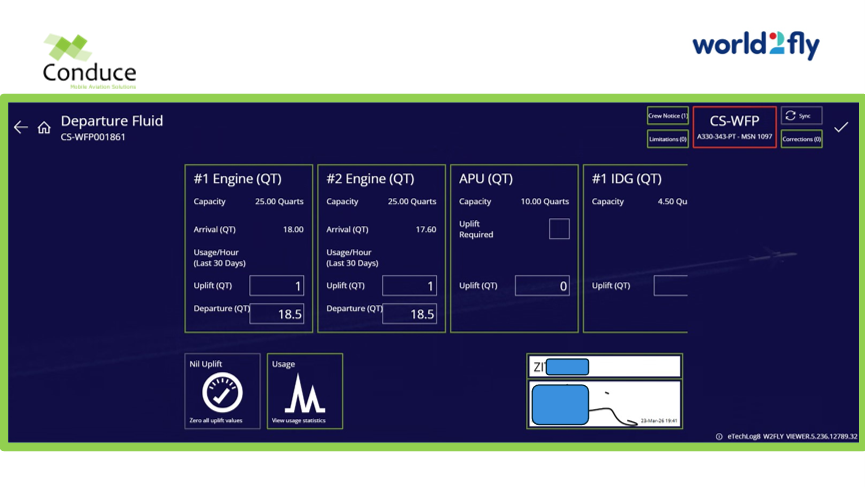
Figure 6
Oil uplift information is recorded for each engine within eTechLog8 before being transferred automatically into the data warehouse. From there, calculations are performed every 25 flight hours, allowing engineers to monitor consumption trends over time rather than relying solely on isolated data points. Static alert thresholds enable engineering teams to quickly identify abnormal consumption patterns, while high-consumption alerts draw attention to engines that require further investigation, as in figure 7.
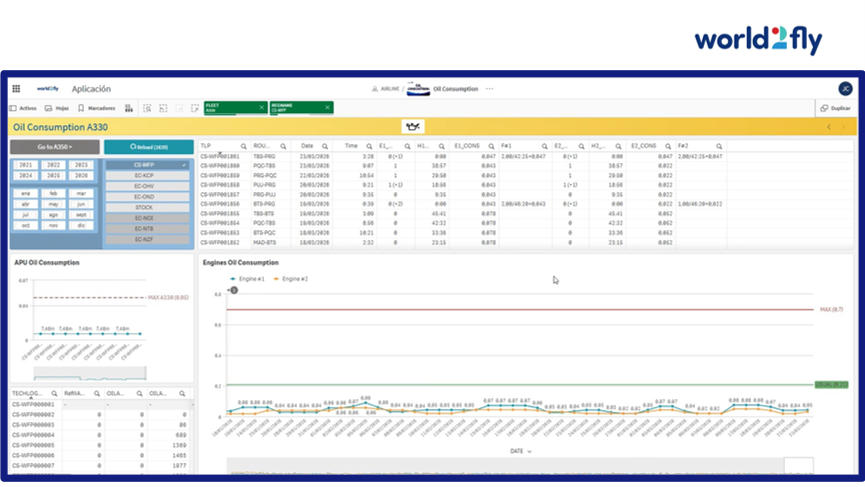
Figure 7
The system also tracks engine changes and maintains historical consumption records, allowing maintenance teams to identify emerging trends before they develop into operational issues. Rather than simply recording maintenance events, World2Fly is using operational data to support condition monitoring and informed engineering decisions.
SUPPORTING FLIGHT OPERATIONS
The benefits of digital data are not limited to engineering. Operational information captured within eTechLog8 also supports Flight Operations through improved situational awareness and more effective planning. By providing access to accurate, near real-time information, operational teams can identify developing issues earlier and coordinate responses before they impact the flying program.
Maintenance Control can prepare troubleshooting activities before an aircraft arrives.
Engineering teams can ensure parts and resources are available at the correct location. Flight Operations can make more informed operational decisions using consistent information shared across the organization. This shared operational picture significantly reduces delays caused by incomplete or outdated information.
LOW VISIBILITY OPERATIONS
Operational analytics have also proved valuable when monitoring Low Visibility Operations (LVO) as figure 8.1 shows.
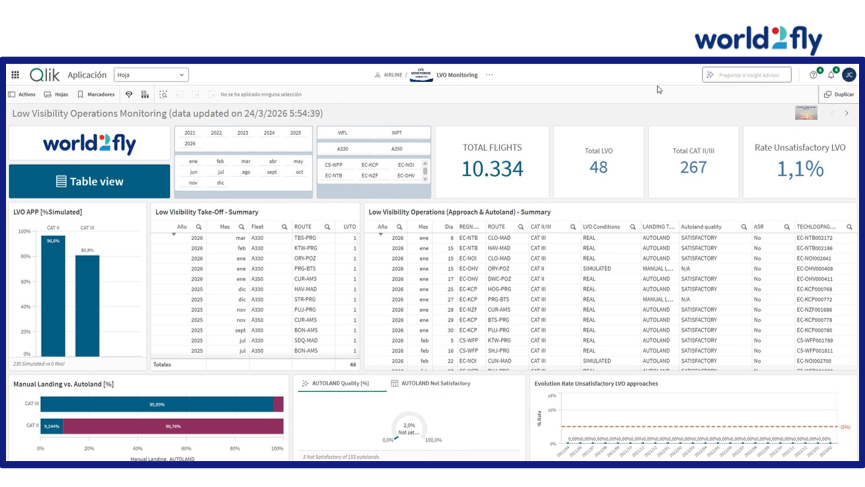
Figure 8.1
By combining information from multiple operational systems, World2Fly can analyze how weather conditions influence aircraft operations, maintenance activities and operational performance as in figure 8.2.
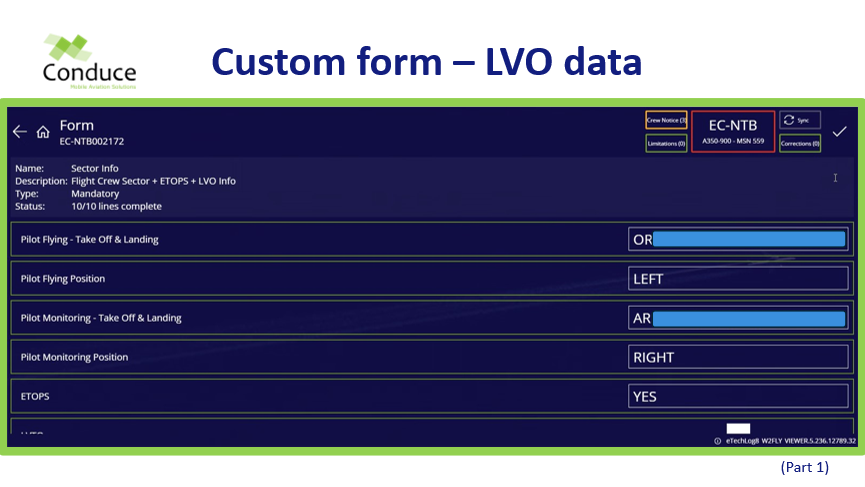
Figure 8.2
Understanding these trends allows departments to review operational procedures, allocate resources more effectively and improve planning during periods of challenging weather. This type of cross-functional analysis would be significantly more difficult if operational information remained isolated within individual systems.
MANAGING DE-ICING OPERAIONS
The same philosophy has also been applied to winter operations. De-icing activities generate large volumes of operational data involving fluid usage, timings, weather conditions and aircraft movements (figure 9).
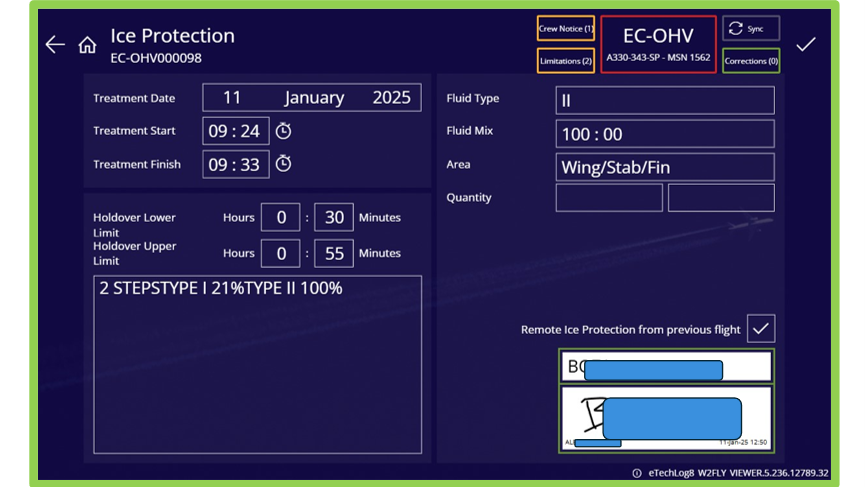
Figure 9
By bringing this information together within the data warehouse, World2Fly is able to review operational performance, compare activity across different airports and better understand the associated operational costs. The ability to analyze these events collectively provides opportunities to improve planning while supporting more accurate financial reporting.
DATA BEYOND MAINTENANCE
One of the most interesting aspects of World2Fly’s digital strategy is that many of the greatest benefits are realized outside the engineering department. Although eTechLog8 captures technical and operational information, that data subsequently supports a much wider audience as in figure 10.
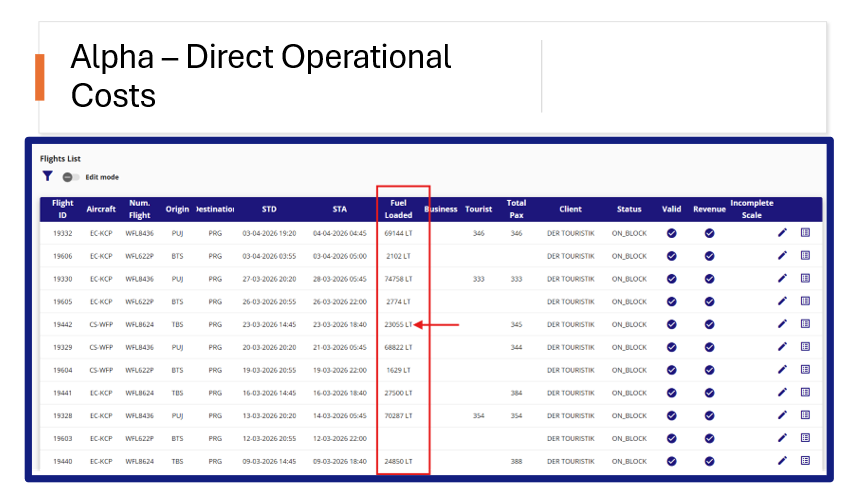
Figure 10
Finance uses operational data to improve forecasting and invoice reconciliation. Management teams gain greater visibility of operational performance. Reliability engineers benefit from trend analysis and predictive monitoring. Flight Operations receives faster access to accurate operational information. Each department works from the same trusted data source rather than maintaining independent versions of operational records. This organizational approach demonstrates that digital transformation is not simply an engineering project. But using elements like Conduce’s custom forms we can extend our current usage in exciting ways, such as to manage Ground handing, as in figure 11.
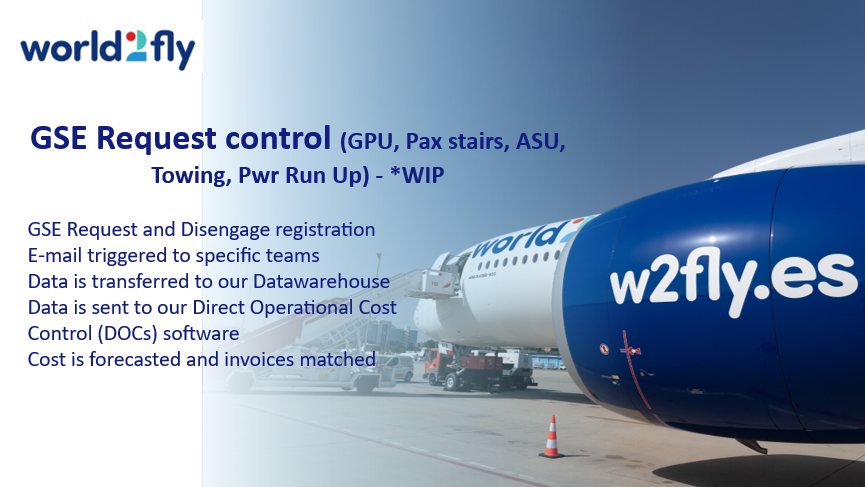
Figure 11
We want to automate sending requests, for example if someone orders extra usage of Baxter’s it is recorded automatically and trigger’s an email to the supplier. There’s no need for calling or chasing or confusion over duplicate communications.
LOOKING TOWARDS ARTIFICIAL INTELLIGENCE
High-quality structured data also provides an important foundation for future technologies such as Artificial Intelligence. While AI continues to evolve rapidly across aviation, its effectiveness depends entirely upon the quality of the information available. Poor quality data inevitably produces poor quality outputs (figure 12).
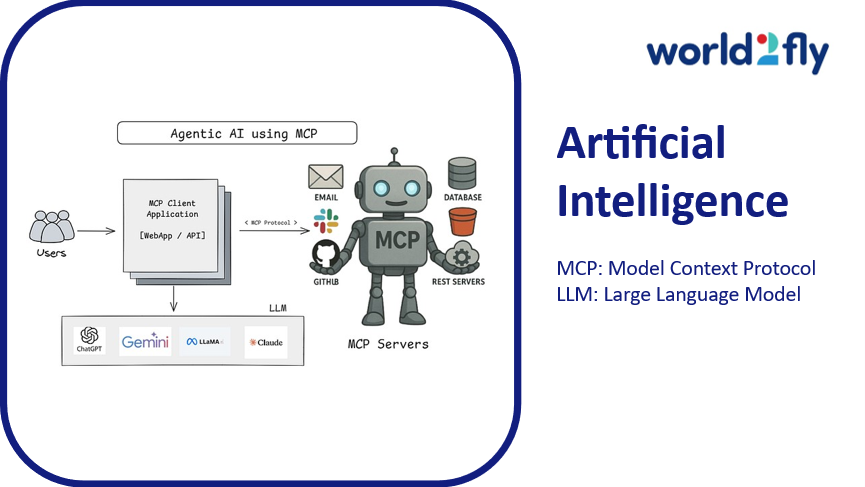
Figure 12
By contrast, structured operational information captured through workflow-controlled systems creates an environment where future AI tools can provide meaningful operational assistance.
Whether supporting predictive maintenance, identifying operational trends or assisting engineers with troubleshooting, AI relies upon consistent, reliable datasets. World2Fly’s investment in digital data quality therefore positions the airline well for future technological developments.
Digital transformation as a Continuous journey
One of the key messages emerging from World2Fly’s experience is that digital transformation should not be viewed as a single implementation project. Replacing paper represents an important milestone, but it is only the first step. The real opportunity lies in continually expanding how operational data is shared, analyzed and applied throughout the organization. Each new integration creates additional opportunities to remove manual processes, improve collaboration and generate new operational insight. As more systems become connected, the value of every individual data point continues to grow
CONCLUSION
World2Fly demonstrates that successful digital transformation is fundamentally about processes rather than technology. The airline’s objective was never simply to replace paper with tablets. Instead, it sought to create an interconnected operational environment where information is captured once, trusted throughout the organization and transformed into meaningful business intelligence. eTechLog8 provides the foundation for that approach through structured data capture, workflow-controlled processes and seamless integration with the wider operational ecosystem. From fuel management and oil consumption monitoring to maintenance planning, financial forecasting and future AI applications, World2Fly continues to demonstrate how high-quality operational data can unlock value far beyond the electronic technical logbook itself. As airlines increasingly look to modernize their operations, the distinction between paperless and truly digital will become ever more important. World2Fly’s experience shows that when data is treated as a strategic asset rather than simply a record of activity, digital transformation becomes not just an IT project, but a catalyst for continuous operational improvement across the entire airline.
Comments (0)
There are currently no comments about this article.
To post a comment, please login or subscribe.