
Articles
| Name | Author | |
|---|---|---|
| CASE STUDY: ZIPAIR tackles turbulence with predictive real-time data | Kenichi Ura, Flight Operations team, ZIPAIR | View article |
| CASE STUDY: Time-saving digital Operational Flight Plans transform Hyperion Aviation | Noah Hummel, Flight Operations Officer and Electronic Flight Bag (EFB) Administrator, Hyperion Aviation | View article |
| CASE STUDY: Copa Airlines builds future with integrated EFB architecture | Catherine Caballero, EFB Specialist and Systems Administrator, Copa Airlines & Captain Ramon Andres Patino Duran, Flight Standards Manager, Copa Airlines | View article |
| CASE STUDY: Atlantic Airways finds a gamechanger for documents | Randi Reinert, Compliance Monitoring Manager, Atlantic Airways | View article |
| CASE STUDY: A strong partnership for Helvetic | Christian Suhner, Chief Technology Officer, Helvetic Airways & Michael Anklin, CEO, WinOps | View article |
| WHITE PAPER: Beyond the tablet | Klaus Olsen, CEO of EFB Admin Services | View article |
| CASE STUDY: Saving fuel at Azul with custom flight analytics | Juliana Paes Dos Santos, Fuel Efficiency Coordinator, Azul Brazilian Airlines | View article |
| CASE STUDY: Air Atlanta crews get in the picture | Various, Air Atlanta | View article |
WHITE PAPER: Beyond the tablet
Author: Klaus Olsen, CEO of EFB Admin Services
SubscribeKlaus Olsen, CEO of EFB Admin Services Int. AS considers the future of Electronic Flight Bags in the Age of AI
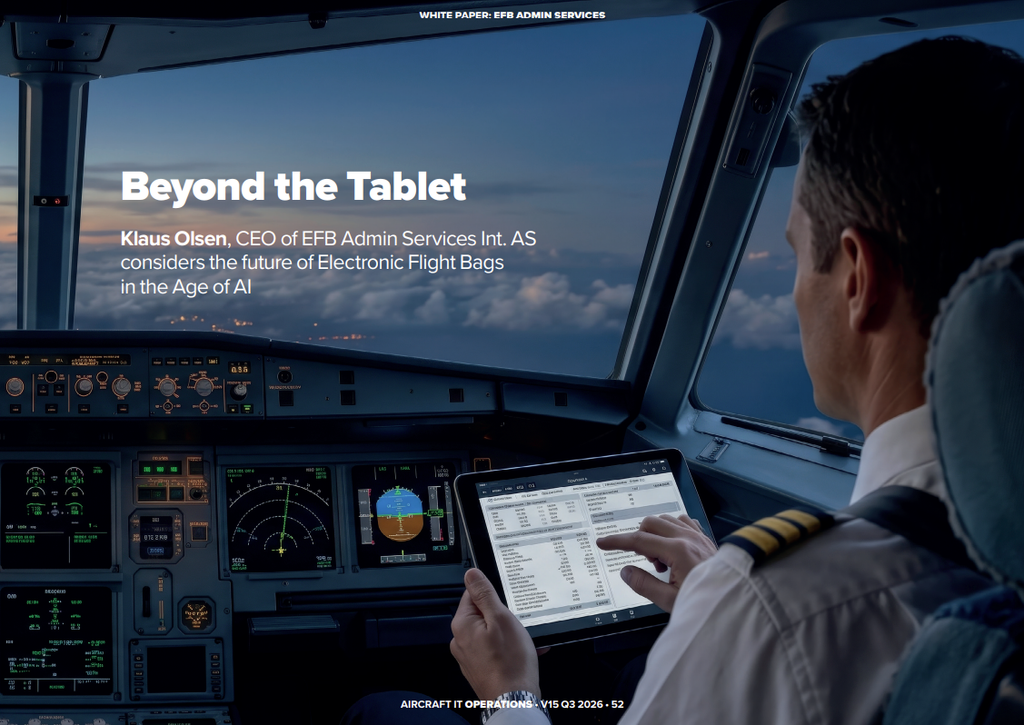
In 2026, many airline pilots are still using an EFB that looks remarkably similar to the one they carried eight years ago. Certainly, today’s devices are faster, lighter, and more capable than their predecessors. Battery life has improved, displays are brighter, and processing power has increased dramatically. Yet despite these advances, the fundamental concept remains largely unchanged. The modern Electronic Flight Bag is still, at its core, a tablet delivering operational information to the flight crew.
For an industry that has spent more than a decade transforming flight operations through digitalization, this raises an interesting question: have we reached the end of the EFB hardware revolution? If the answer is yes, then the future of Electronic Flight Bags may not be found in the next generation of tablets, mounting solutions, or cockpit displays. Instead, the next major leap forward could come from something far less visible, intelligence.
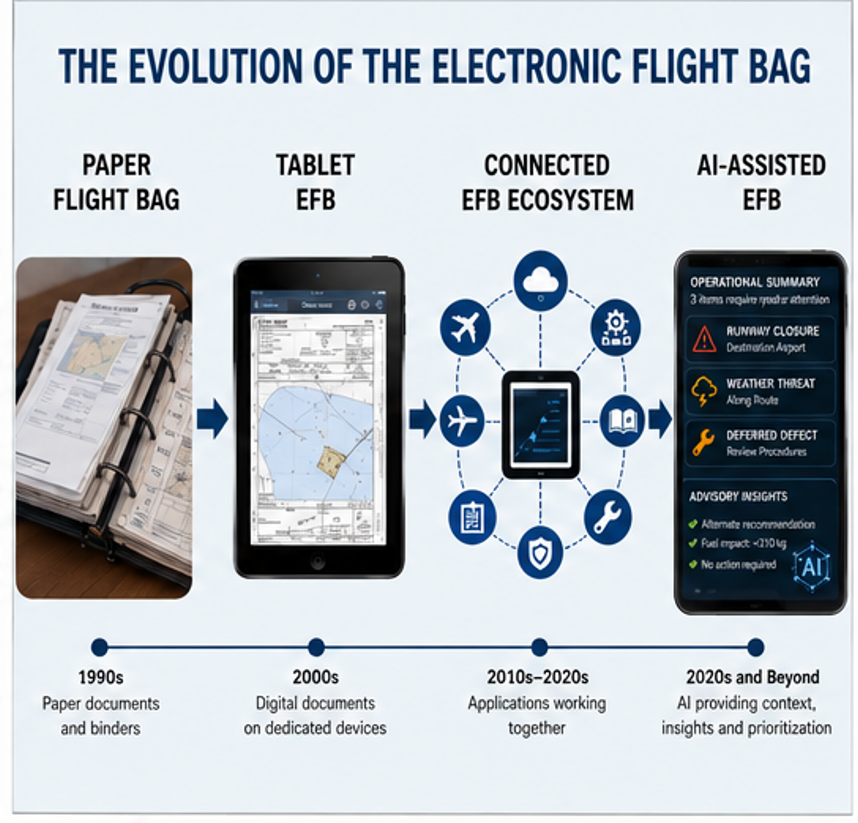
This would not be the first time aviation predicted a technological future that never quite arrived. Over the years, the industry explored a variety of concepts that promised to redefine how pilots interact with operational information. Smart glasses, wearable displays, augmented reality overlays, and even the projection of flight information directly onto cockpit surfaces all generated considerable excitement. Some of these technologies remain technically viable today. Yet despite the promise, few achieved widespread adoption. The reason was surprisingly simple; the challenge facing pilots was never where information was displayed. The challenge was understanding which information mattered most.
Modern flight crews have access to more operational data than at any point in aviation history. Weather information, NOTAMs, airport charts, manuals, operational bulletins, aircraft status messages, performance calculations, and company communications are now available at the touch of a screen. The problem is no longer access to information. The problem is filtering, prioritizing, and interpreting it in an increasingly complex operational environment. This is where artificial intelligence may fundamentally change the role of the EFB.
The next generation of Electronic Flight Bags may evolve beyond digital document repositories and become intelligent operational assistants, capable of identifying relevant information, highlighting operational threats, recognizing patterns, and helping crews focus on what matters most. Not by replacing pilots, but by reducing complexity. At the same time, this evolution may reshape the role of the EFB Administrator . As routine administrative functions become increasingly automated, future EFB administrators may spend less time managing devices and more time governing data, validating intelligent systems, managing cybersecurity risks, and ensuring operational trust. The future of the EFB may therefore have little to do with the tablet itself. The future may be defined by what the tablet understands.
THE HARDWARE REVOLUTION IS OVER
For much of the past two decades, Electronic Flight Bag development has been driven by hardware. Airlines evaluated different device platforms, debated mounting solutions, assessed battery endurance, and navigated the transition from paper-based operations to electronic workflows. The arrival of the tablet fundamentally changed how pilots accessed operational information, and the industry invested significant time and resources determining which devices were best suited for the cockpit environment. Today, those debates have largely subsided.
While a number of operators continue to utilize Windows-based platforms such as Microsoft Surface devices or Panasonic Toughpad, particularly within specific fleets, cargo operations, and business aviation environments, the commercial airline industry has largely standardized on Apple’s iPad ecosystem. The reasons are well understood maturity, reliability, battery performance, application availability, and a robust enterprise management environment. This widespread adoption has created something unusual in aviation technology. The industry has effectively converged on a common hardware platform. That does not mean innovation has stopped. Modern tablets continue to offer faster processors, improved displays, enhanced connectivity, and longer operational life. Yet these developments are evolutionary rather than revolutionary. The difference between a current-generation tablet and one released three or four years ago is often measured in performance gains rather than transformational capability. This maturity is reflected in how airlines approach EFB projects today.
A decade ago, discussions frequently centered around hardware selection. Today, airlines rarely ask whether they should deploy tablets. Instead, the focus has shifted toward application ecosystems, connectivity strategies, compliance requirements, cybersecurity, operational integration, and user experience. In many ways, the tablet itself has become almost invisible. Few pilots board an aircraft thinking about the processor speed of their EFB. What matters is whether the information they need is available, accurate, current, and accessible when required. This represents an important shift.
The first generation of EFB innovation focused on replacing paper. The second generation focused on expanding digital capabilities. The third generation may focus on reducing complexity. This distinction is critical because the modern cockpit does not suffer from a lack of information. If anything, flight crews are increasingly challenged by the sheer volume of operational data available to them before and during a flight. Industry observers generally estimate that the overwhelming majority of commercial airline EFB deployments today are based on Apple’s iPad ecosystem. As hardware improvements become increasingly incremental, the next competitive advantage will not come from the device itself; it will come from what the device is capable of understanding.
THE FUTURES THAT NEVER ARRIVED
The aviation industry has never lacked ambitious ideas. Throughout the evolution of Electronic Flight Bags, numerous technologies have been proposed that promised to fundamentally change how pilots interact with operational information. Some generated significant excitement. Others attracted substantial investment. Many appeared, at least initially, to be logical next steps in the digital transformation of the cockpit. Yet surprisingly few became mainstream. More than a decade ago, concepts such as wearable displays, smart glasses, augmented reality overlays, and projected cockpit information were being actively discussed throughout the industry. Some vendors envisioned pilots accessing charts through head-mounted displays. Others explored the possibility of projecting EFB information directly onto cockpit surfaces or integrating operational information into augmented reality environments. At the time, these ideas seemed entirely plausible. I remember discussions surrounding the potential use of early smart-glasses technology, including Google Glass, within EFB environments. The concept was appealing. Flight crews could potentially view charts, procedures, operational messages, or navigation information without looking at a separate device. Similar discussions explored whether operational information could eventually be projected directly onto cockpit windows or integrated into advanced display systems.
Technically, many of these concepts were achievable. Operationally, however, they never gained meaningful traction. This was not necessarily because the technology failed. Rather, the anticipated operational benefits often proved insufficient to justify the additional complexity, certification challenges, human factors considerations, training requirements, and costs associated with deployment. The aviation industry ultimately demonstrated a characteristic that has served it well for decades: technology is adopted not because it is innovative, but because it solves a genuine operational problem. And this is where an important lesson emerged. The challenge facing pilots was never where information was displayed. The challenge was understanding which information mattered most.
Moving a chart from paper to a tablet delivered enormous value. Moving that same chart from a tablet to a pair of smart glasses delivered considerably less value. Similarly, projecting information onto a cockpit surface may alter how information is presented, but it does little to address a more fundamental issue, the growing volume of information flight crews must process before and during every flight. This realization may explain why many of the most significant developments in recent years have focused less on new display technologies and more on improving information management, connectivity, integration, and operational awareness.
In hindsight, many of the industry’s predictions were focused on bringing information closer to the pilot’s eyes. The next generation of EFB innovation may instead focus on helping pilots understand what deserves their attention.
Lessons from technologies that never scaled
Not every promising technology has become part of everyday flight operations. Examples include:
- Smart glasses and Google Glass concepts;
- Augmented reality EFB displays;
- Projected cockpit information systems;
- Wearable operational devices;
- Early mixed-reality flight deck concepts.
Why?
Because aviation adopts technology to solve operational problems, not simply because technology exists. Many of these concepts successfully changed how information was displayed. Few significantly improved how information was understood.
THE REAL CHALLENGE: INFORMATION OVERLOAD
Ironically, one of the greatest successes of the EFB may have created one of its greatest challenges. The digitalization of flight operations has given flight crews access to more information than at any point in aviation history. Weather products, NOTAMs, operational bulletins, airport charts, aircraft manuals, performance calculations, flight plans, company communications, maintenance information, and real-time operational updates are now available within seconds from a single device.
This transformation has undoubtedly improved operational efficiency, accessibility, and situational awareness. Yet it has also created a new challenge that few anticipated during the early years of EFB adoption. The problem is no longer access to information. The problem is determining what matters.
A modern airline crew may review hundreds of pages of information before a single flight. NOTAM packages alone can contain large volumes of data, much of which may have little relevance to the specific operation being conducted. Operational bulletins continue to increase. Weather information is available from multiple sources. Airport documentation continues to expand. Maintenance information, dispatch messages, and company communications all compete for the crew’s attention throughout the day. The result is an environment where critical information can sometimes become difficult to identify simply because it is surrounded by so much additional data.
This challenge is not unique to aviation. Similar issues are being experienced across many industries as organizations continue to digitize their operations. However, aviation presents a unique complication. Not all information carries equal importance. A runway closure affecting the destination airport clearly deserves immediate attention. A minor notice affecting an unrelated airport does not. A significant weather development along the planned route may be operationally critical. Other weather information may have little impact on the flight. The difficulty lies in distinguishing between the two.
Historically, this filtering process has been performed almost entirely by humans. Pilots, dispatchers, and operational personnel have relied on experience, training, and judgement to identify the information that is operationally relevant while filtering out information that is not. As information volumes continue to grow, this approach becomes increasingly challenging. The future EFB may therefore be defined not by its ability to present information, but by its ability to prioritize it.
Imagine a future briefing package that not only presents a list of NOTAMs, but highlights those that directly affect the planned route, destination airport, alternate airports, aircraft type, or specific operational procedures. Consider weather information that automatically identifies potential operational threats rather than simply displaying raw data. Imagine operational bulletins that are prioritized according to relevance, fleet applicability, and operational impact. None of these capabilities remove decision-making authority from the flight crew; instead, they reduce the effort required to identify what deserves attention. This distinction is important because it highlights a fundamental shift in how EFB systems may evolve over the coming decade. While the first generation of EFBs focused on digitizing information, the next generation may focus on contextualizing information. And this is precisely where artificial intelligence begins to move from industry buzzword to practical operational tool.
FROM DIGITAL DOCUMENTS TO DIGITAL ADVISORS
For most of their existence, Electronic Flight Bags have served a relatively straightforward purpose. They provide flight crews with access to information. Whether displaying charts, manuals, weather data, flight plans, operational bulletins, or performance calculations, the EFB’s primary role has been to present information in a digital format and make it accessible when needed. The interpretation of that information remains largely the responsibility of the user. Pilots review weather products and determine operational significance. They assess NOTAMs, identify potential hazards, review aircraft limitations, and evaluate operational risks based on training, experience, and judgement. This model has served the industry well. However, as operational environments become increasingly data-rich, a new opportunity is emerging.
Rather than simply presenting information, future EFBs may begin helping users understand the relationships between information. This distinction may appear subtle, but it represents a significant evolution. Consider a typical pre-flight briefing.
Today’s EFB systems may provide access to weather reports, NOTAMs, airport charts, operational bulletins, performance calculations, and maintenance information. Each element is available, but the responsibility for correlating the information remains with the flight crew. Future systems may be capable of identifying connections automatically. A runway-related NOTAM could be linked directly to airport charts and performance considerations. Weather conditions along the planned route could be analyzed against operational limitations and alternate planning requirements. Aircraft maintenance items could be cross-referenced with route characteristics, destination infrastructure, and operational procedures. The information itself does not change; the context surrounding that information does.
This is where artificial intelligence may deliver its greatest value. Not by making decisions. Not by replacing pilots. But by helping identify what deserves attention. An AI-assisted EFB might highlight operationally relevant NOTAMs while suppressing those with little impact on the flight. It could identify emerging weather threats based on route, aircraft type, and operational conditions. It could recognize patterns across multiple information sources that might otherwise require significant manual review. Importantly, the pilot remains the decision-maker.
The role of the AI is not to determine what action should be taken. Its role is to assist in identifying information that may require further assessment. In many respects, the future EFB may begin to resemble an operational advisor rather than a digital library. The distinction is important; a digital library stores information; an advisor helps users understand information. This evolution may ultimately become one of the most significant developments in the history of Electronic Flight Bags. The industry’s first challenge was replacing paper. The next challenge may be helping crews navigate an increasingly complex operational environment without becoming overwhelmed by information. If successful, the future EFB will not necessarily provide more information than today’s systems. It may simply help users focus on the information that matters most.
THE RISE OF THE CONNECTED EFB ECOSYSTEM
While artificial intelligence may become an important part of the future EFB, its effectiveness will depend heavily on something far less visible: the ability of systems to communicate with one another. For many years, Electronic Flight Bag applications have largely operated as independent islands of information. A chart application provides charts. A flight planning application provides flight plans. A weather application provides weather information. A performance application calculates take-off and landing performance. An electronic document system provides manuals and operational procedures. Each application performs its task well, but the responsibility for combining the information remains largely with the user. In effect, the pilot often becomes the integration layer. As EFB ecosystems continue to mature, this model is beginning to evolve.
Across the industry there is growing recognition that future operational efficiency will depend not only on the quality of individual applications, but on how effectively those applications can share information and work together. This shift was evident during discussions at recent EFB industry forums, where increasing attention has been given to interoperability and standardized information sharing between EFB applications. One of the developments supporting this transition is ARINC 840A.
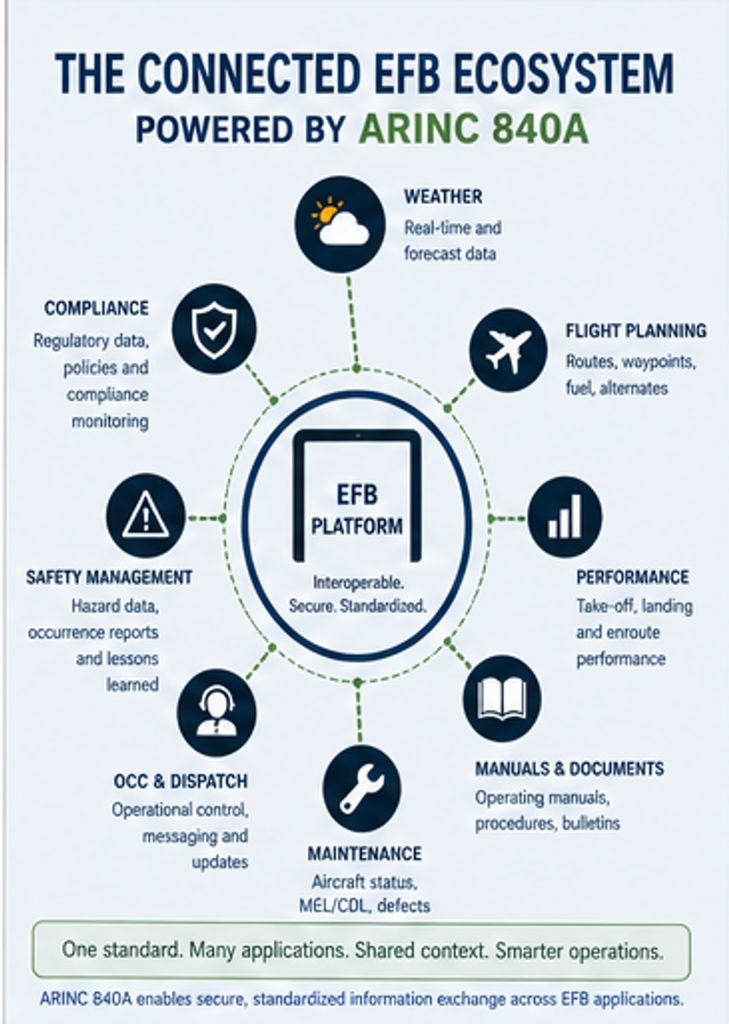
While the standard itself is highly technical, its objective is straightforward: to create a common framework that allows EFB applications to exchange information securely and consistently. In practical terms, this means that applications no longer need to operate in complete isolation. Information generated by one application can potentially be shared with another, creating opportunities for a more connected and context-aware operational environment. The significance of this development should not be underestimated.
Consider a future scenario where flight planning data, weather information, airport charts, operational bulletins, aircraft status information, and performance calculations can all share relevant contextual information through standardized interfaces. Suddenly, information that previously existed in separate systems can be viewed as part of a larger operational picture. This creates opportunities not only for improved workflow efficiency, but also for more intelligent operational support. Artificial intelligence, for example, becomes significantly more powerful when it can evaluate relationships across multiple information sources rather than analyzing each application independently. A weather application may understand weather. A flight planning application may understand the route. A performance application may understand aircraft limitations. A connected ecosystem creates the possibility of understanding how all three interact.
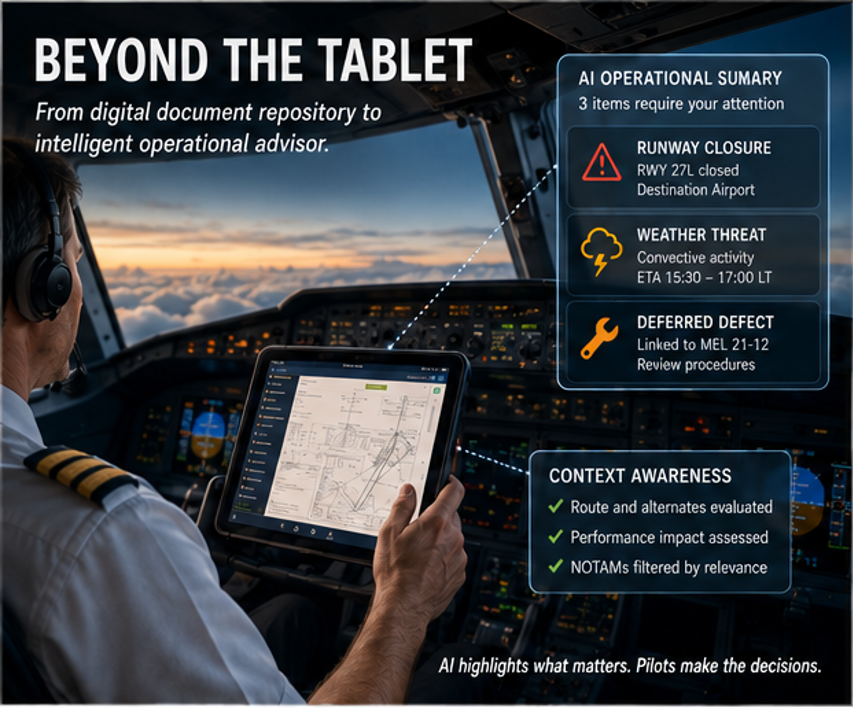
This is where future EFB platforms may begin moving beyond information delivery and toward operational awareness. Some vendors may initially view interoperability as a commercial challenge, fearing that open standards could reduce customer dependency on individual platforms. In reality, the opposite may prove true. As airlines increasingly adopt multi-vendor environments, interoperability may become a competitive advantage rather than a competitive threat. Vendors that embrace open standards can position themselves as trusted participants within a larger ecosystem, allowing their products to deliver greater value through collaboration rather than isolation.
The future EFB may therefore be defined less by individual applications and more by how effectively multiple systems work together. The industry’s next major challenge might not be creating more data; it might be creating meaningful connections between the data that already exist.
ARINC 840A – Why It Matters
For many years, EFB applications have operated as largely independent systems. Flight planning applications, weather platforms, performance tools, chart providers, and document management systems each performed their own functions, but shared relatively little information. ARINC 840A represents an important step toward greater interoperability within the EFB ecosystem. In simple terms, the standard provides a framework that allows EFB applications to exchange information in a secure and standardized manner. Rather than requiring pilots to manually correlate data across multiple applications, future systems can increasingly share context automatically.
The significance of ARINC 840A extends beyond convenience. Interoperability enables more operational awareness, improved workflow efficiency, and creates the foundation upon which future AI-assisted capabilities can operate effectively. The future value of an EFB may therefore depend not only on the quality of individual applications, but on how effectively those applications collaborate within a connected ecosystem.
AI AND REGULATORY REALITY
No discussion about the future of Electronic Flight Bags would be complete without addressing the topic currently dominating conversations across almost every industry: artificial intelligence.
The potential benefits are significant. AI systems are becoming increasingly capable of analyzing large volumes of information, identifying patterns, recognizing anomalies, and assisting users in navigating complex data environments. For an industry facing growing information overload, these capabilities appear highly attractive. Yet aviation has always approached new technology differently than most industries.
Unlike consumer markets, where innovation can often be adopted rapidly and refined over time, aviation operates within a framework of safety, accountability, validation, and regulatory oversight. New technologies are not simply evaluated based on functionality. They must also demonstrate reliability, predictability, and operational suitability. Artificial intelligence will be no exception. In many industries, AI systems are increasingly trusted to generate recommendations, produce content, and even make certain decisions autonomously. Aviation is unlikely to adopt such approaches without significant safeguards. The reason is straightforward. Flight crews, operators, and regulators must be able to understand and trust the information presented to them.
This introduces several challenges that extend beyond technology itself. If an AI-assisted EFB highlights a potential operational concern, users will naturally ask important questions: Why was this information highlighted? What data was used? How was the conclusion reached? Can the recommendation be verified? What happens if the system is wrong?
These questions are not merely technical. They are fundamental to operational acceptance. The future success of AI within aviation may therefore depend less on the intelligence of the algorithms and more on the transparency of their outputs. An AI system that produces highly accurate recommendations but cannot explain its reasoning may struggle to gain acceptance within regulated operational environments. Conversely, systems that provide traceable, explainable, and verifiable outputs are far more likely to gain trust from operators and authorities alike. This may ultimately lead to a different form of aviation AI than many people currently imagine. Rather than relying on large, generalized AI systems capable of answering virtually any question, future operational EFB environments may utilize highly specialized and tightly controlled AI models designed to perform specific tasks within clearly defined boundaries. Examples might include:
- Prioritizing operationally relevant NOTAMs.
- Identifying route-specific weather concerns.
- Highlighting airport-related operational risks.
- Detecting inconsistencies within operational data.
- Assisting with compliance monitoring and reporting.
In these scenarios, artificial intelligence functions as an analytical assistant rather than an autonomous decision-maker. The pilot remains responsible for operational decisions. The dispatcher remains responsible for operational control. The operator remains accountable for compliance. The AI simply helps identify information that may warrant further attention. This distinction is likely to be critical as regulators begin evaluating how artificial intelligence can be safely integrated into operational flight environments. Much as previous generations of EFB technology required operational evaluations, risk assessments, testing programs, and regulatory approvals, future AI-enabled capabilities will almost certainly face similar scrutiny.
For operators operating under EASA frameworks, this evolution will likely raise new considerations under guidance material such as AMC 20-25 and associated operational approval processes. While existing guidance was not written with modern artificial intelligence in mind, many of the underlying principles remain directly relevant. Human factors, software assurance, operational suitability, failure condition assessment, crew workload, data integrity, and procedural mitigation strategies will remain central considerations whenever AI-assisted capabilities influence operational decision-making. In many respects, future AI-enabled EFB systems may not require entirely new regulatory philosophies. Instead, they may require the application of long-established aviation principles to a new generation of technology. The aviation industry has spent decades building systems designed around trust, accountability, and human oversight. There is little reason to believe those principles will change. If anything, the introduction of artificial intelligence may make them more important than ever.
As EFB ecosystems become increasingly interconnected and reliant upon intelligent data processing, cybersecurity considerations will become even more critical. Future EFB Administrators may find themselves responsible not only for device and application governance, but also for validating data integrity, monitoring AI-driven workflows, and ensuring operational resilience against increasingly sophisticated cyber threats.
THE FUTURE OF THE EFB ADMINISTRATOR: THE GUARDIAN OF TRUST
Whenever a new wave of automation enters an industry, a familiar question inevitably follows. Will technology replace the people responsible for managing it? As artificial intelligence becomes increasingly integrated into operational systems, many EFB Administrators may be asking themselves a similar question. If future EFB platforms can monitor compliance, track software versions, identify synchronization failures, generate reports, detect anomalies, prioritize information, and even recommend actions, what role remains for the human administrator? The answer may be more significant than many expect.
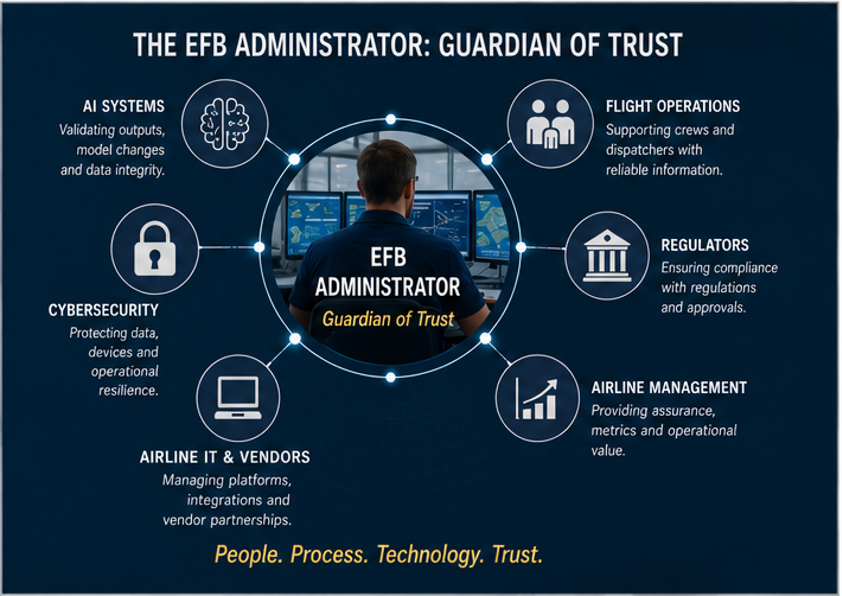
To understand why, it is important to recognize that the EFB Administrator’s role extends far beyond managing devices. Historically, EFB Administrators have been responsible for a broad range of operational, technical, and regulatory functions. They oversee application deployments, document distribution, mobile device management, software updates, compliance monitoring, operational procedures, vendor coordination, regulatory interactions, and user support. Many of these activities involve repetitive administrative processes. These are precisely the types of tasks that artificial intelligence and automation are likely to perform exceptionally well. Future systems may automatically identify failed deployments, detect outdated applications, monitor compliance status, track acknowledgement requirements, identify synchronization issues, generate audit reports, and proactively alert administrators to emerging concerns. In many cases, this could significantly reduce the administrative workload associated with managing large EFB environments. At first glance, this may appear to reduce the importance of the EFB Administrator. The reality may be exactly the opposite.
As operational systems become increasingly intelligent, the challenge shifts from performing tasks to ensuring that those tasks are performed correctly. Someone must validate the data; someone must verify the outputs; someone must assess the operational impact; and someone must determine whether the recommendations generated by intelligent systems can be trusted. This responsibility cannot easily be delegated to software. In fact, artificial intelligence may introduce entirely new responsibilities that did not previously exist. Questions such as the following may become part of everyday EFB governance:
- What data sources are being used?
- How are AI-generated recommendations validated?
- Can outputs be explained and audited?
- How are model changes controlled?
- How are cybersecurity risks managed?
- What safeguards exist against incorrect recommendations?
- Who is accountable when an AI-assisted process influences an operational outcome?
These are not purely technical questions: they are governance questions, and governance requires accountability. The aviation industry has always operated on the principle that responsibility ultimately rests with identifiable individuals and organizations. Regulations, approvals, Safety Management Systems, operational evaluations, and compliance frameworks are all built upon this foundation. Artificial intelligence does not remove this requirement. If anything, it strengthens it. The future EFB Administrator may therefore spend less time managing devices and more time managing trust.
Rather than acting primarily as a system operator, the role may evolve toward that of a system governor, responsible for validating data quality, overseeing operational integrity, assessing cybersecurity risks, managing intelligent workflows, and ensuring continued regulatory compliance. In many respects, the EFB Administrator of the future may become the bridge between technology, operations, and regulatory oversight. The title might remain unchanged: the responsibilities might not. As EFB platforms evolve from information repositories into intelligent operational systems, the role of the EFB Administrator may become more strategically important than ever before.
The future is unlikely to be human versus AI: it is far more likely to be human plus AI, with accountability remaining firmly in human hands. In that environment, the EFB Administrator may become something aviation has always valued above all else:
A guardian of trust.
THE EFB OF 2035
The captain arrives at the operations center and opens the EFB. Rather than being presented with hundreds of pages of information, the briefing begins with a summary:
“Three items require immediate attention.”
- The first concerns a runway closure affecting the planned arrival airport.
- The second highlights developing convective weather expected to affect the destination during the estimated arrival window.
- The third identifies a deferred aircraft defect and links it directly to operational procedures, MEL guidance, and company policy.
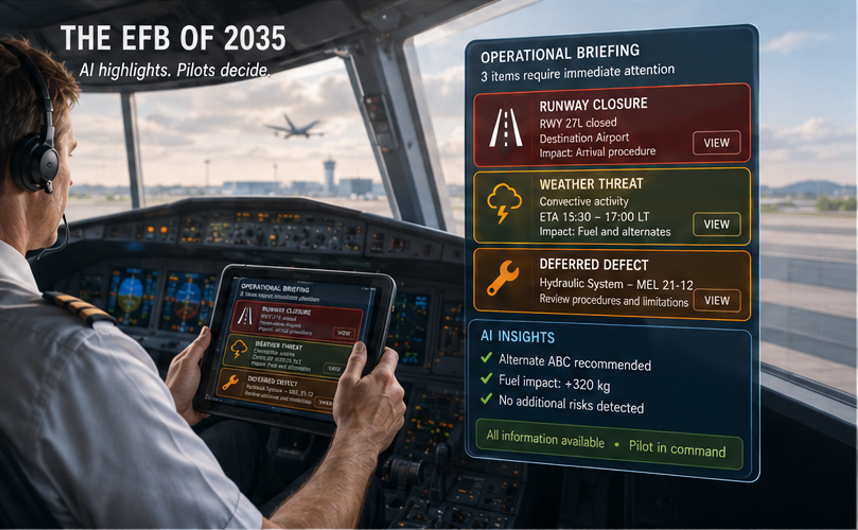
The crew can still access every weather product, every NOTAM, every chart, and every operational bulletin. Nothing has been removed; nothing has been filtered from view. The difference is that the EFB has already performed the initial correlation and prioritization, allowing the crew to focus their attention where it is likely to matter most. Behind the scenes, multiple applications exchange information through standardized interfaces. Flight planning systems, weather providers, performance applications, operational documentation platforms, maintenance systems, and airline operational control environments work together as part of a connected ecosystem rather than isolated applications. Artificial intelligence continuously analyzes relationships between data sources, identifying patterns, highlighting potential concerns, and assisting users in navigating an increasingly complex operational environment. Yet the most important aspect of this future may not be the technology itself. The pilot remains the decision-maker. The operator remains accountable. The regulator continues to provide oversight. And the EFB Administrator continues to ensure that the system remains trustworthy, secure, compliant, and operationally effective.
In many respects, the future EFB may not represent a revolution at all. It may simply represent the next logical step in a journey that began when airlines first replaced paper with electronic information. The first generation of EFBs digitized flight operations. The next generation may help us understand them.
CONCLUSION
For more than a decade, discussions surrounding Electronic Flight Bags have focused on hardware, applications, connectivity, and the transition from paper to digital operations. Today, much of that transformation has already taken place. The tablet has become commonplace. Digital workflows have become routine. Information is more accessible than ever before. The challenge facing the industry is no longer how to provide information. The challenge is how to manage it.
As operational environments become increasingly complex, the future value of the EFB may be measured not by the quantity of information it can display, but by its ability to provide context, prioritize relevance, and support situational awareness. Artificial intelligence will undoubtedly play a role in this evolution. However, its greatest contribution may not be automation or autonomous decision-making. Its greatest contribution may be helping humans navigate complexity more effectively. Likewise, the future of EFB Administration is unlikely to be defined by the replacement of human expertise. Instead, the role may evolve toward governance, oversight, validation, cybersecurity, and trust, ensuring that increasingly intelligent systems remain transparent, reliable, and operationally appropriate.
The future of the EFB may therefore have little to do with the tablet itself. The future may be defined by what the tablet understands. And perhaps most importantly, by how much trust we place in that understanding.
Comments (0)
There are currently no comments about this article.
To post a comment, please login or subscribe.