
Articles
| Name | Author | |
|---|---|---|
| CASE STUDY: ZIPAIR tackles turbulence with predictive real-time data | Kenichi Ura, Flight Operations team, ZIPAIR | View article |
| CASE STUDY: Time-saving digital Operational Flight Plans transform Hyperion Aviation | Noah Hummel, Flight Operations Officer and Electronic Flight Bag (EFB) Administrator, Hyperion Aviation | View article |
| CASE STUDY: Copa Airlines builds future with integrated EFB architecture | Catherine Caballero, EFB Specialist and Systems Administrator, Copa Airlines & Captain Ramon Andres Patino Duran, Flight Standards Manager, Copa Airlines | View article |
| CASE STUDY: Atlantic Airways finds a gamechanger for documents | Randi Reinert, Compliance Monitoring Manager, Atlantic Airways | View article |
| CASE STUDY: A strong partnership for Helvetic | Christian Suhner, Chief Technology Officer, Helvetic Airways & Michael Anklin, CEO, WinOps | View article |
| WHITE PAPER: Beyond the tablet | Klaus Olsen, CEO of EFB Admin Services | View article |
| CASE STUDY: Saving fuel at Azul with custom flight analytics | Juliana Paes Dos Santos, Fuel Efficiency Coordinator, Azul Brazilian Airlines | View article |
| CASE STUDY: Air Atlanta crews get in the picture | Various, Air Atlanta | View article |
CASE STUDY: Atlantic Airways finds a gamechanger for documents
Author: Randi Reinert, Compliance Monitoring Manager, Atlantic Airways
SubscribeRandi Reinert, Compliance Monitoring Manager, Atlantic Airways, describes how a Web Manuals solution that supports its compliance system has transformed operations
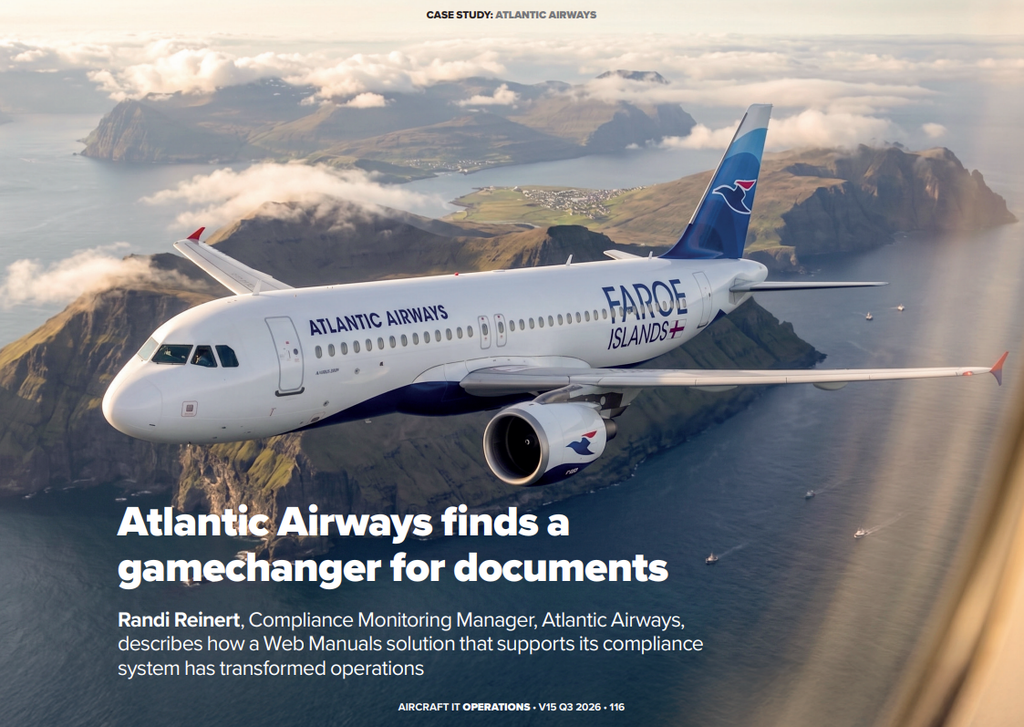
This case study examines how Atlantic Airways uses one solution to digitize flight operations, along with our company-wide manuals and other documents. By monitoring compliance as well, the new system has been a real gamechanger.
FAROE FOCUS
I’ll begin by briefly explaining why we were so keen to adopt all-encompassing technology. Simply put, it is a lack of people – the Faroe Islands, where we operate from, is a country with a population of only around 55,000, so we benefit from digital support in our operations (figure 1).
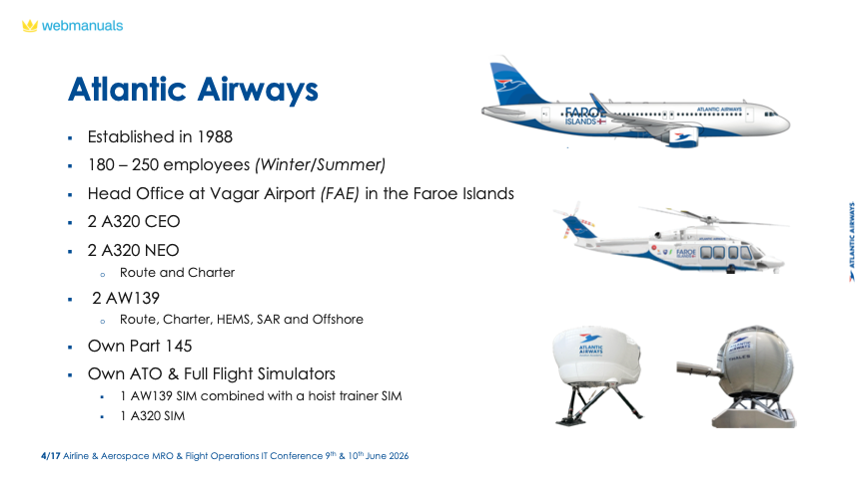
Figure 1
Atlantic flies to 12 destinations and also offers charter flights. Our fleet of six aircraft includes four fixed-wing Airbus 320s and two AgustaWestland helicopters. We were established in 1988 and employ around 200 people.
We also have our own CAMO (Continuing Airworthiness Management Organization), Aircraft Part 145 MRO (Maintenance, Repair and Overhaul) operation, and ATO (Aircraft Training Organization), which increases complexity in terms of meeting regulatory requirements and knowing what’s happening across the business daily.
DIGITIZING WITH WEB MANUALS
We were looking for a management system that could help with both compliance and documentation (see figure 2) and chose Web Manuals.
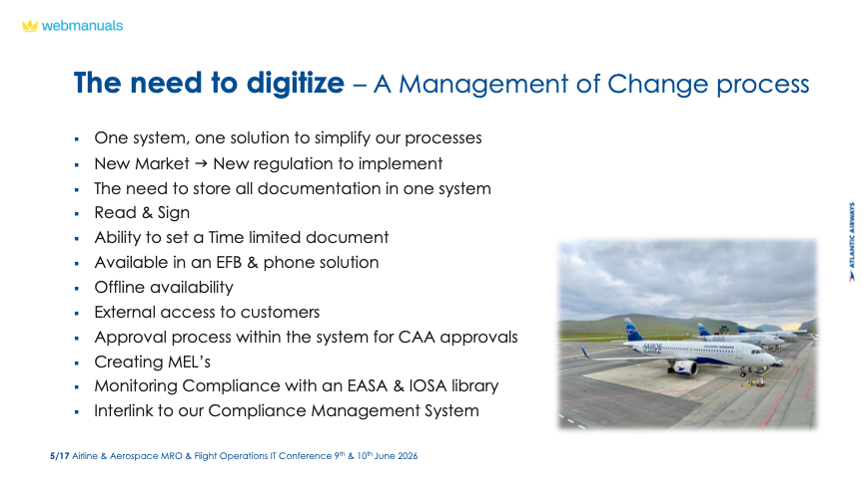
Figure 2
The system had to be user-friendly and simple to use, where we could store all of our documentation. It also needed to keep up with regulatory changes, feature written signatures and indicate who has read the documents. A time-limit feature helps us ensure anything out of date isn’t visible, such as airworthiness review certificates and insurance papers. The offline capability and external access were also important.
Web Manuals can create MELs (Minimum Equipment Lists) and handle the approval process with the CAA (Civil Aviation Authority). We also monitor compliance with EASA (European Aviation Safety Agency) and IOSA (IATA Operational Safety Audit) libraries.
A SINGLE SOLUTION
We began our transition with a pre-implementation phase, where one of our biggest tasks was defining the scope of the project and deciding who should be looking at what when the system was live (figure 3). Getting everybody on board with the new system was relatively easy as Atlantic is a small company, where we all know each other.
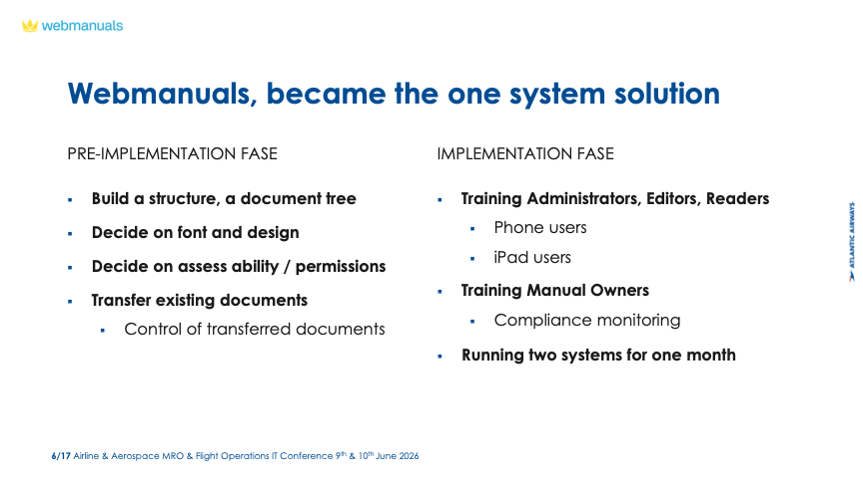
Figure 3
Our objective during the pre-implementation phase was to identify and agree on how best to make it easier for users to access the information they need. This was followed by the implementation phase, which included extensive training, including using Web Manuals on mobile phones and iPads. We also trained manual owners in handling notifications whenever legislation changes.
For about one month, we ran the old and new systems simultaneously, after which we found that users were comfortable using it and the Web Manuals single solution has been running smoothly ever since.
Comprehensive document transfer
We have now transferred over 6,000 pages to Web Manuals, with some 1,300 documents residing in the system (figure 4).
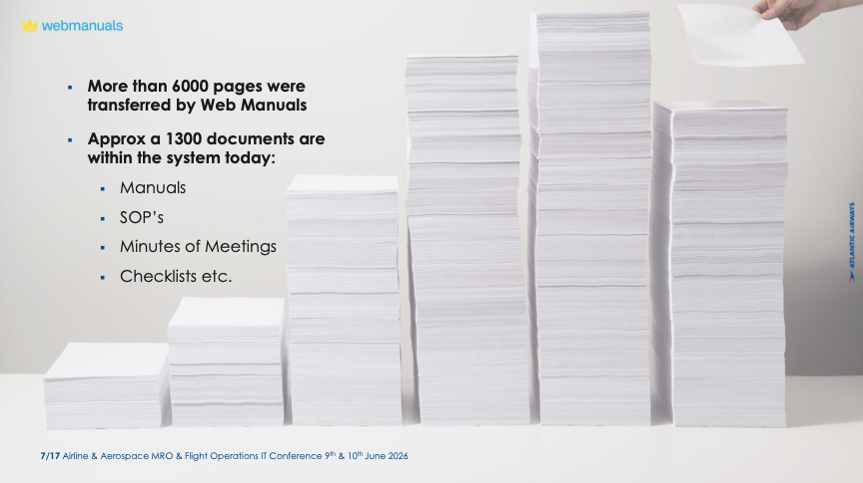
Figure 4
In addition, we put our SOPs (Standard Operating Procedures), checklists, and even the minutes of meetings into Web Manuals. Access to all of these documents is available to everyone, whether they are working on a phone, iPad or computer.
COMPLIANCE CHALLENGE
Before we introduced Web Manuals, we relied on Excel spreadsheets to keep track of regulations and revisions (figure 5).
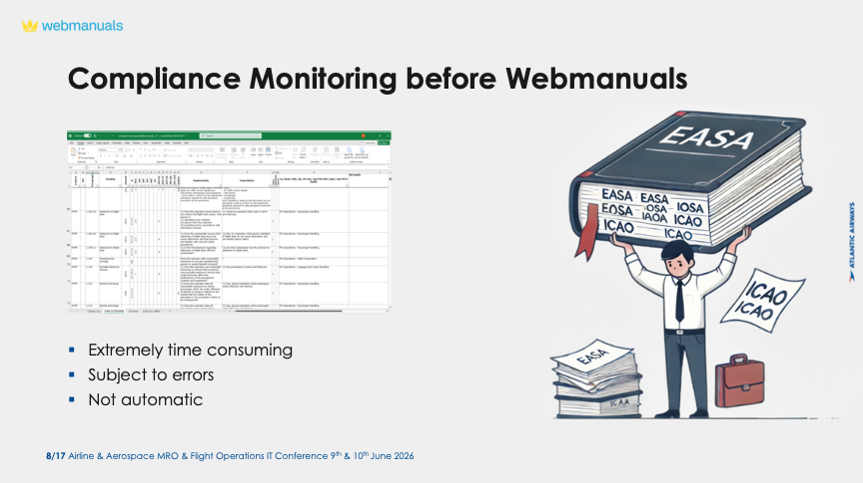
Figure 5
With information coming from IASA (International Air Safety Association), the EU, ICAO (International Civil Aviation Organization), IOSA and ISO (International Organization for Standardization), we found it very time-consuming to keep records up to date, and there was a greater risk of errors being made.
Web Manuals delivers multiple benefits, including automatic updates on changes to regulations. We find the system easy to use, readable, and it runs live, which is very important as our compliance team reviews regulations daily. Visual notifications of changes are helpful for all our departments.
TRANSFORMATION WITH WEB MANUALS
Compliance monitoring with Web Manuals has certainly transformed how we work (figure 6).
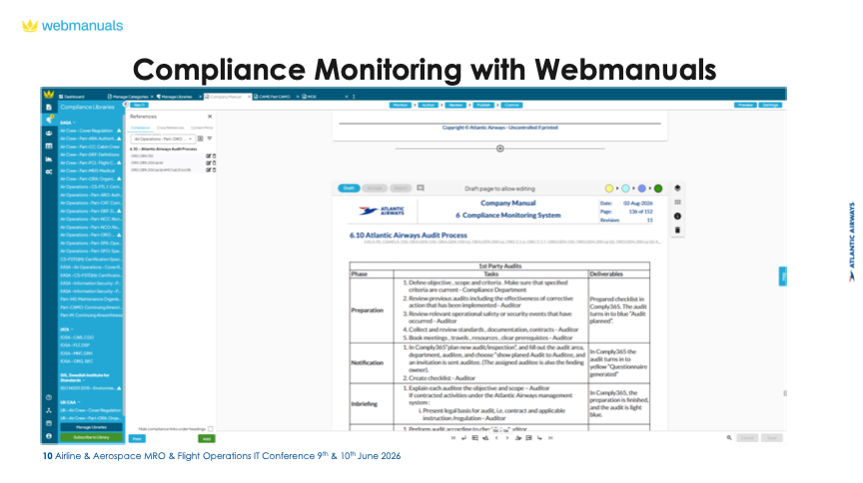
Figure 6
Each headline on the screen opens the relevant regulation, so it’s easy to check details and see what has changed.
Visual notifications
Web Manuals provides visual notifications of changes (figure 7), for example, highlighted in yellow and with a triangle icon showing where a document has been updated.
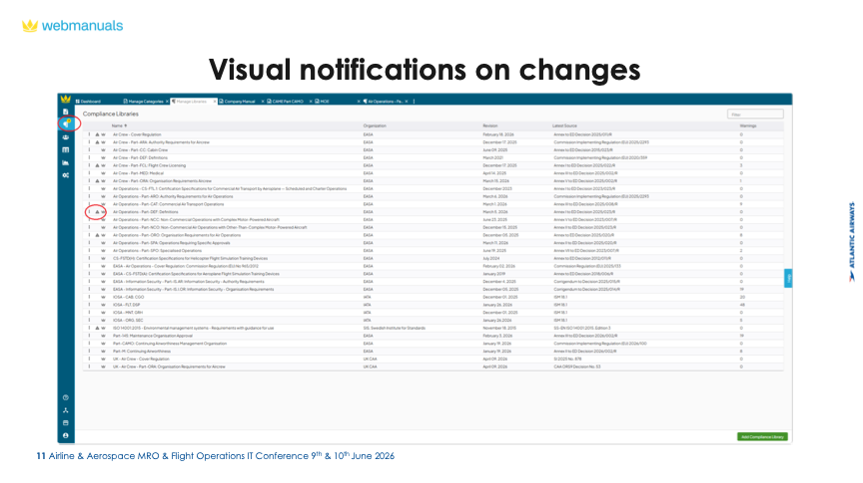
Figure 7
When you click on the triangle symbol, you see a full history of all the changes made to a particular regulations (figure 8).
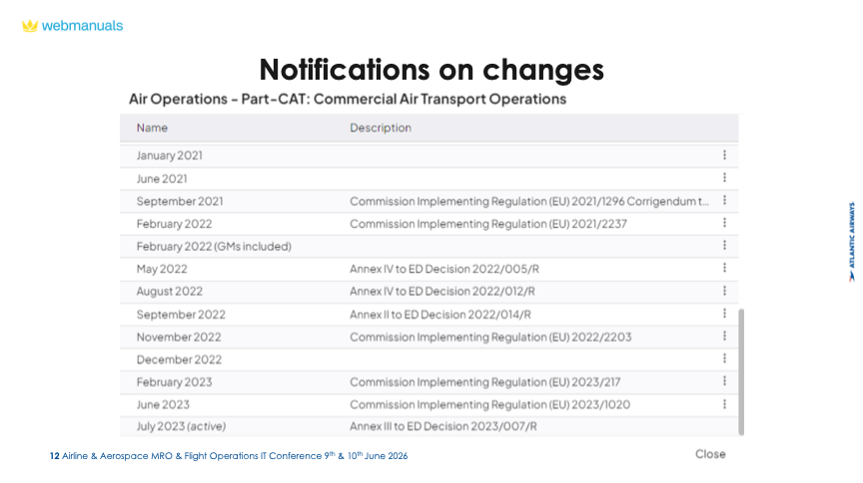
Figure 8
Each update provides a page where you can see links in the manuals to the specific regulation.
TRACKING AMENDMENTS
Amendments to regulations are displayed in a clearly laid-out page (figure 9), and, at the bottom of the screen, you have the option to click and dig deeper into the amendments.
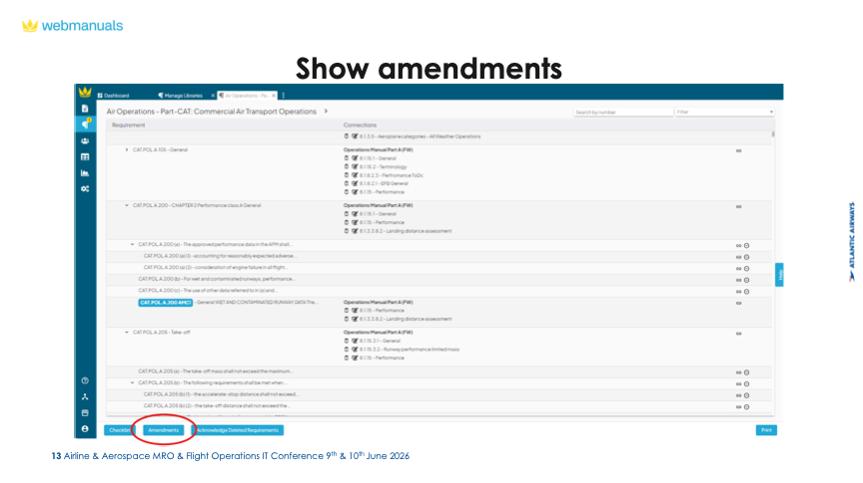
Figure 9
Using this link takes you to all the different amendments (figure 10), with additions highlighted in purple and deletions in amber. It means you don’t need to read through pages of information to find the changes; you can see straightaway with the clear visual presentation of information.
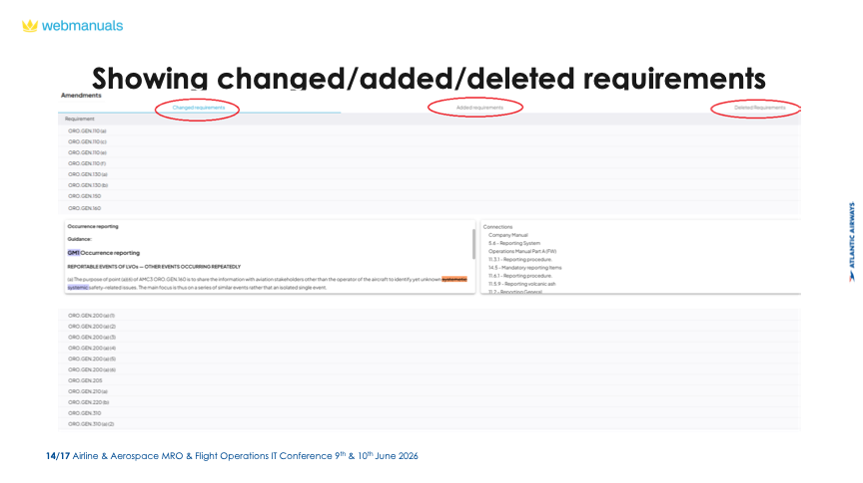
Figure 10
Our manual owners don’t often go into the system so, for them, we set up an alternative way of displaying the information they need (figure 11).
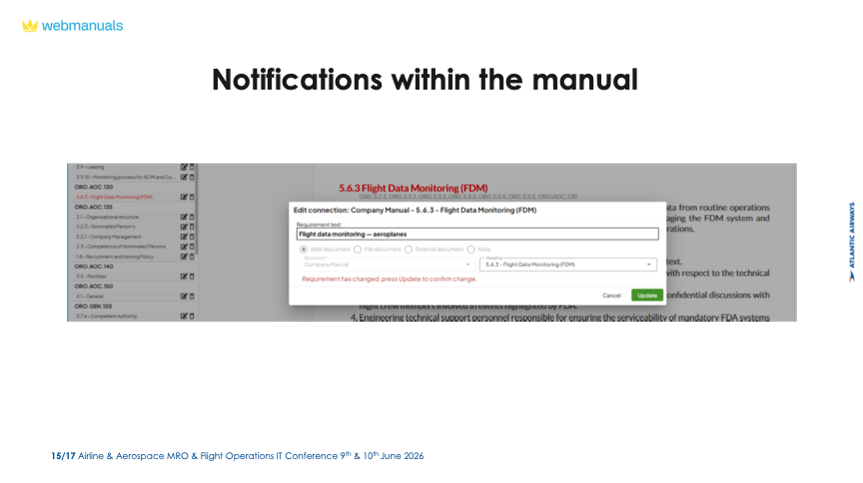
Figure 11
Here, a red headline shows that there has been a regulatory change. The editors of our manuals click here to read what has changed with reference to the same purple and amber visual indicators.
SUCCESSFUL MISSION
We are pleased to report that our mission to convert to Web Manuals has been accomplished (figure 12), and we have been using the system successfully for a couple of years.
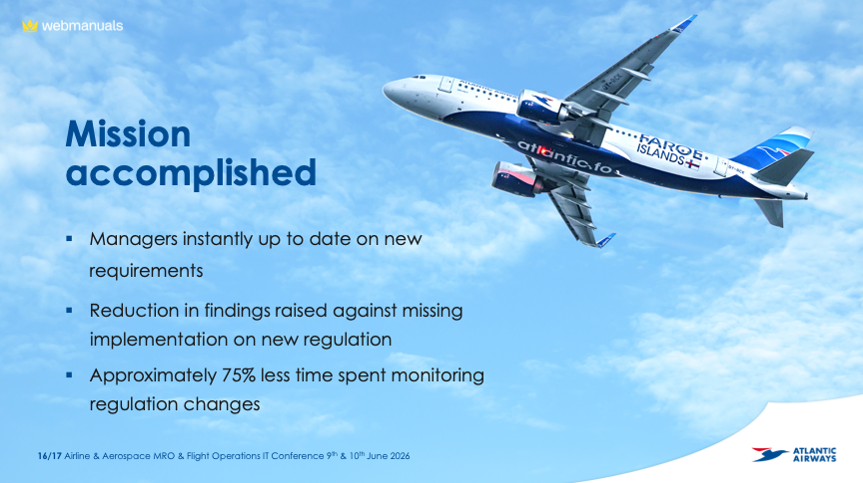
Figure 12
Our managers are updated constantly, and there are far fewer incidences of missed information regarding regulatory changes. It is very easy for us to get new employees on board with Web Manuals via their mobile phones so that they can keep up to date with new documentation.
I now spend around 75% less time reading through the regulations to see what has been added, amended or deleted. Web Manuals has also advance with an AI (Artificial Intelligence) tool, to help write our manuals. This is very useful and helps editors managing manuals.
Comments (0)
There are currently no comments about this article.
To post a comment, please login or subscribe.