
Articles
| Name | Author | |
|---|---|---|
| CASE STUDY: ZIPAIR tackles turbulence with predictive real-time data | Kenichi Ura, Flight Operations team, ZIPAIR | View article |
| CASE STUDY: Time-saving digital Operational Flight Plans transform Hyperion Aviation | Noah Hummel, Flight Operations Officer and Electronic Flight Bag (EFB) Administrator, Hyperion Aviation | View article |
| CASE STUDY: Copa Airlines builds future with integrated EFB architecture | Catherine Caballero, EFB Specialist and Systems Administrator, Copa Airlines & Captain Ramon Andres Patino Duran, Flight Standards Manager, Copa Airlines | View article |
| CASE STUDY: Atlantic Airways finds a gamechanger for documents | Randi Reinert, Compliance Monitoring Manager, Atlantic Airways | View article |
| CASE STUDY: A strong partnership for Helvetic | Christian Suhner, Chief Technology Officer, Helvetic Airways & Michael Anklin, CEO, WinOps | View article |
| WHITE PAPER: Beyond the tablet | Klaus Olsen, CEO of EFB Admin Services | View article |
| CASE STUDY: Saving fuel at Azul with custom flight analytics | Juliana Paes Dos Santos, Fuel Efficiency Coordinator, Azul Brazilian Airlines | View article |
| CASE STUDY: Air Atlanta crews get in the picture | Various, Air Atlanta | View article |
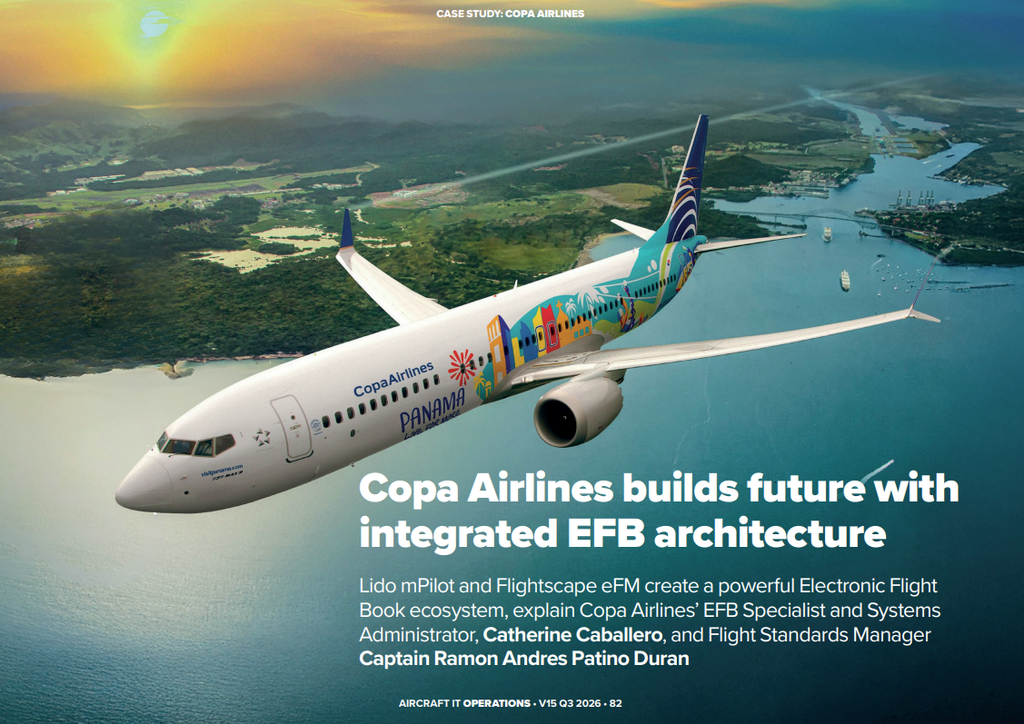
CASE STUDY: Copa Airlines builds future with integrated EFB architecture
Author: Catherine Caballero, EFB Specialist and Systems Administrator, Copa Airlines & Captain Ramon Andres Patino Duran, Flight Standards Manager, Copa Airlines
SubscribeLido mPilot and Flightscape eFM create a powerful Electronic Flight Book ecosystem, explain Copa Airlines’ EFB Specialist and Systems Administrator, Catherine Caballero, and Flight Standards Manager Captain Ramon Andres Patino Duran
Catherine Caballero
In this case study, we’d like to share how Copa Airlines evolved its EFB (Electronic Flight Book) program, not just through a technology upgrade, but also to transform how we operate in the flight deck.
ABOUT COPA AIRLINES
Before we talk about our EFB architecture and demonstrate the workflow from a pilot’s perspective, it will be helpful to give readers a brief overview of Copa Airlines and our operational environment.

Figure 1
Copa Holdings is one of the leading airline groups in Latin America, operating through Copa Airlines, Wingo and La Nueva Linea. Each airline serves a different operational model, allowing us to cover a full service, a low-cost carrier and cargo operations across the region (figure 1).
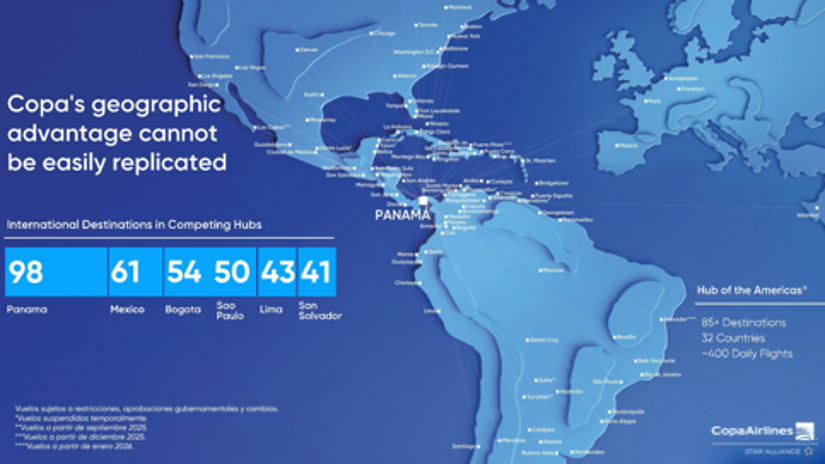
Figure 2
We operate a hub-and-spoke model from Panama (figure 2), connecting more than 85 destinations across 32 countries through approximately 400 daily flights.
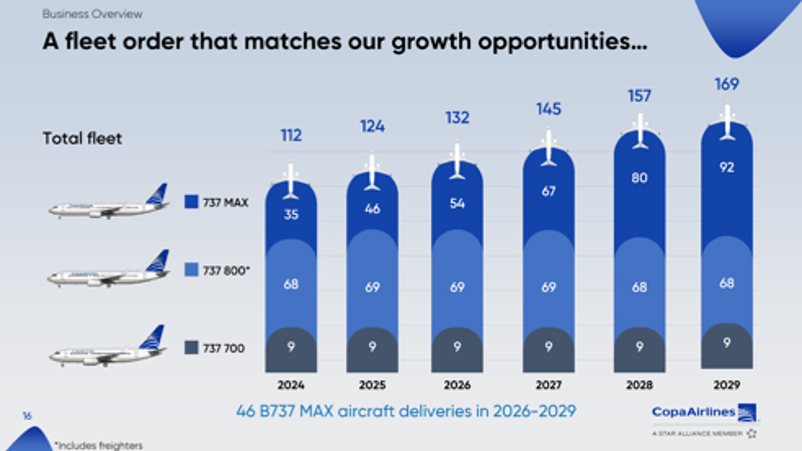
Figure 3
In addition to network growth, our fleet continues to expand (figure 3). Copa currently operates over 132 aircraft, all Boeing 737 and 737 MAX family, with more than 40 additional aircraft deliveries planned in the upcoming years.
WINGO OPERATIONAL MODEL
Captain Ramon Andres Patino Duran
I’d like to highlight the activities of Wingo, the low-cost carrier subsidiary in the Copa Holdings Group (figure 4).
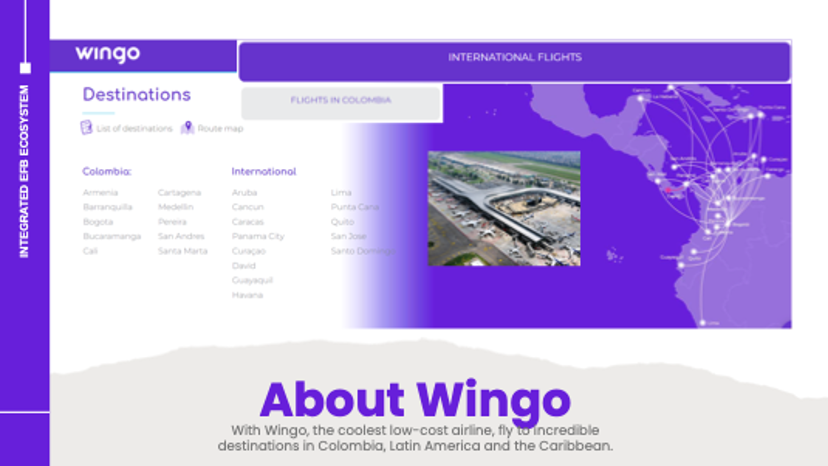
Figure 4
Wingo flies 10 Boeing 737 Next Generation aircraft, each with 186 seats in a single cabin, with 42 extra-room seats. Safety is a guiding principle at Wingo and that’s why we are IOSA (IATA Operational Safety Audit) certified. This certification comprises more than 900 operational standards and practices, including air safety, in-flight and ground operations, engineering, maintenance, cargo, and transportation of special goods, dispatching, and operational control.
We fly to both domestic and international destinations, operating mostly in Colombia, with our main bases in Bogota and Medellin.
SOLID EFB ARCHITECTURE
Catherine Caballero
With Copa Airlines’ operational background in mind, the technical foundation of our EFB ecosystem is built on four pillars (figure 5).
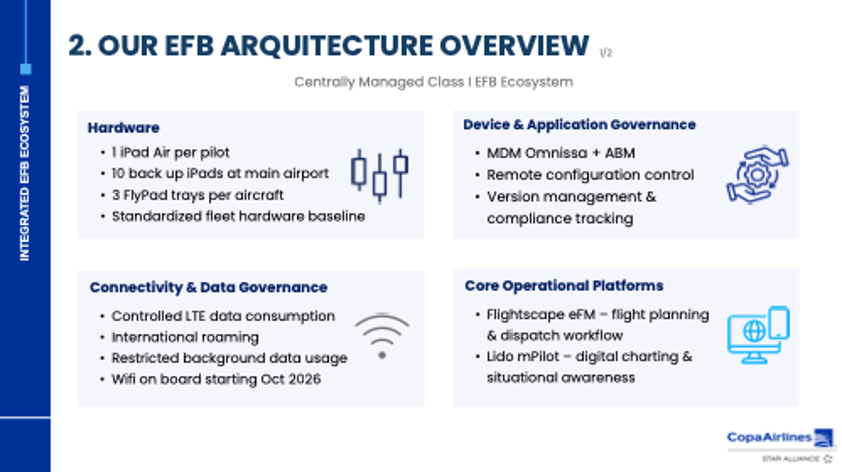
Figure 5
The first pillar is hardware and our EFB program follows a standard hardware model across the fleet, where each pilot is assigned an iPad Air. The second pillar is device and application governance, which involves managing our fleet using Omnissa Workspace ONE integrated with Apple Business Manager. Regarding connectivity and data governance, our EFB devices are equipped with a data plan, and by the end of the year we expect to have onboard connectivity. You can see that our core operational platforms are integrated by Flightscape’s eFM (eFlight Manager) and Lufthansa System’s Lido mPilot.
EFB APPS
We provide a number of EFB program apps that integrate a range of applications to support pilots across the entire flight lifecycle (figure 6).
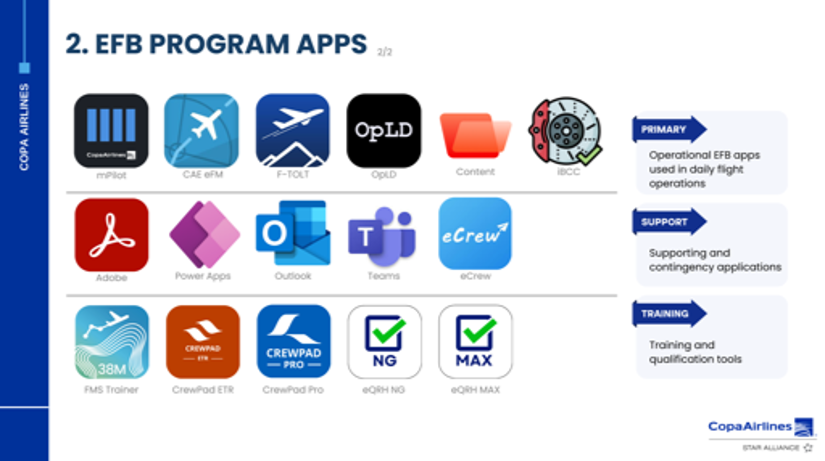
Figure 6
They are divided into primary, support and training apps, and together these form a digital ecosystem for pilots before, during and after the flight.
The context behind this architecture is that around five years ago we were evaluating solutions that would allow us to operate more efficiently, reduce operational costs, and, at the same time, maintain the high safety standards required in our operation.
EFM SERVICES AND BENEFITS
Going into greater detail on our eFM core platform, you can see that it represents the full suite of Flightscape solutions (figure 7).
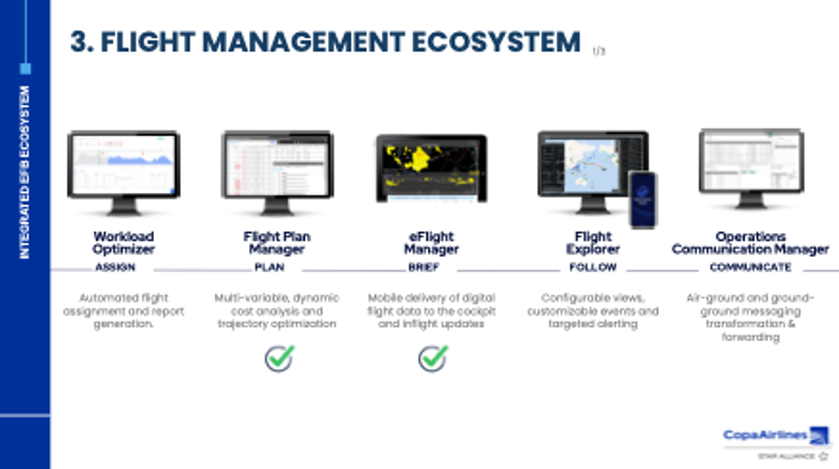
Figure 7
Copa currently uses only two of the solutions: Flight Plan Manager and eFM, which acts as our EFF (Electronic Flight Folder) and is the central hub of our dispatch and pre-flight workflow.
Supporting key functions
The eFM supports several key functions in our flight operations workflow (figure 8).
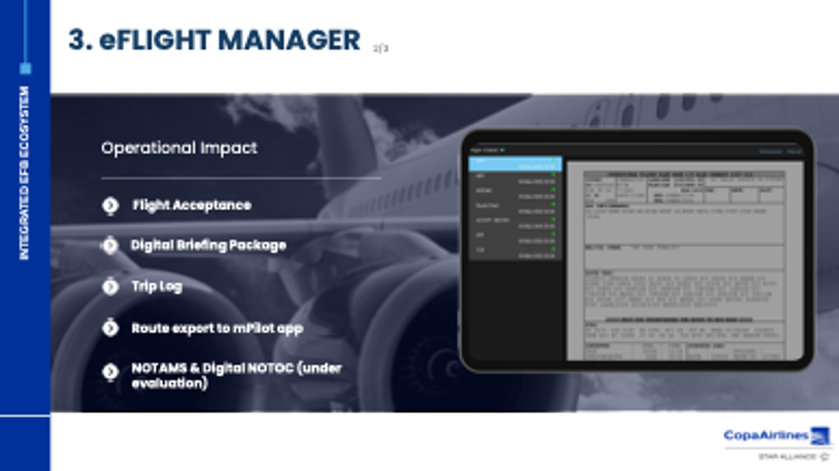
Figure 8
We have flight acceptance, where pilots review and acknowledge the operational flight plan. The flight digital briefing package is for operational information. Also, eFM supports flight progress, tracking and reporting, as well exporting routes to Lido mPilot.
Positive impact of eFM
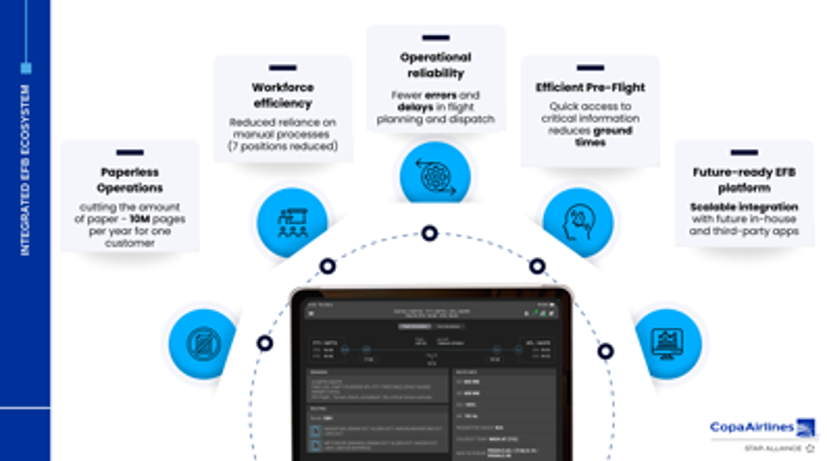
Figure 9
The implementation of eFM has delivered five main benefits (figure 9). First, it allows us to move forward to paperless operations – we have reduced the amount of paper we use by about 10 million pages per pilot per year. Second, automation simplifies several manual processes while maintaining the same operational performance. Third, it improves operational reliability because pilots have immediate access to critical information. Next, quicker access makes the preflight process more efficient. Lastly, it gives us a scalable eFM platform where we can integrate new apps and third-party apps. In short, eFM is not just a planning tool; it is the workflow engine connecting dispatch and the cockpit.
LIDO MPILOT
Looking in more detail at Lido mPilot, it serves as the primary cockpit interface for navigation and situational awareness (see figure 10).
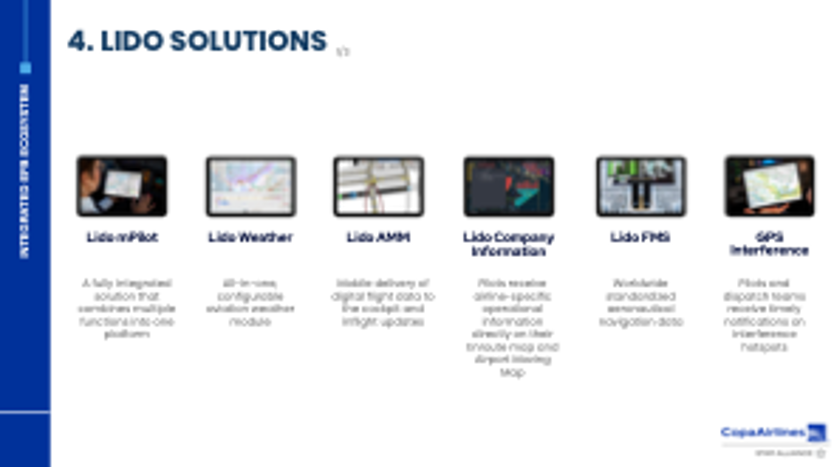
Figure 10
Lido mPilot gives us access to key operational services, such as Lido Weather, Lido AMM (Airport Moving Maps), Lido Company Information, and global navigation data. Once a route is generated, it is released through Flightscape eFM and exported directly into Lido mPilot, where pilots visualize, brief and execute the flight.
Supporting daily operations
By integrating into our operational architecture, Lido mPilot facilities multiple daily pilot operations. Procedure-specific charts and company layers give pilots quick access to critical information (figure 11).
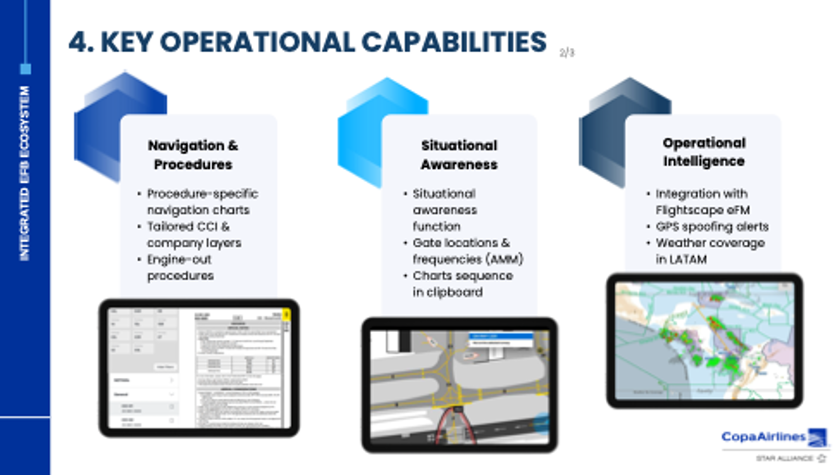
Figure 11
Airport situational awareness through the AMM helps pilots navigate complex airport environments, while the seamless integration with Flightscape eFM allows planning data to flow directly into the cockpit. Together, these capabilities support better situational awareness and more informed decision-making during the flight.
How pilots use Lido mPilot
Lido mPilot gives us fleet-wide standardization (figure 12). All our pilots use the same chart baseline and configuration, centrally managed through our EFB environment.
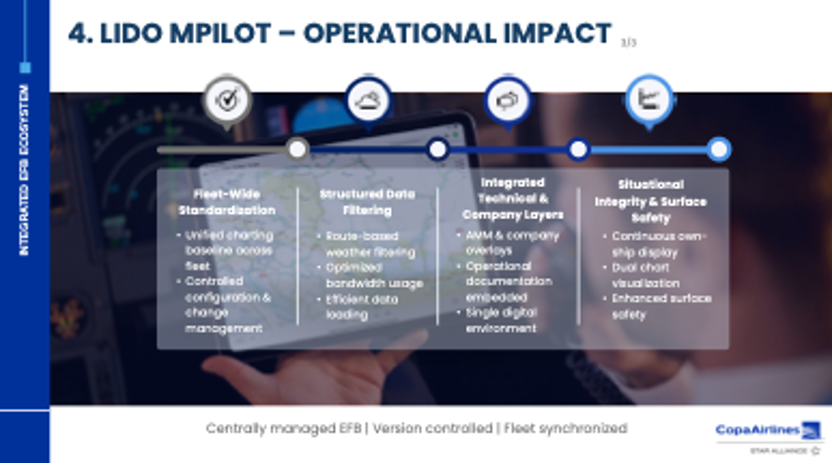
Figure 12
We can filter weather and operational data on the route to reduce bandwidth usage. Integrated technical and company layers are directly integrated with the navigation environment, while features like continuous on-shift display and dual-shared visualization help pilots maintain better situational awareness, especially during ground operations.
PILOT WORKFLOWS
Captain Ramon Andres Patino Duran
Our pilots interact with the EFB and the suite of operational applications in a number of ways that support both pre-flight preparation and flight decision-making. A few examples of how we use EFB apps in the cockpit can be seen below
Lido mPilot is the pilot’s primary navigation and cartography tool, enabling them to create, download, modify and adjust flight routes and flight plans. It also facilitates the organized management of navigation charts and real-time visualization of weather conditions. The pilot uses the application to arrange navigation charts, access our company and crew information charts, and, of course, monitor weather phenomena, such as turbulence or volcanic advisories. Other features include operational enhancements, such as escape routes, GNSS (Global Navigation Satellite Systems), jamming and spoofing interference areas, and airport classifications.
Cockpit information
Flightscape eFM delivers briefing data from Flight Explorer and Flight Plan Manager directly to the cockpit. It streamlines the workflow by automatically pulling relevant flight plan information and generating a comprehensive trip package that includes weather NOTAMs (NOTice to AirMen), new terms, company new terms, upper wind and temperature data, significant weather charts and operational documentation. This application also uploads critical operational data, such as fuel records, actual flight times and onboard fuel for immediate analysis and any follow-up, if required, by the dispatch team or the engineering department.
Secure access
Our content app is a Type E software that securely manages and distributes sensitive material, providing crews with secure access to documents anytime and anywhere, without requiring an active connection. It serves as the primary pilot repository for all manuals and operational documentation, organized into extensive categories to support both flight and reference needs. We also use the Adobe Acrobat app, certified as Type A software, which enables pilots to update PDF forms and share them with the flight operations department for follow-up and review.
Accurate calculations
Other software used on board aircraft includes an OpLD application developed in partnership between our operations engineers and technical standards team. Our OpLD simplifies the use of normal and abnormal configuration landing distance tables that are included in our FCOM (Flight Crew Operating Manual) and QRH (Quick Reference Handbook). It automates interpolation and the calculations required to determine landing distance requirements. As it is 100% accurate for both normal and abnormal situations, we can make any calculation in real time.
Our iBCC (Interactive Briefing & Cockpit Communication) app was similarly developed internally and enhances interpretation of the recommended brake cooling schedule tables, also included in our F Command QRH. It supports the accurate application of performance tables, helping crews calculate the values required for efficient turnaround operations.
Once the flight package is downloaded from Flightscape eFM, pilots can review all documentation, verifying flight times, operational details and fuel calculations, among others. It also has a sign-off module that requires two key actions. Acceptance of the dispatch release must be completed through the app and then the pilot starts to review the full briefing package, which includes weather NOTAMs, company NOTAMs, route charts, weather charts, field summaries, and more. Then the pilots start to complete the flight log, capturing relevant performance data and departure metrics.
During the flight, the navigation log section enables continuous monitoring of waypoints and fuel status in accordance with company policy.
Organizing charts more efficiently
Pilots use Lido mPilot to organize charts for origin, destination and alternate airports. These charts include guidance on taxi routes, departures, arrivals and engine failure scenarios. They serve as a key risk mitigation tool for crews to consider during all phases of flight.
KEY TAKEAWAYS
In summary (figure 13), Lido mPilot and Flightscape eFM provide us with a centrally managed and synchronized EFB ecosystem.
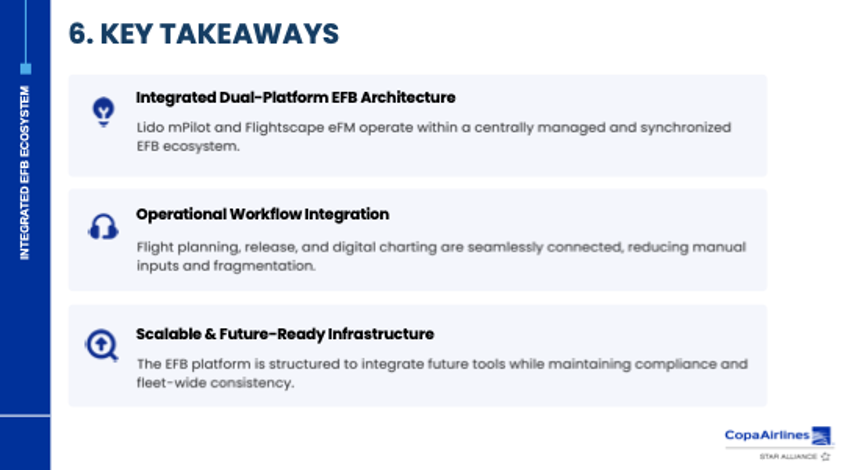
Figure 13
Our EFB architecture enables Copa to achieve operational workflow integration where flight planning, release and digital charting are seamlessly connected, which reduces the need for manual inputs and the risk of fragmentation. Finally, the EFB platform is structured to integrate future tools, while maintaining compliance and fleet-wide consistency.
Comments (0)
There are currently no comments about this article.
To post a comment, please login or subscribe.