
Articles
| Name | Author | |
|---|---|---|
| CASE STUDY: Lufthansa Airlines advances automated maintenance planning optimization | Stefan Guigas, Senior Project Manager at Technical Fleet Management of Lufthansa Airlines, and Nathan Niebergall, Sales Director – Americas, AMOS | View article |
| CASE STUDY: Safety Management System upgrade puts JSX in control | Hayes Hodges, Manager, Safety Management Systems, JSX | View article |
| CASE STUDY: Spirit Airlines masters maintenance control challenges | Randy Knowles, Director of Maintenance & Director of Maintenance Control, Spirit Airlines and Jason Ramnath, Senior Manager of Maintenance Control, Spirit Airlines | View article |
| CASE STUDY: ADE pursues lower maintenance costs | Roben Ekananta Manullang, Material Manager for the Component Warehouse and Services (CWS) Department, ADE | View article |
| CASE STUDY: Mexicana MRO Services embraces real-time data to improve customer service | Alder Pineda, Marketing Director, Mexicana MRO services | View article |
| Bringing buyers and sellers in shipping together with what has worked well for aviation | Ed Haskey, Director of Aircraft IT and Seacraft IT | View article |
CASE STUDY: Mexicana MRO Services embraces real-time data to improve customer service
Author: Alder Pineda, Marketing Director, Mexicana MRO services
Subscribe
Transitioning from a legacy system, designed for airline operations, to EmpowerMX has enabled Mexicana MRO Services to introduce real-time data accuracy, process standardization and greater transparency in customer communications, explains Alder Pineda, Marketing Director of Mexicana MRO services
Modernizing Mexicana MRO Services’ maintenance operations has been a major step forward, producing significant benefits for both the company and its customers, as this case study demonstrates. But before the case study itself, I’ll first introduce you to Mexicana.
MEXICANA MRO
Mexicana MRO traces its origin to the original Mexicana airline which was the third oldest airline in the world having been founded in 1921. As the MRO branch of an airline with 110 aircraft, it was operating as a cost centre. In 2010 the airline ceased operations and Mexicana MRO was spun off as a full third-party MRO. Headquartered at Mexico City Airport, Mexicana, is an end-to-end maintenance service provider (figure 1).
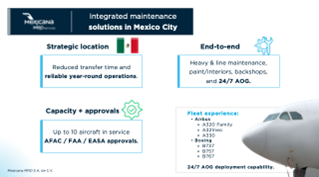
Figure 1
We work on heavy and line maintenance, back shops and paint services, with 24/7 AOG (Aircraft on Ground) deployment capability. Our team supports a wide range of aircraft, including the Airbus 320 family, Airbus 330s and Boeing 737, 757 and 767.
From an approvals perspective, Mexicana is registered with the AFAC (Mexican Federal Civil Aviation Agency), FAA (Federal Aviation Administration) and EASA (European Air Safety Agency). The nature and range of our maintenance workload necessitated the move to a new scalable MRO IT solution that would underpin future expansion from the 2.1 million man-hours of work undertaken during 2025.
OPERATIONAL CONTEXT AND DRIVERS
At Mexicana, we run multiple workstreams that demand high levels of coordination, where success hinges on good execution, timely decisions and visibility across all aspects of work (figure 2).
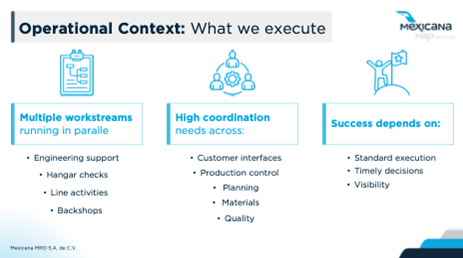
Figure 2
Four key operational aspects drove our desire to change systems (figure 3).
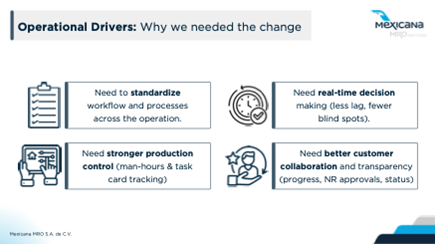
Figure 3
First, we needed to standardize workflows and processes across the whole organization. Different teams tended to work following their own collective wisdom Next, we needed a tighter production control with accurate management of the time spent on tasks. Also, having real-time decision-making capability was essential to reduce delays and remove ‘blind spots’ in our operations. Finally, as with any MRO, we rely on approvals from customers to carry out services, so we had to improve the speed of and accountability for our interactions as well as increase the transparency of our operation.
IMPLEMENTING EMPOWERMX
This operational context led us to implement EmpowerMX, a company now part of IFS (figure 4), and leverage the system’s capabilities to improve operational performance.
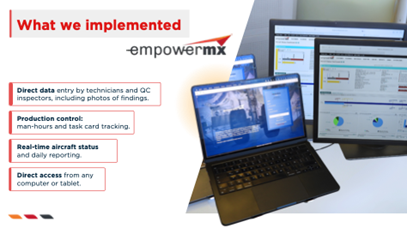
Figure 4
Our technicians and quality control inspectors (QC) now input data directly into the system using digital stamps. We have tightened production control through more accurate recording of man-hours and task card tracking. We can directly access the system from any computer or tablet device and the same applies for our clients. A huge benefit for customers is real-time tracking of aircraft status – they can log on to the system to see the whole service flow in real time. This way they can see if an aircraft is at risk of getting behind schedule or if it will be ready on time. Providing visibility of ongoing production constraints makes them part of timely corrective actions.
ENABLING FASTER CUSTOMER DECISIONS
As well as easily following progress on aircraft maintenance with the real-time checking, customers can quickly authorize additional work and materials with our streamlined approvals progress see figure 5.
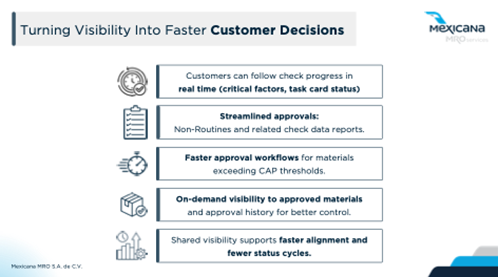
Figure 5
In particular, this is significant for non-routine work which is often detected during the inspection phase by QC, at which point photos, videos and other content can be attached so the customer can learn all the details of the defect without having to be physically onsite. We also benefit from more rapid approval of workflows by customers when the cost of materials exceeds the cap price established on top of the agreed fixed price. These thresholds are defined in the digital twin of the paper contract which covers the labor and material terms of the MRO event.
BETTER TIME MANAGEMENT
Real-time management brings a range of benefits (figure 6). Greater control of materials by having more accurate inventories improves recurring counts and ensures stronger execution. It is now much more convenient to define who is responsible for providing different types of materials. The material requests are sourced electronically helping the supply chain team and the customers to act swiftly.
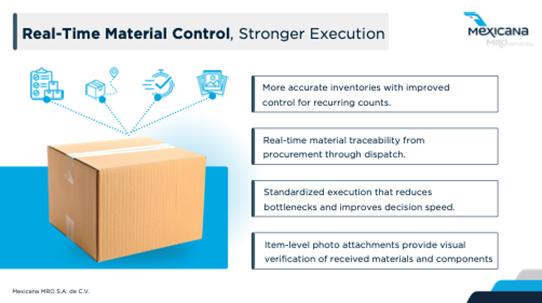
Figure 6
Having standardized execution reduces bottlenecks in the system and speeds up decision-making. Furthermore, it is very helpful that the certifications and photos attached during the receiving process stay with the materials throughout the execution process.
REMOVING LEGACY CONSTRAINTS
As figure 7 shows, our new way of working with EmpowerMX removes the roadblocks to efficiency posed by our previous legacy system. We no longer rely on manual status updates and follow-ups coming from different areas of the business No more ‘Project Plans on a Wall’ that become stale as soon as they were printed.
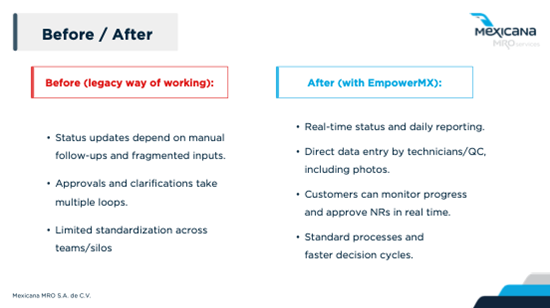
Figure 7
The multiple loops and delays required for client approval have also been removed. EmpowerMX has enhanced teamwork by moving us away from non-integrated silos to a standardized process with very clear accountability.
IMPLEMENTATION STEPS
The implementation of EmpowerMX was seen as an opportunity to ramp up the adoption of independent MRO best practices. Adopting the new operational process using EmpowerMX required several steps, beginning with better clarity of job roles (figure 8). We now have clearly mapped out definitions around who owns each stage, across planning, production control, QC and customer communications.
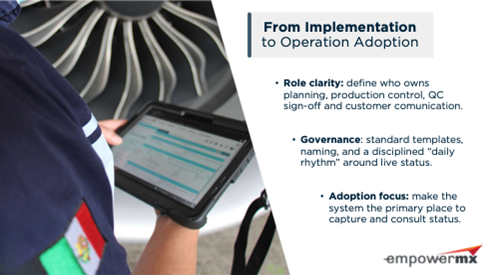
Figure 8
Looking at governance, we use digital standard templates and naming conventions for a more disciplined approach, especially around the live status of work. The company uses EmpowerMX as the primary system to capture data, manage the services and collect invoice information.
LESSONS LEARNED
We began the transition to EmpowerMX by focusing first on the processes that caused us the most friction, such as status visibility, approvals and execution tracking (figure 9).
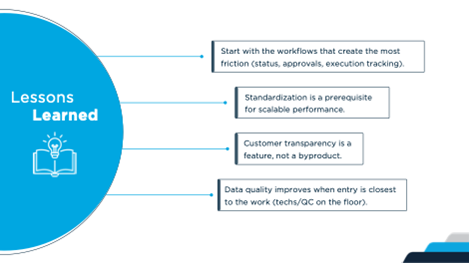
Figure 9
We knew that if we could remove these friction points early on, then we would immediately be able to reduce the ‘noise’ surrounding maintenance processes and create strong momentum for the next steps. The best data is coming out in real-time from the sources closest to the work being undertaken – our technicians and QC inspectors. The technicians became the focal point of the implementation with all the other entities providing support and with their response times monitored electronically.
Initially there were some issues with Wi-Fi coverage, and the MRO expedited an existing plan to upgrade to the infrastructure. Connectivity also soon became a non-issue as EmpowerMX made available a comprehensive offline capability to all its customers.
With standardization comes the ability to scale performance, which wouldn’t have been possible without the consistent use of templates by all of our teams. Transparency with our customers, wasn’t automatic before we implemented EmpowerMX. Now the customers go hand in hand with us. This transparency allows clients to assist us whenever there are constraints they can help us with, like, for example, a unique tool may be required, and the MRO is having a hard time sourcing it. The airline may have the tool in stock, and they are willing and able to ship it down to our facility in Mexico City to help us finish their aircraft on time.
We moved from simply reporting after the fact to truly controlling the execution of the services in real time and, as a by-product, improving the the overall customer experience strengthening their long-term relationship with our company.
NEXT STEPS
Overall, the system has been a game changer for Mexicana MRO. It helped us to introduce cultural change from a cost to a full profit centre. Now, everyone works following standardized processes. Different execution teams don’t have to rely any more on their own lore. We implemented the system in a way that it acts as a sort of ‘straitjacket’, ensuring everyone stays within the swim lanes of proven MRO best practices. The system also helps to bring technicians with less knowledge to the level of the most expert specialists with many years of experience. With everybody working in a standardized way we were able to start measuring key production indicators to drive continuous improvements on quality, safety, delivery times and cost control as shown in figure 10.
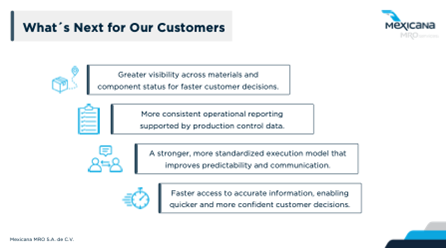
Figure 10 EmpowerMX helped Mexicana MRO to gain real operational control by tightly connecting planning and shop‑floor execution, improving labor productivity, and delivering real‑time visibility into task progress, constraints, and work scope changes. This led us to achieve more predictable turnaround times, higher throughput, increased margins, and introduce better communications with our customers. We plan to continue expanding by maximizing productivity and doing more with the available capacity and workforce. We also plan to double down on empowering our technicians and inspectors and continue to go digital with customers already charting a path to paperless operations. Moving forward we are exploring ways of leveraging the acquisition of EmpowerMX by IFS and utilizing its advanced AI platform to continue improving how we manage our services, processes, our capacity and our most important resource – our people.
Comments (0)
There are currently no comments about this article.
To post a comment, please login or subscribe.