
Articles
| Name | Author | |
|---|---|---|
| CASE STUDY: Lufthansa Airlines advances automated maintenance planning optimization | Stefan Guigas, Senior Project Manager at Technical Fleet Management of Lufthansa Airlines, and Nathan Niebergall, Sales Director – Americas, AMOS | View article |
| CASE STUDY: Safety Management System upgrade puts JSX in control | Hayes Hodges, Manager, Safety Management Systems, JSX | View article |
| CASE STUDY: Spirit Airlines masters maintenance control challenges | Randy Knowles, Director of Maintenance & Director of Maintenance Control, Spirit Airlines and Jason Ramnath, Senior Manager of Maintenance Control, Spirit Airlines | View article |
| CASE STUDY: ADE pursues lower maintenance costs | Roben Ekananta Manullang, Material Manager for the Component Warehouse and Services (CWS) Department, ADE | View article |
| CASE STUDY: Mexicana MRO Services embraces real-time data to improve customer service | Alder Pineda, Marketing Director, Mexicana MRO services | View article |
| Bringing buyers and sellers in shipping together with what has worked well for aviation | Ed Haskey, Director of Aircraft IT and Seacraft IT | View article |
CASE STUDY: ADE pursues lower maintenance costs
Author: Roben Ekananta Manullang, Material Manager for the Component Warehouse and Services (CWS) Department, ADE
Subscribe
Used Serviceable Material (USM) cuts costs but not quality in maintenance operations while strengthening sourcing capabilities and spare parts availability, says Roben Ekananta Manullang, Material Manager for the Component Warehouse and Services (CWS) Department, ADE
Roben Ekananta Manullang, Material Manager for the Component Warehouse and Services (CWS) Department, ADE
USM (Used Serviceable Material) components and consumables are an increasingly important feature in many airline maintenance operations; delivering cost savings without comprising quality or reliability, as this case study demonstrates.
USM SPECIALIST: ADE INDONESIA
Asia Digital Engineering (ADE) Indonesia is a Part 145 MRO, with over twenty years of industry experience (figure 1). By understanding the challenges that airlines face in maintaining aircraft at peak performance, as well as the cost pressures they are under, we recognize the significant role USM can play in the maintenance cycle.
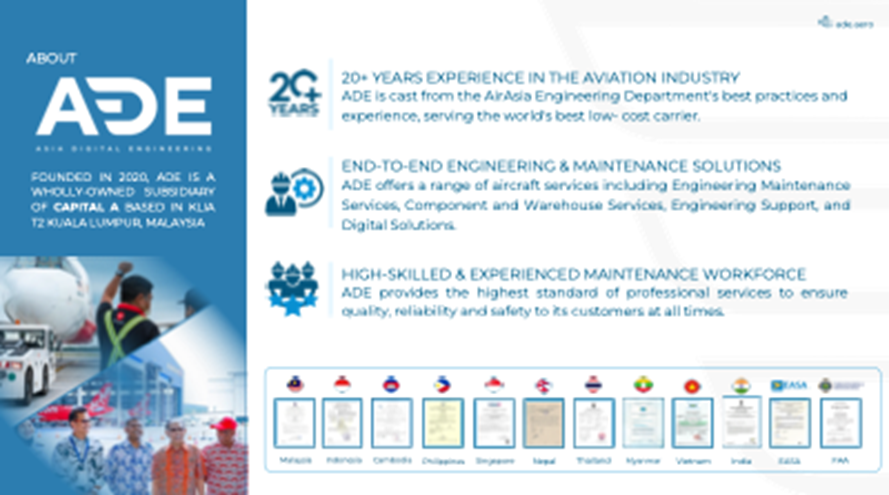
Figure 1
ADE’s more than twenty years of experience in end-to-end engineering and maintenance solutions has always relied on our highly skilled maintenance workforce. Our track record is backed by more than ten certifications, including with the ASA (Aviation Suppliers Association) and the FAA (Federal Aviation Administration). The speed and efficiency of our maintenance service is enhanced by using two innovative digital platforms as part our maintenance solution: AEROTRADE and ELEVADE.
Regional reach
ADE provides maintenance solutions at over twenty airports (see figure 2) across Southeast Asia, where we manage an average of 10,000 transits per month, with a focus on providing customers with quick turnarounds.
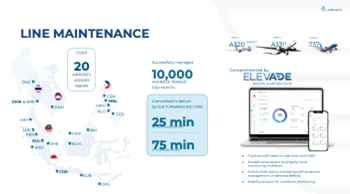
Figure 2
Maintenance facilities
Our maintenance infrastructure is growing as we take on more work. In Malaysia, we have Base Maintenance facilities at Kuala Lumpur airport, where we are headquartered, and at Senai airport. Our new Kuala Lumpur hangar serves both narrow and wide-body aircraft (figure 3).
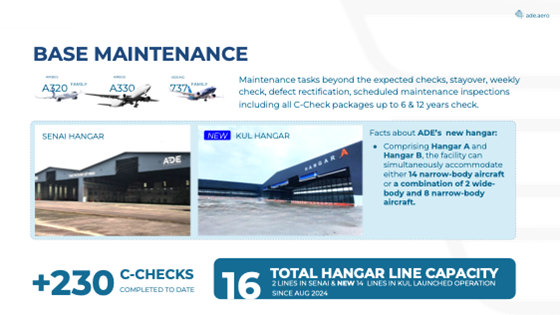
Figure 3
That hanger has the capacity to simultaneously handle 14 narrow-body aircraft or a combination of eight narrow-body and two wide-body. We are currently considering further expansion by building another Base Maintenance facility in the region.
End-to-end solution
As a growing MRO provider, we offer an end-to-end supply chain management solution encompassing procurement, repair and warranty support, repair management and warehousing (figure 4).
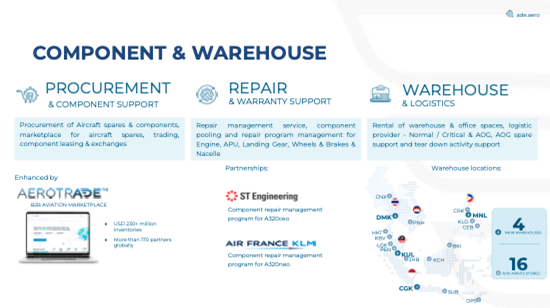
Figure 4
WHAT IS USM?
What we mean by USM are certified parts, including engines, components and consumables, that have been removed from retired and decommissioned aircraft, as well as surplus stock. Distributors around the world provide a USM market to support aircraft maintenance with most things needed – from nose to tail and crown to belly.
Challenges and opportunities with USM are evident throughout the component lifecycle (figure 5). Inflationary pressures are driving up maintenance costs, particularly for parts and labor. Delays in sourcing new materials are another problem, which is why airlines look for smarter maintenance strategies. That’s where USM comes in: offering not only cost-savings, but also greater supply chain resilience.
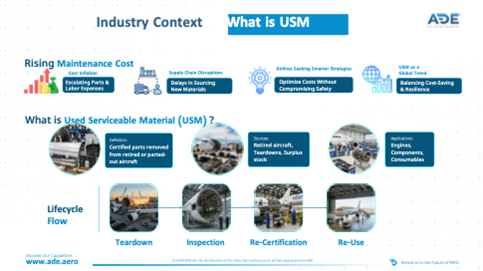
Figure 5
Typically, airlines follow a pattern of sourcing components from an OEM (Original Equipment Manufacturer) but then come back to us every few months as they cannot risk their operational activities being delayed due to parts shortages. Consequently, USM adoption is becoming a global trend for all types of airlines, from budget to high-class.
USM ADOPTION
Several factors are driving demand for used serviceable parts (figure 6).
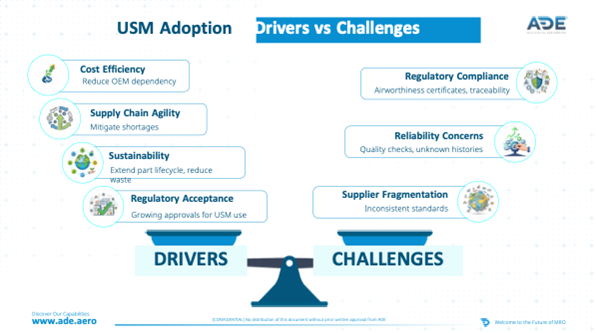
Figure 6
Airlines are switching to USM to reduce their dependence on OEM components, improve cost efficiency and reduce the risk of product shortages. With the industry increasingly focused on sustainability, it makes sense to reuse materials until they reach the end of their useful life. A USM component can go through multiple lifecycles, so long as it passes an inspection recertification every time. As demand for USM increases, we are seeing regulatory acceptance keep pace by approving more components for USM use.
Challenges for USM
Set against the drivers for USM adoption MROs face a range of challenges. One of our top priorities is assuring customers that USM is compliant, particularly in terms of airworthiness and traceability. Reliability is front-of-mind when considering replacement components – if we don’t know the history of a component, then we might not be able to vouch for it. This might sometimes hinder our ability to supply USM, but it is an essential safeguard for customers, for example, if a component lacks an ID plate, then we won’t use it. Ensuring consistent quality standards in USM is another challenge, especially when you consider that there are thousands of suppliers around the world.
STRUCTURED APPROACH
ADE’s approach centers on quality assurance and a standardized process, where we only accept certified USM products (figure 7).
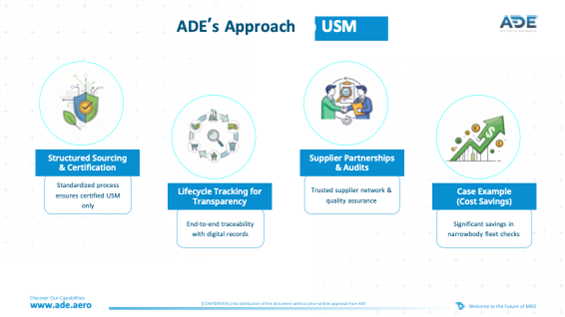
Figure 7
Inevitably, there are bogus products on the market, and it is important that we spot them. We aim for transparency and traceability throughout the lifecycle of a USM, supported by digital records. Rigorous checking of suppliers is another key factor in our approach. We have established a trusted supplier network and conduct regular supplier audits to check that they are maintaining the highest standards in the stock we buy.
AEROTRADE PARTNERSHIP
We use AEROTRADE (figure 8), the online aviation parts marketplace, to support airlines with a rapid service, for example, sourcing scarce AOG (Aircraft On Ground) and USM parts in hours rather than days.
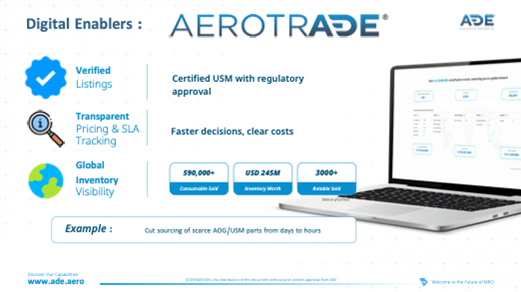
Figure 8
We do this through our listing of verified components, where, to date, ADE has sold over 590,000 consumables and over 3,000 components. Currently, we have an inventory valued at $245 million with AEROTRADE. Our pricing, tracking, certificates and global inventory are all easily visible on our platform.
ELEVADE PARTNERSHIP
ADE also relies on ELEVADE, the MRO digital enabler, which provides reliable in-service tracking (figure 9).
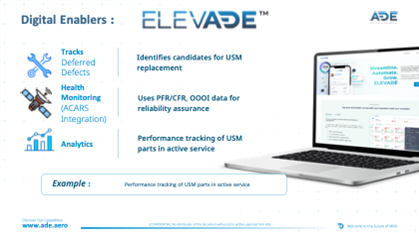
Figure 9
For deferred defects, whether in base maintenance or line maintenance, the system looks for suitable USM stock in our inventory. We also use ELEVADE for health monitoring, as well as data analytics.
UPTAKE IN USM
We believe USM is a viable and a strategic lever for airlines in their cost management process. As we expand our maintenance solutions, we will continue to remove the barriers to adopting USM (figure 10).
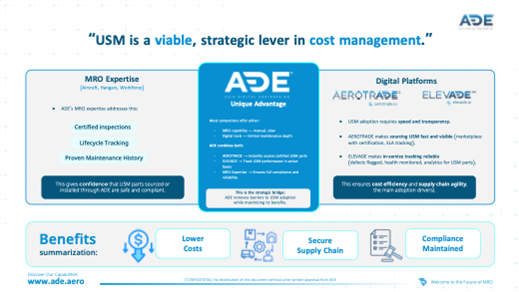
Figure 10
In addition to enhancing cost efficiency for airlines, ADE’s approach to USM also brings peace of mind around supply chain security and compliance with regulatory requirements when sourcing components and consumables.
Comments (0)
There are currently no comments about this article.
To post a comment, please login or subscribe.