
Articles
| Name | Author | |
|---|---|---|
| CASE STUDY: Lufthansa Airlines advances automated maintenance planning optimization | Stefan Guigas, Senior Project Manager at Technical Fleet Management of Lufthansa Airlines, and Nathan Niebergall, Sales Director – Americas, AMOS | View article |
| CASE STUDY: Safety Management System upgrade puts JSX in control | Hayes Hodges, Manager, Safety Management Systems, JSX | View article |
| CASE STUDY: Spirit Airlines masters maintenance control challenges | Randy Knowles, Director of Maintenance & Director of Maintenance Control, Spirit Airlines and Jason Ramnath, Senior Manager of Maintenance Control, Spirit Airlines | View article |
| CASE STUDY: ADE pursues lower maintenance costs | Roben Ekananta Manullang, Material Manager for the Component Warehouse and Services (CWS) Department, ADE | View article |
| CASE STUDY: Mexicana MRO Services embraces real-time data to improve customer service | Alder Pineda, Marketing Director, Mexicana MRO services | View article |
| Bringing buyers and sellers in shipping together with what has worked well for aviation | Ed Haskey, Director of Aircraft IT and Seacraft IT | View article |
CASE STUDY: Safety Management System upgrade puts JSX in control
Author: Hayes Hodges, Manager, Safety Management Systems, JSX
Subscribe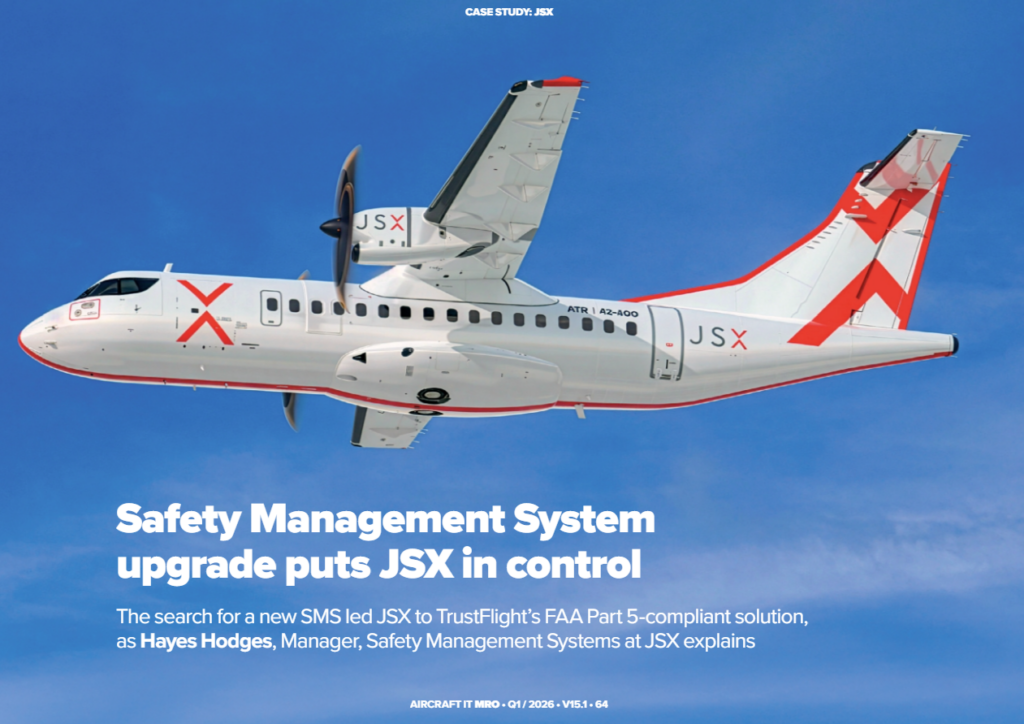
The search for a new SMS led JSX to TrustFlight’s FAA Part 5-compliant solution, as Hayes Hodges, Manager, Safety Management Systems at JSX explains
Words: Hayes Hodges, Manager, Safety Management Systems at JSX
Upgrading to a new SMS (Safety Management System) and the lessons learned along the way are the subject of this case study. We look at why JSX switched to TrustFlight’s Centrik 5 software for quicker and easier safety management.
COMMERCIAL AND PRIVATE CARRIER
Workplace safety in all its aspects is a priority at JSX. To begin this case study, it is helpful to look at who we are and where we operate. JSX is a competitively priced commercial and private airline, with most of our business on the private side. We offer all the benefits of private air travel, from no queues at the airport to bringing your pets if you want (figure 1).
Our fleet comprises over 50 Embraer 145s and 135s, and the number is growing as we expand. Our operations are focused mainly in California and also fly to Florida and New York (figure 2).
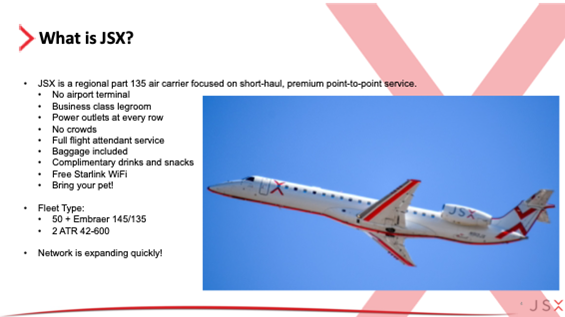
Figure 1
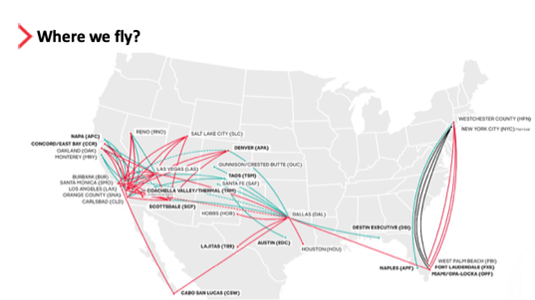
Figure 2
MOVING ON FROM WBAT
Before TrustFlight, we relied on WBAT, the FAA’s (Federal Aviation Administration) SMS. Created in 2004, WBAT is an outdated platform and not very user-friendly. All our employees had to use it to submit reports and carry out risk assessments, but the platform didn’t allow them to do this easily or quickly (see figure 3).
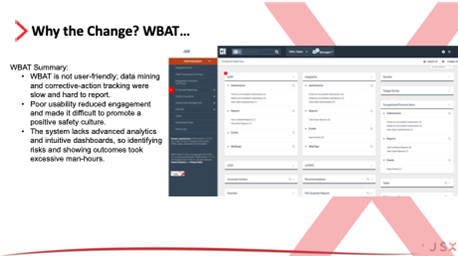
Figure 3
In particular, our safety team needs to pull data from the SMS for regular presentations to our executive team. Not being able to do that efficiently created a negative view of safety promotion and our safety culture. When I started at JSX in December 2024, I knew immediately that one of my first tasks must be to find new SMS software.
SMS REQUIREMENTS
First and foremost, we wanted to be compliant with FAA Part 5 standards (figure 4). The solution had to be user-friendly, especially for the safety team and the executive team, because if we can’t present good data to our executive team, they can’t make good risk-based decisions.
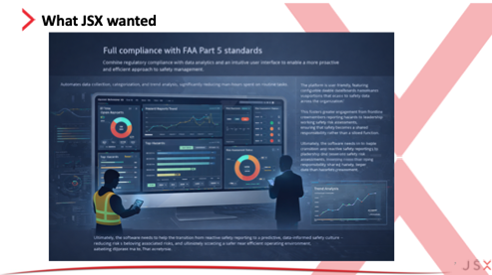
Figure 4
We describe our SMS as the safety pulse of our operation. Executives always want to know quickly if something safety-related happens and whether it is a trend or a normal issue. The executive team had to be sure that it was worth investing in a new SMS, so we needed to ensure that the proposed solution would give accurate and timely data.
TRUSTFLIGHT’S CENTRIK 5
After looking at numerous providers for around four months, we narrowed the choice down to two. TrustFlight came onsite and presented Centrik 5 to our executive team and provided a good road map of where they are going in the future. That was one of the deciding factors for us as TrustFlight has a lot of promising things due to come out. Also, Centrik 5’s clear, clean dashboard gives a good overview of what’s going on (see figure 5).
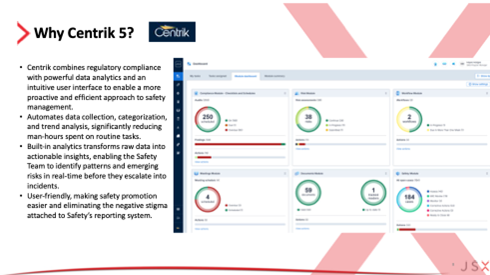
Figure 5
We have been using Centrik 5 for around a year and recently presented the first quarter’s worth of data from the SMS to our executive team, who liked what they saw and where we’re headed. An advantage of Centrik 5 is that you can make many of the necessary corrective actions on the SMS, whereas with WBAT it usually had to be undertaken separately by email. This means our reports on Centrik 5 contain the whole story, from beginning to end. We can delegate actions and see what was done to mitigate an issue and when it was closed out.
SAFETY CURVE
Figure 6 shows a Brady safety curve, with the injury rate on the left. It is divided into four columns: reactive, dependent, independent and interdependent. Our goal is to be on the right side, where interdependent teams support each other to improve safety in an organization.
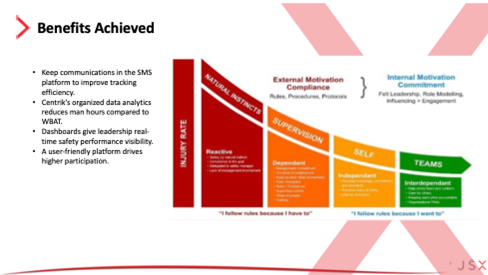
Figure 6
The Centrik 5 SMS is helping us to move along the curve, for example, by finding the root cause of a safety issue and taking mitigating action. Now, our managers are conducting root cause analysis without even realizing it, which is very beneficial, as it creates high-quality reporting and more effective corrective actions. It also makes it harder for safety reports to slip through the cracks, which was a problem we experienced with WBAT.
WHAT TO LOOK FOR IN AN SMS
A checklist of key questions came in handy (see figure 7) during the software selection process. When you go through software demonstrations, it can be easy to get sidetracked by the ‘bells and whistles’ and overlook whether it covers the basics, such as being FAA Part 5 compliant, as well as whether it will integrate into your existing systems. Ask vendors if their software is customizable, so that it will work with your processes and workflows, and obtain a good idea about resolution times to resolve support tickets. At a more granular level, find out about data security, reliability and the implementation process.
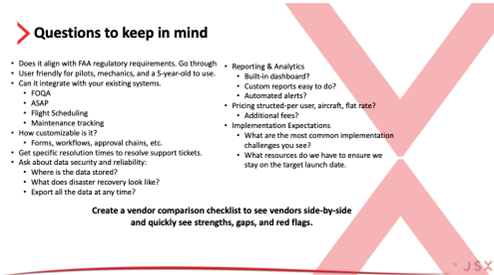
Figure 7
INTRODUCING THE NEW SMS
Setting an implementation timeline in stone could set you up for failure because hiccups do happen, and you need to be prepared for them (figure 8). We found that getting colleagues from across departments in our implementation team and involving them throughout the process meant they were invested in its success. It also helped to provide regular updates on progress.
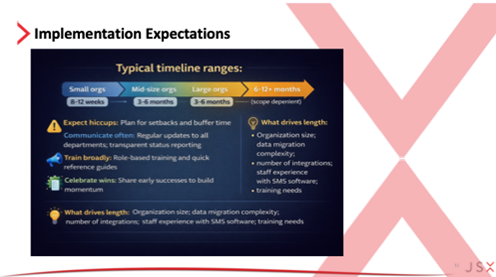
Figure 8
User training is another important aspect to consider, as is sharing and celebrating successes during the rollout. This also helps to create a positive view around having a strong safety culture.
We rolled out Centrik 5 at the rate of one department per week, which worked well for us. This made it easier for us to tackle issues as they emerged and make any necessary changes ready for the following week’s rollout. Weekly Teams calls with the whole department made sure everyone understood how the new SMS worked and what changes were coming. Overall, the rollout went well, and we look forward to continuing our safety journey with TrustFlight.
Comments (0)
There are currently no comments about this article.
To post a comment, please login or subscribe.