
Articles
| Name | Author | |
|---|---|---|
| CASE STUDY: Lufthansa Airlines advances automated maintenance planning optimization | Stefan Guigas, Senior Project Manager at Technical Fleet Management of Lufthansa Airlines, and Nathan Niebergall, Sales Director – Americas, AMOS | View article |
| CASE STUDY: Safety Management System upgrade puts JSX in control | Hayes Hodges, Manager, Safety Management Systems, JSX | View article |
| CASE STUDY: Spirit Airlines masters maintenance control challenges | Randy Knowles, Director of Maintenance & Director of Maintenance Control, Spirit Airlines and Jason Ramnath, Senior Manager of Maintenance Control, Spirit Airlines | View article |
| CASE STUDY: ADE pursues lower maintenance costs | Roben Ekananta Manullang, Material Manager for the Component Warehouse and Services (CWS) Department, ADE | View article |
| CASE STUDY: Mexicana MRO Services embraces real-time data to improve customer service | Alder Pineda, Marketing Director, Mexicana MRO services | View article |
| Bringing buyers and sellers in shipping together with what has worked well for aviation | Ed Haskey, Director of Aircraft IT and Seacraft IT | View article |
CASE STUDY: Spirit Airlines masters maintenance control challenges
Author: Randy Knowles, Director of Maintenance & Director of Maintenance Control, Spirit Airlines and Jason Ramnath, Senior Manager of Maintenance Control, Spirit Airlines
Subscribe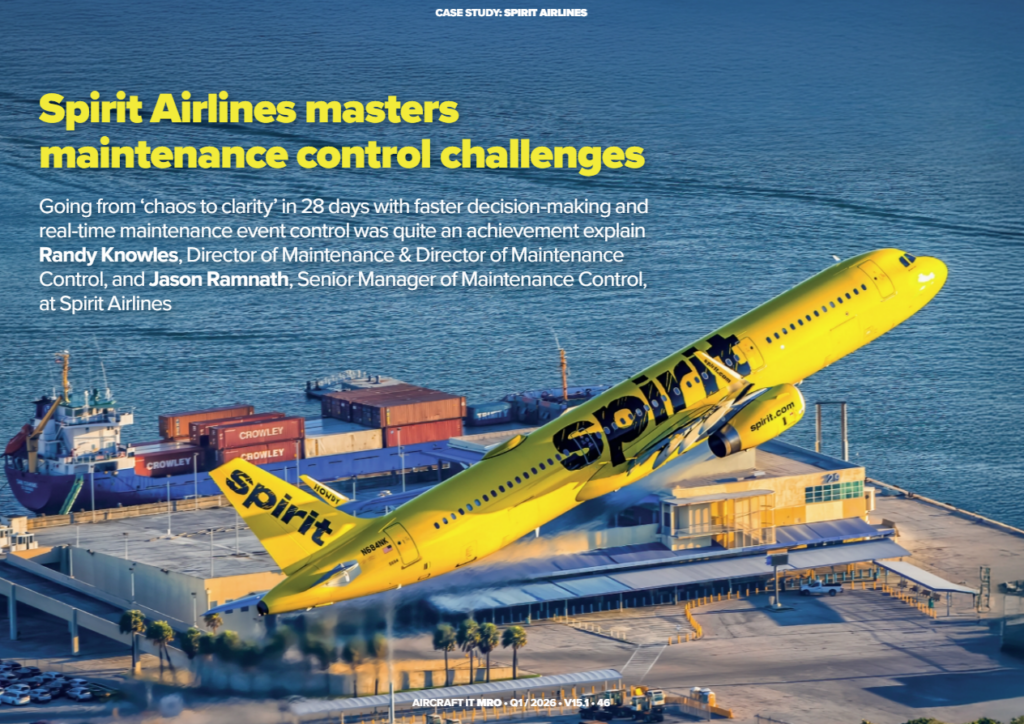
Going from ‘chaos to clarity’ in 28 days with faster decision-making and real-time maintenance event control was quite an achievement explain Randy Knowles, Director of Maintenance & Director of Maintenance Control, and Jason Ramnath, Senior Manager of Maintenance Control, at Spirit Airlines
This case study covers the rapid transformation in maintenance event control that took Spirit Airlines from ‘chaos to clarity’ by accelerating decision-making using event-driven data and real-time collaboration.
A CHALLENGING REALITY
Randy Knowles
One of our biggest challenges with maintenance control is with AOG (Aircraft On Ground) events. The best way to describe how we were operating was semi-organized chaos. In most cases, the stumbling block was around communication between our people rather than the broken aircraft. We needed to get our mechanics, maintenance controllers and parts staff talking with each other, when traditionally they had tended to work in siloes. Against this background of poor communication, many AOG events are unique (figure 1), as so many different factors can come into play.
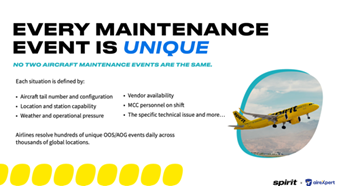
Figure 1
Not only did we face challenges with our communications, but also with locations where we use contract mechanics or have never flown to before. Add to that factors like the weather and relying on various parts vendors, and we were left scrambling to deal with every AOG event. Clearly, we lacked a playbook for handling AOG events. For example, a leak in a coffee maker may sound simple, but, depending on the situation, we could have 15 different ways to handle it.
MIND THE GAP
A communications control gap existed because we relied on a mix of email, phone calls, Excel spreadsheets and messaging platforms (figure 2). This caused people to be left off important messages, for example, if they were omitted from an email chain or if side conversations started in parallel with the main communications. Fragmented information led to miscommunication, slow decision-making and a lack of shared operational visibility.
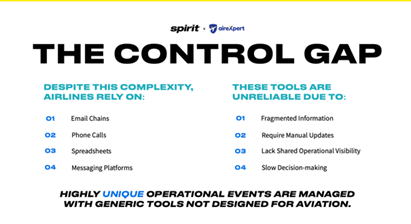
Figure 2
Looking at where we are now, AireXpert is proving to be a fantastic communication tool for navigating AOG events. AireXpert’s solution is the best I have used in twenty years for maintenance control and AOG events: it has been a gamechanger for Spirit.
Jason Ramnath
As Randy stated, before we started using AireXpert, we found it very difficult to manage AOG and OOS (Out Of Service) events. One of our main goals is to maintain awareness across different departments and keep the executive leadership team updated about OOS events.
The volume of messages in circulation was another problem. In addition to the maintenance controller or the technician working on the aircraft, we interface with outstation vendors, maintenance bases and our engineering group. Sometimes, we need support from our materials department and our tooling department, as well as Flight Ops, to accurately estimate the return-to-service time.
We were averaging over 1,000 emails a day and 300-plus phone calls for OOS aircraft because of the back-and-forth trying to decipher information (figure 3). Often, contract mechanics unfamiliar with our aircraft type sometimes need to email photos or videos showing what had happened to the aircraft so we can better understand the situation and make the correct decisions to expedite the aircraft’s return to service.
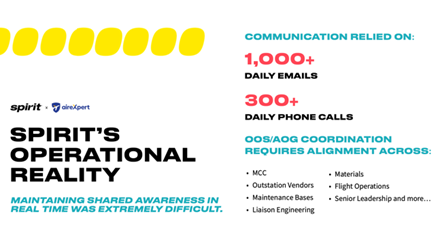
Figure 3
EVENT CONTROL
OOS events are very dynamic situations and the shortcomings of conventional communications (figure 4) impacted time-dependent operations, like crew availability. If we took too long making maintenance decisions, we would use crew time and flights had to be cancelled. We run fairly aggressive turn times on our Airbus a320 fleet, so handling a maintenance event efficiently was essential to minimize delays. But we wanted to do more than just track maintenance events: we wanted to actively control them.
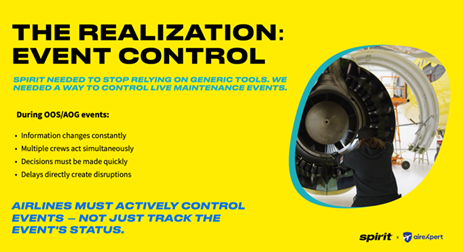
Figure 4
SHARED INTERFACE
AireXpert creates a single, shared environment for managing OOS and AOG events by enabling us to interface and coordinate activity in real-time across departments (figure 5). It also provides centralized documentation for our maintenance controllers to share troubleshooting, manual references, wiring diagrams and other types of technical documentation with technicians working on the front line. We also request parts through AireXpert.
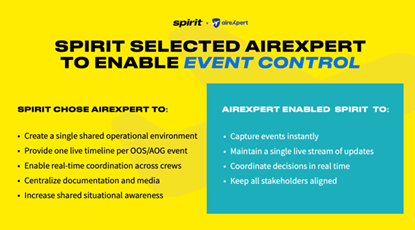
Figure 5
As a result of implementing AireXpert, our executive leadership team knows what’s going on with an OOS and quickly assesses each situation, with events captured instantly in a single livestream of updates. AireXpert runs on desktops, mobile apps, iPads and cell phones and when a notification pops up, we immediately see that an aircraft is being taken care of and can coordinate decisions in real-time.
MANAGING EVENT LIFECYCLES
AireXpert puts maintenance events into a five-stage lifecycle (figure 6) that starts with the flight crew or a technician calling Maintenance Control to report an issue using its Quick Query function, or by a phone call or email. Next comes the initial coordination stage, where we chat with, or message, the controller to clarify any points about the issue and to decide if it needs to be escalated to an OOS or if it can be quickly resolved. This enables a faster understanding of the severity of a problem and what the next steps would be. The third stage is the active event control, where an aircraft goes OOS, and we create a single workspace for Maintenance Control and the technician to share information. There is usually some back-and-forth in this ‘central hub’, where various tags can applied, if required, such as an AOG event or parts ordering.
Simplified workflow
The system allows multiple aircraft to be managed in a very simplified process. At this point, Maintenance Planning might decide that the aircraft needs a service check as well, which can be added at the same time. The fourth stage is about supporting the event using automated workflows and previous event history for better decision-making. During this stage, we track parts and materials, which includes flagging up if the most efficient route isn’t being used to move parts from point A to B. The lifecycle ends when the event is closed and the information about it is retained for future reference.
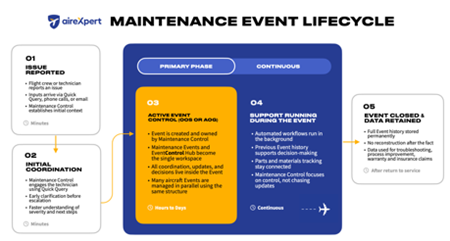
Figure 6
We use our central hub to obtain specialized advisory support from our engineering and materials colleagues (see figure 7). Overall, AireXpert enables Spirit to proactively avoid and control disruptions, so Tech Ops can shift from reactive to proactive maintenance.
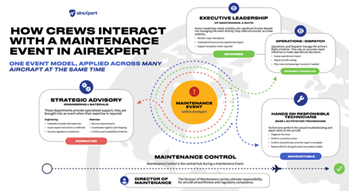
Figure 7
COUNTDOWN: 28 DAYS
It only took us 28 days to implement AireXpert, starting with our MCC (Maintenance Control Center) and outstations, where our main struggles had been with vendor coordination, dispatch decisions, escalation management and limited local visibility. Improving event control delivered immediate operational impact, with a 60 percent reduction in emails and 40 percent fewer phone calls (see figure 8), all tracked and analyzed by AireXpert.
After completion of the MCC and outstation adoption in the first week, we held employee roadshows during the second week, followed by adoption of AireXpert at Spirit bases in the third week. The final week of the 28-day transformation involved cross-departmental adoption.
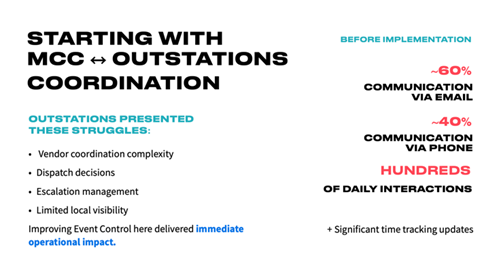
Figure 8
Speedy adoption
We find AireXpert very intuitive and user-friendly, with minimal training required, and many of our partners are familiar with AireXpert (figure 9).
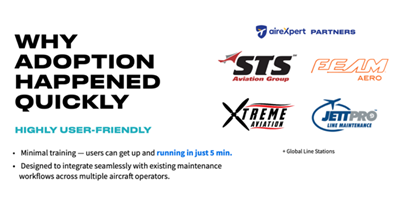
Figure 9
MEASURABLE IMPROVEMENTS
Randy Knowles
Looking at how our maintenance control has improved, we have cut an hour and a half off the almost eleven hours average OOS duration pre-AireXpert (figure 10). With the average industry rate of about $120 for every minute of a delay, the savings quickly adds up per event (figure 11).
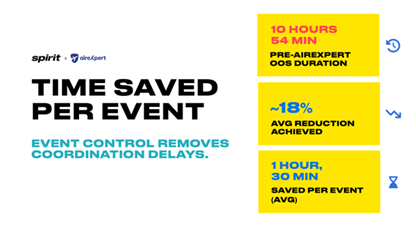
Figure 10

Figure 11
Contract maintenance costs at our outstations has fallen by 13 percent, saving us millions of dollars and ensuring that our investment in AireXpert has more than paid for itself (figure 12). In the MCC, we now spend more time resolving issues thanks to a 20 percent drop in phone calls relating to OOS events and less reliance on email (figure 13). We have even reduced language barriers with WhatsApp integration.
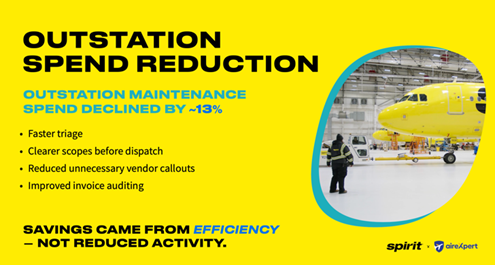
Figure 12
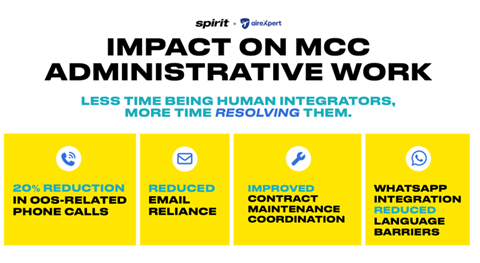
Figure 13
AireXpert has transformed our airline and the way we operate. We were delighted that in 2025, Spirit was ranked as the number three North American airline for on-time performance (via Cirium aviation analytics) and AireXpert played a major role in that achievement.
WHAT’S NEXT
With AireXpert now well-established in our maintenance operations, we are focusing on three areas to further improve event control (see figure 14).
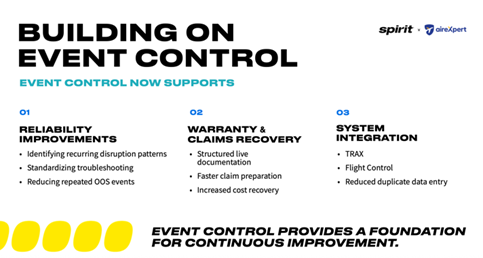
Figure 14
We aim to improve reliability, enhance our warranty and claims recovery activities, and integrate systems to reduce duplication. Event control using AireXpert enables us to continuously improve our core operational capability.
Comments (0)
There are currently no comments about this article.
To post a comment, please login or subscribe.