
Articles
| Name | Author | |
|---|---|---|
| CASE STUDY: Lufthansa Airlines advances automated maintenance planning optimization | Stefan Guigas, Senior Project Manager at Technical Fleet Management of Lufthansa Airlines, and Nathan Niebergall, Sales Director – Americas, AMOS | View article |
| CASE STUDY: Safety Management System upgrade puts JSX in control | Hayes Hodges, Manager, Safety Management Systems, JSX | View article |
| CASE STUDY: Spirit Airlines masters maintenance control challenges | Randy Knowles, Director of Maintenance & Director of Maintenance Control, Spirit Airlines and Jason Ramnath, Senior Manager of Maintenance Control, Spirit Airlines | View article |
| CASE STUDY: ADE pursues lower maintenance costs | Roben Ekananta Manullang, Material Manager for the Component Warehouse and Services (CWS) Department, ADE | View article |
| CASE STUDY: Mexicana MRO Services embraces real-time data to improve customer service | Alder Pineda, Marketing Director, Mexicana MRO services | View article |
| Bringing buyers and sellers in shipping together with what has worked well for aviation | Ed Haskey, Director of Aircraft IT and Seacraft IT | View article |
CASE STUDY: Lufthansa Airlines advances automated maintenance planning optimization
Author: Stefan Guigas, Senior Project Manager at Technical Fleet Management of Lufthansa Airlines, and Nathan Niebergall, Sales Director – Americas, AMOS
Subscribe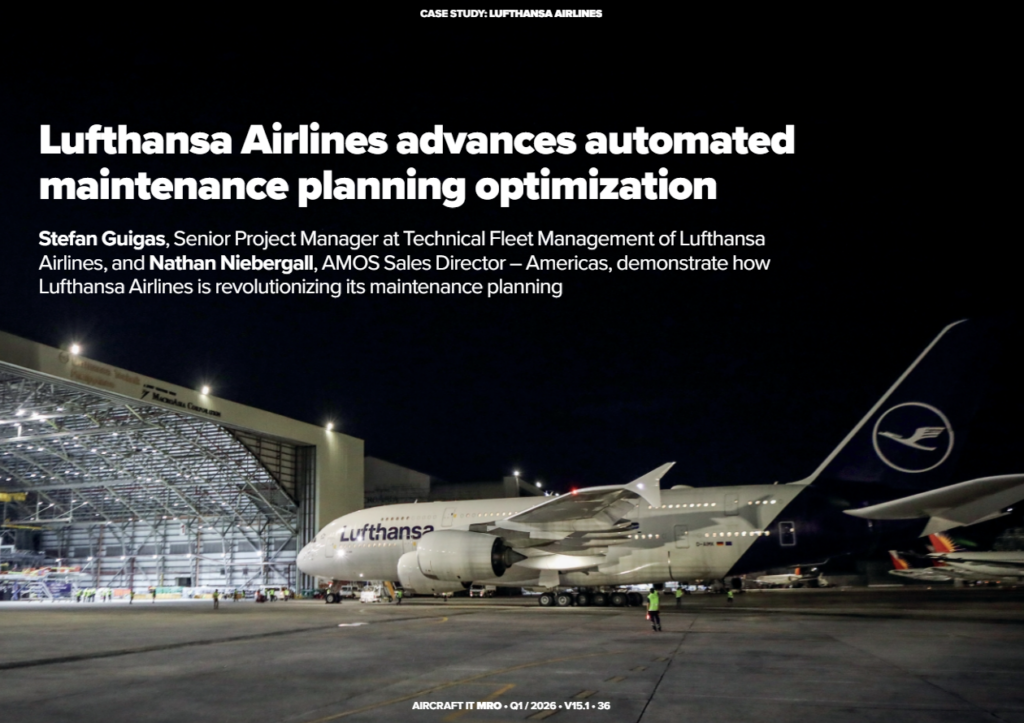
Stefan Guigas, Senior Project Manager at Technical Fleet Management of Lufthansa Airlines, and Nathan Niebergall, AMOS Sales Director – Americas, demonstrate how Lufthansa Airlines is revolutionizing its maintenance planning
Stefan Guigas
In looking at developments in line maintenance planning optimization (LMPO) and heavy maintenance planning optimization (HMPO), this case study explores how automation by Lufthansa Airlines draws on Lufthansa’s Digital Tech Ops Ecosystem, which includes AVIATAR, AMOS and flydocs. But, to better set the scene, we’ll start with a brief introduction to Lufthansa Group.
LUFTHANSA AIRLINES
A brief summary of the size of Lufthansa Group operations gives you an appreciation of the scale – and the challenges – we face in maintenance planning optimization. As part of the Lufthansa Group, Lufthansa relies on a technical fleet management team of over 6,000 employees who are responsible for the airworthiness of more than 730 aircraft (see figure 1).
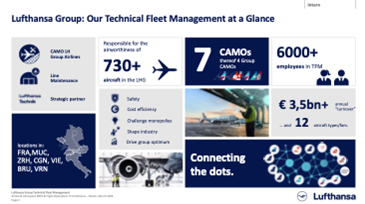
Figure 1
To achieve our maintenance goals, we work with strategic partners who include Lufthansa Technik, which provides AVIATAR, AMOS and flydocs.
Tech or humans?
Like all airlines, we face challenges as our fleet expands. Research by Boeing and Airbus shows that global commercial aircraft fleets are expected to grow by more than 53 percent until 2043, requiring 700,000 new aircraft mechanics (see figure 2).
Recruitment is an issue that is becoming increasingly significant for us. In fact, nearly one quarter of Lufthansa employees are over 55 years old, so many are approaching retirement age. The answers to many of our maintenance planning optimization challenges lie in Tech Ops digitalization.
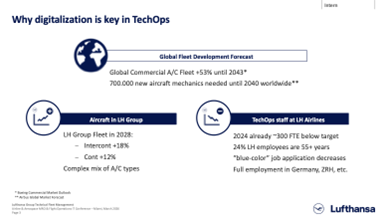
Figure 2
While growth is good for Lufthansa, the problem is that we lack qualified staff, not only in maintenance but also engineering.
DIGITALIZATION DRIVE
We are focusing on three large digitalization clusters: engineering, maintenance planning and line maintenance (figure 3).
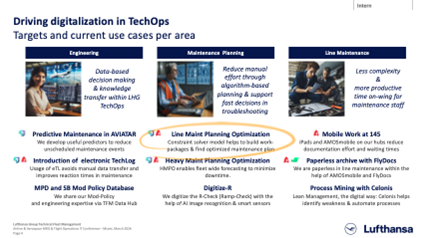
Figure 3
Worth noting here are our plans for Digitize-R to replace the R-Check daily using AI image recognition and smart sensors. Other projects in line maintenance are the implementation of AMOS Mobile and the paperless archiving of maintenance records with flydocs.
For maintenance planning, our records are handled in AMOS, with a seamless integration between flydocs and AMOS. We use flydocs to provide a standardized data set that enables us to carry out a full text search to find records. Theoretically, we can transition an aircraft from one AOC (Aircraft Operating Certificate) to another in the Lufthansa Group, which is a significant benefit for us.
UNLOCKING AUTOMATON POTENTIAL
In maintenance planning, we are unlocking automation with smart bundling, optimizing resources, and by shaping the future of CAMO (Continuing Airworthiness Management Organization) operations (see figure 4).
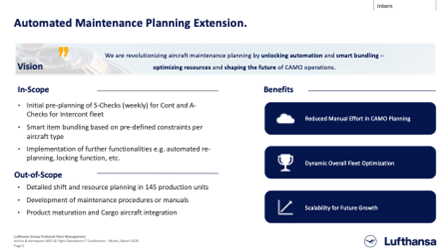
Figure 4
Our project includes pre-planning weekly S-Checks for continental aircraft, while A-Checks for our long-range fleet are usually every two to three months.
By using smart item bundling, we have taught Aviatar to obey the parameters we give it; for example, replacing a fuel filter and a supply filter both require a run up afterwards. If you combine them, you can save on run ups, time and materials. As well as reducing manual effort, the LMPO project should also improve overall fleet optimization and give Lufthansa scalability for future growth.
MILESTONES AND CHALLENGES
Currently, we have 173 aircraft in the soft ‘go-live’ of our automated maintenance planning as we transition to AVIATAR (figure 5). A series of change management roadshows held at every station in Germany has helped to reduce people’s concerns about technology replacing humans.
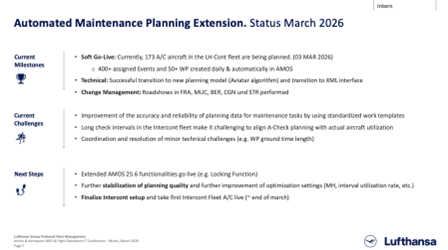
Figure 5
We still face numerous challenges and have a lot more work to do, especially around the accuracy and reliability of planning data. We are also looking at aircraft utilization, particularly for our long-range fleet. We want to introduce standardized work templates, where Lufthansa Airlines’ technical fleet management team will clean up the data and create a workstep repository in AMOS containing information, such as how much ground time and manpower you need, what kind of resources, and how much material.
Our next steps include adding further functionality, such as a locking function for staff to use (see the ‘sneak preview’ below), stabilizing planning quality and finalizing the intercontinental fleet setup.
LMPO IMPROVEMENTS
We have already overcome many challenges with AVIATAR and are turning it into a useful LMPO tool (figure 6).
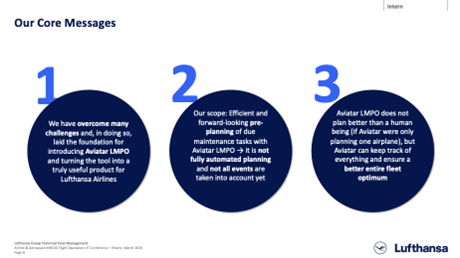
Figure 6
In our pre-planning, humans are still responsible for the work package, so it is not fully automated. We find that change management for our workforce continues to be a big issue for us. That said, we tell our people that AVIATAR does not plan better than a person, but it is a tool that humans can use to work better and to get the optimum result for the whole fleet.
LMPO EXAMPLES
Our LMPO automation is now taking shape, as these examples illustrate. Figure 7 shows an AMOS work package relating to several of the 173 aircraft currently live on the project.
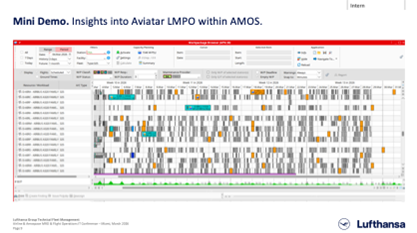
Figure 7
On the left are the tail signs and dates are along the top. The grey rectangles are the flight legs, and the orange rectangles are work packages. This is the type of maintenance event information that Aviatar will transfer to AMOS.
The work package in figure 8 focuses on an S-Check created by AVIATAR, including a future event.
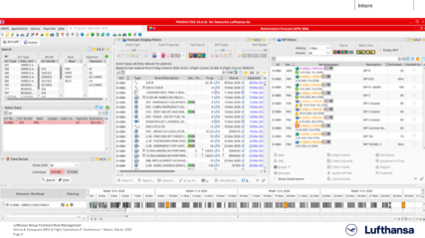
Figure 8
Overall, our policy is that as soon as a person changes something, they should also change the description, so that we know a human has worked on it.
The work packages shown in figure 9 were created by AVIATAR.
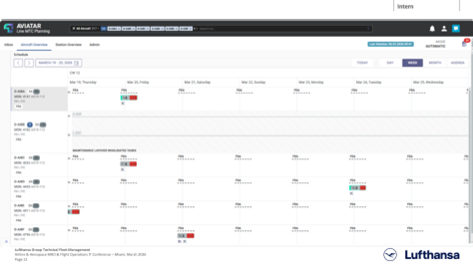
Figure 9
All those Workpackages including the maintenance events were built by AVIATAR LMPO and created fully automatically, with no clicks at all, which is a huge milestone and we are very much pleased about.
ADDING FUNCTIONALITY
We are currently preparing to introduce a locking function that means the human planner is the ‘master of planning’, as it gives back to them certain capabilities (see figure 10).
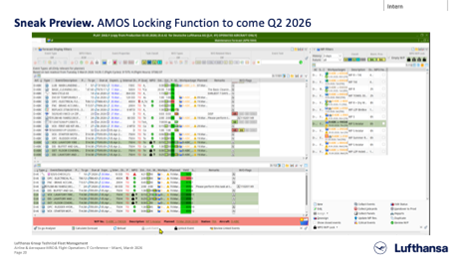
Figure 10
For example, if they put a maintenance event on a work package, they can lock the event on that package and on a date as well.
Nathan Niebergall
HEAVY MAINTENANCE
In addition to LMPO, Aviatar is working on an HMPO project in conjunction with AMOS. Like LMPO, the great thing about the heavy maintenance project is how it integrates AVIATAR with AMOS.
When we talk to airlines and MROs, one thing they ask for is having some sort of a forecast capability. There are some strong tools out there already that do heavy maintenance planning, but the fact that we can integrate into the M&E (maintenance and engineering) system seamlessly is what’s most important here. Our HMPO (see figure 11) automatically creates work packages from the fleet data from the due dates, and all other applicable constraints, which are within AMOS.
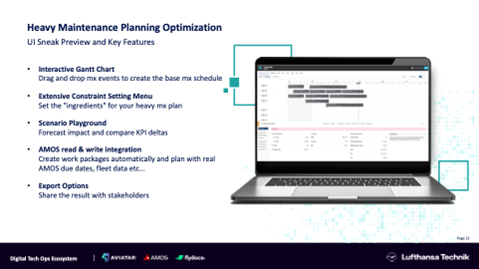
Figure 11
This makes our HMPO tool extremely powerful, especially when you assess the financial impact – the ROI (Return On Investment) and when to schedule aircraft downtime because some of these heavy checks can take a lot of time.
HMPO benefits
The ability to create unlimited scenarios and run them against potential due dates and potential constraints, then within minutes see the impact, is extremely valuable for airlines and MROs. We have been working on this project for about a year and seven customers are currently helping to develop and test it (figure 12).
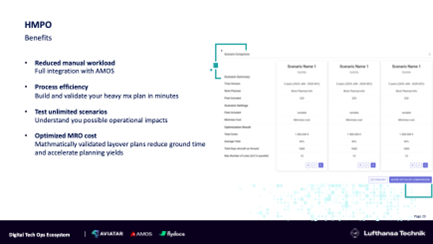
Figure 12
We plan to start bringing the HMPO to new customers Q3 2026.
Comments (0)
There are currently no comments about this article.
To post a comment, please login or subscribe.