
Articles
| Name | Author | |
|---|---|---|
| CASE STUDY: From startup to multi-station airline: BeOnd digitizes and scales up flight operations | Zain Eejaz, Manager, Flight Operations Technical & Planning, BeOnd | View article |
| CASE STUDY: Saving fuel in the climb at KLM Cityhopper | Torsten van Kouwen, Business consultant ATM and & Matthies Dubelaar, Business Pilot Digitizing; both at KLM Cityhopper, Flight Operations | View article |
| CASE STUDY: Wizz Air achieves greater fuel efficiency, during descent | Captain Petros Souppouris, Safety Captain and Fuel Efficiency Promoter, Wizz Air, and David Bronks, Key Account Manager, AVTECH | View article |
| CASE STUDY: Peach Aviation optimizes airport and obstacle data management | Yuya Maeda, Performance Engineer, Peach Aviation | View article |
| CASE STUDY: Marabu Airlines improves EFB-to-Operations and Crew Management data handling | Maxim Dubovik, EFB Administrator & Manager, Marabu Airlines | View article |
| CASE STUDY: The perfect balance with documents at Sunclass Airlines | Anders Hofmeister, Captain and Manual Administrator, Sunclass Airlines | View article |
| CASE STUDY: A rapid digital evolution at Discover Airlines | Alexandra Kosjuberda, Manager Crew Training, Discover Airlines | Sarah Kurowsky, Manager Flight Ops Engineering Support, Discover Airlines | Arne-Martin Gruene, Project Manager, Lufthansa Industry Solutions | View article |
CASE STUDY: Wizz Air achieves greater fuel efficiency, during descent
Author: Captain Petros Souppouris, Safety Captain and Fuel Efficiency Promoter, Wizz Air, and David Bronks, Key Account Manager, AVTECH
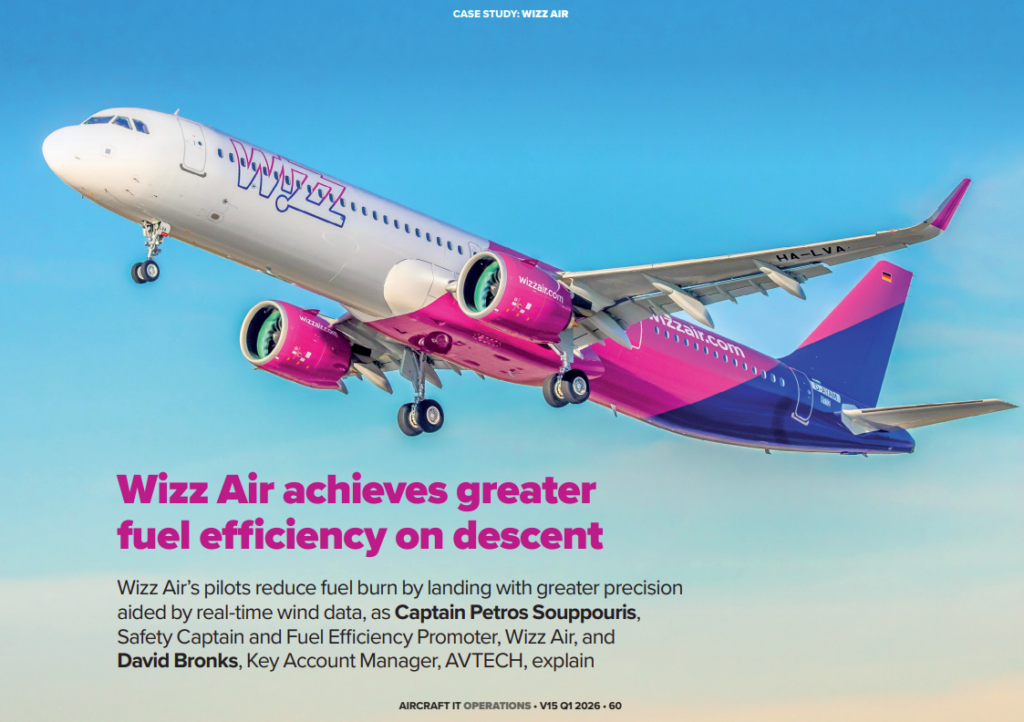
SubscribeWizz Air’s pilots reduce fuel burn by landing with greater precision aided by real-time wind data, as Captain Petros Souppouris, Safety Captain and Fuel Efficiency Promoter, Wizz Air, and David Bronks, Key Account Manager, AVTECH, explain
Captain Petros Souppouris
The focus of this case study is the commitments Wizz Air has in reducing fuel burn on descent and how we are working in partnership with AVTECH to solve them using real-time wind data uplinks to the FMC (Flight Management Computer). Up to 5.8 million euros in cost savings can be achieved by implementing improvements, as demonstrated by the results included here.
WIZZ AIR
The airline operates mainly in Europe, with focus on Central and Eastern Europe. We make approximately 1,000 flights per day with a fleet of more than 250 aircraft (figure 1). Our fleet consists of more than 72% Airbus 321neos and we aim to carry more than 68 million customers in 2026.
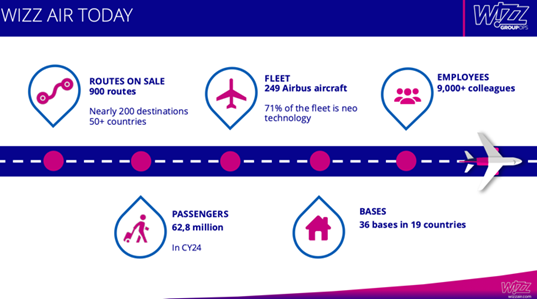
Figure 1
Wizz Air was established in 2000 and was floated on the stock exchange in 2014. The business model of our ultra-low-cost airline requires new, fuel-efficient aircraft for the fleet and, of course, the most effective fuel consumption. The fuel efficiency commitment comes from flying to nearly 200 destinations in over 50 countries, where the size of airports varies considerably (figure 2). We needed to find a way for our pilots to evaluate local wind conditions and to calculate the length of descent accurately in order to select the most fuel-efficient options available to them at the time.
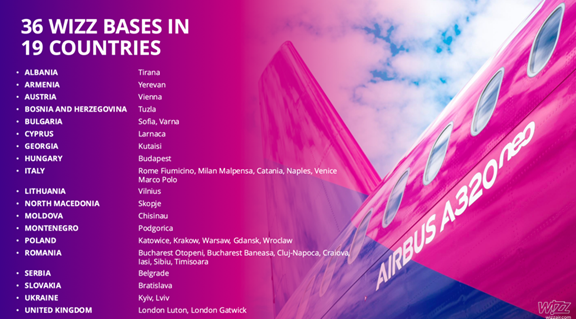
Figure 2
EVALUATING THE BUSINESS CASE
In 2021, we began a trial with AVTECH before signing a three-year agreement in November 2023 and deploying the firm’s Aventus and SIGMA services. This involved undertaking a case study in our Airline Operations Centre (AOC) with 18 aircraft and analyzing the data it produced. The case for implementing Aventus was proven following a successful evaluation, and, in 2025, we extended the contract to Wizz Air in Hungary and Malta. That means we now have all of our AOCs and aircraft running with the same service.
FUEL CHALLENGES ON DESCENT
There are various reasons that pilots may increase fuel burn on descent (see figure 3). Typically, fuel burn flying into airports with a descent from about 130 to 140 miles towards touchdown could range from 270kg in some airports to 800kg at others. The FMGS (Flight Management Guidance System) calculates the descent profile at the top of descent, provided it has accurate wind information. In collaboration with AVTECH we focused on improving the accuracy of the wind data used by the FMGS, enabling it to calculate a more optimal and fuel-efficient descent profile.
One of our key challenges is that descent conditions vary significantly between airports. At major hubs such as Frankfurt and Heathrow, high traffic density and complex airspace often make it more difficult to fly an optimal descent, resulting in higher fuel burn.
In contrast, at airports like Larnaca in Cyprus, lower traffic levels typically allow pilots to plan and execute a more predictable and efficient descent. Fuel consumption during descent is also influenced by air traffic control (ATC) instructions and, ultimately, by the pilot’s tactical decisions in response to those constraints.
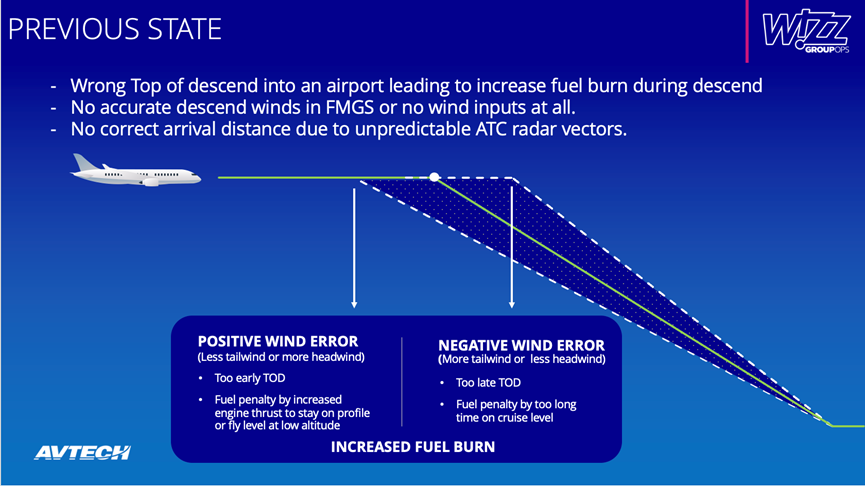
Figure 3
According to our estimates, initiating the descent just 10 nautical miles later than planned can result in an additional 100 kg of fuel burn, highlighting the importance of accurate descent planning. On every flight, pilots must assess where the descent will begin and typically follow standard arrival routes, particularly when operating regularly into the same airport. To improve fuel efficiency, our objective was to enhance the FMGS accuracy, both in terms of the distance remaining to touchdown and the wind data used to calculate the descent profile.
David Bronks
DELIVERING THE MOST COST-EFFICIENT DESCENT TRAJECTORY
Aventus is built on a patented routing algorithm that dynamically selects the most relevant wind data along the aircraft’s actual flight path. Combined with high-resolution weather data from the UK Met Office and the aircraft’s actual performance weight, it allows for highly accurate predictions to the Flight Management Computer (FMC). As a result, FMC predictions are significantly improved, leading to immediate fuel savings and supporting greater operational efficiency, improved punctuality, and overall enhanced flight performance.
The services operate with minimal workload for pilots, while providing data that is available throughout the entire flight, from initialization through to landing. Accurate, real-time wind and temperature information is tailored to each individual flight (see Figure 4) No additional onboard hardware is required, as all calculations are performed on the ground and transmitted to the aircraft via the existing ACARS (Aircraft Communications, Addressing and Reporting System) data link.
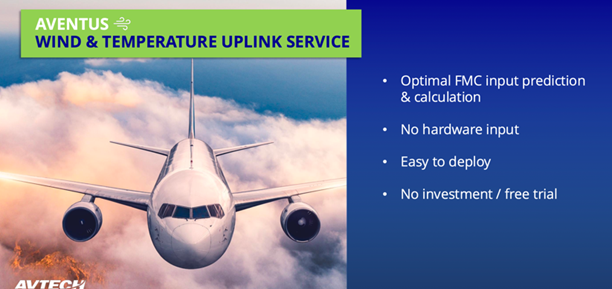
Figure 4
TAILORED UPLINKS
The ACARS data link provides cost-efficient access to information that is easy for pilots to use in operation. Pilots simply request wind data from Aventus, which is then automatically transmitted to the aircraft and is also available upon manual request. Aventus is tailored to each airline’s specific operational requirements (figure 5), but what sets it apart from other static solutions is the high-resolution weather information from the UK Met Office in combination with actual aircraft performance and route data. As part of the service, AVTECH provides a fuel benefit analysis, enabling airlines to track where fuel savings are being achieved. Through a dashboard, operators can monitor savings in real-time, review flight-specific results, and gain an overview of measurable fuel and time savings.
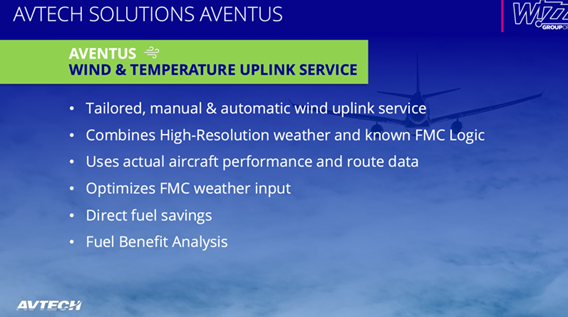
Figure 5
Dynamic wind selection
Shortly after take-off, Aventus automatically uplinks real-time wind data to the flightdeck FMS. Prior to top of descent a new automatic uplink is communicated with fresh optimized dynamic descent winds. This ensures that pilots continuously receive the latest optimized wind information during cruise and descent thus supporting an improved flight optimization and enhanced operational performance.
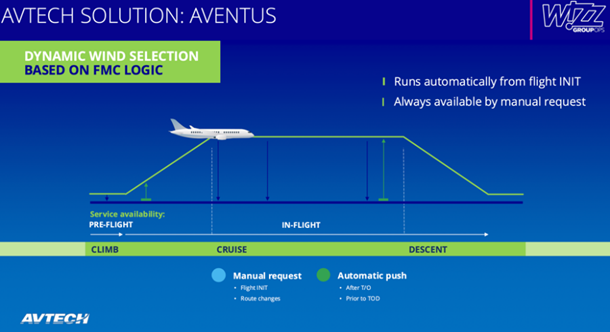
Figure 6
USING FMC LOGIC
Using a patented algorithm, Aventus dynamically determines the optimal set of wind data that best represents the expected atmospheric conditions during the descent and uplinks it directly to the FMS. By providing only the most relevant and precise wind and temperature inputs, the system enables the FMS and autopilot to manage speed and thrust more efficiently, supporting optimized throttle usage and improved fuel efficiency. AVENTUS recalculates the predicted descent upon request.
Following a re-route, it provides an updated descent wind path and refreshed wind and temperature data aligned with the aircraft’s revised track and timing.
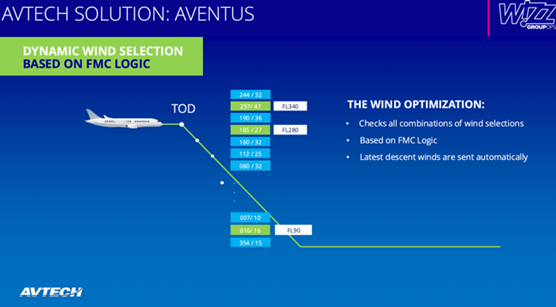
Figure 7
Captain Petros Souppouris
GAINING PILOT ENGAGEMENT
An important factor in the success of Aventus was ensuring that our pilots were actively using it and that the system was easy to use alongside other duties. Following tests of Aventus across the Wizz Air UK fleet, 95% of pilots engaged with the programme and were satisfied with it. If they aren’t fully engaged with it, then we wouldn’t save fuel. We found the best way to achieve this was to make the service as easy as possible for them. We include it in the SOPs (Standard Operating Procedures), so it is part of their workflow.
In the flightdeck, the signal on FMC about 15 minutes after take-off (figure 8) is easy to understand. Pilots can request wind and temperature information at any stage for all the flight levels going up, horizontally, and during the descent.
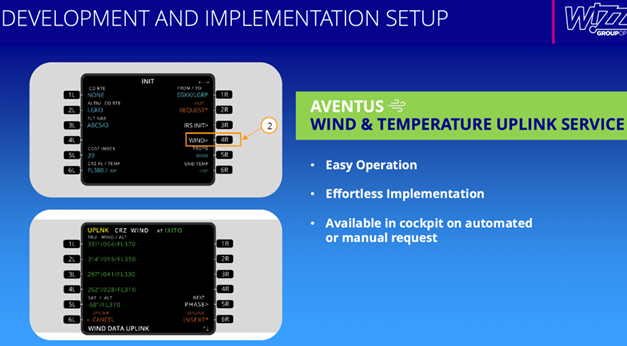
Figure 8
Another dashboard shows how forecast winds compare with Aventus information (figure 9). We found that there can be a significant difference between manually inputting data to forecast winds and getting the system to do it for you.
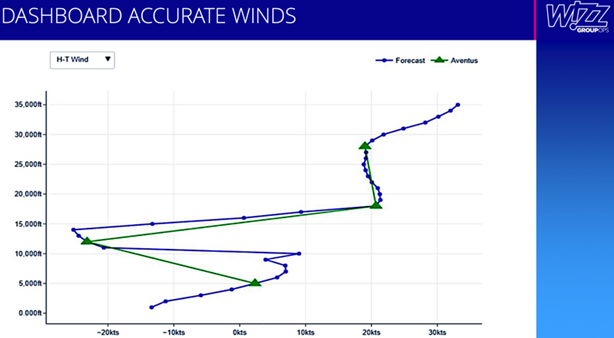
Figure 9
POSITIVE TEST RESULTS
We carried out a detailed analysis to see if we were making fuel cost savings by using Aventus. For this, we chose both smaller and larger airports, calculating fuel burn on descent with and without Aventus. The following four examples took place between September and November 2024, with the same type of aircraft.
Starting with airport A (figure 10), we calculated the fuel burn from 150 miles towards touchdown to 70 miles before touchdown. The benefit of using Aventus was 8.7kg less fuel burn. Then, we looked at 150 miles to 30 miles before touchdown, where the fuel saving with Aventus was 14.9kg.
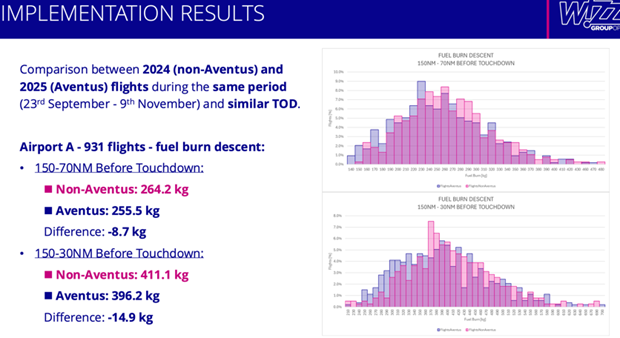
Figure 10
Next, we have airport B (figure 11), where we based the analysis on 407 flights. Here, the fuel saving on 150 miles to 70 miles before touchdown was 4.0kg and 11.9kg for 150 miles to 30 miles before touchdown. Both results were good for us and this was attributed to the accuracy of the real-time wind uplinks.
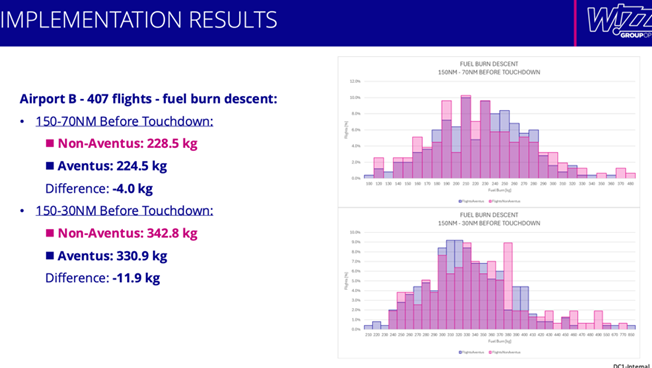
Figure 11
For the third airport (figure 12), the trial featured 478 flights, achieving fuel savings of 16.0kg and 18.9kg on the two respective flight descents. It’s worth noting that most fuel is burned in the final 30 miles and below 10,000 feet, but this is also where you get most of ATC radar headings into the airport. That is why many airlines are working with companies like AVTECH to optimize descent speeds and predict radar headings. For example, one method would be to start at around 125 miles total descent and then idle descent towards 1,500 feet, which is what we are seeing happening in some small airports.
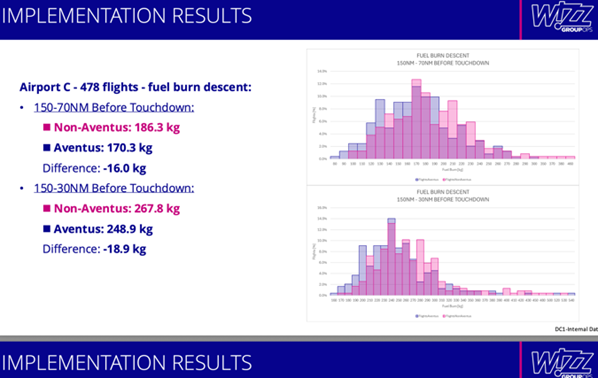
Figure 12
Finally, we have airport D (figure 13), where we achieved fuel savings of 10.0kg and 19.7kg, which was significant. You also have to bear in mind that apart from wind uplink information, a lot of the success in fuel efficiency comes down to the combined efforts of the pilots and the air traffic controllers.
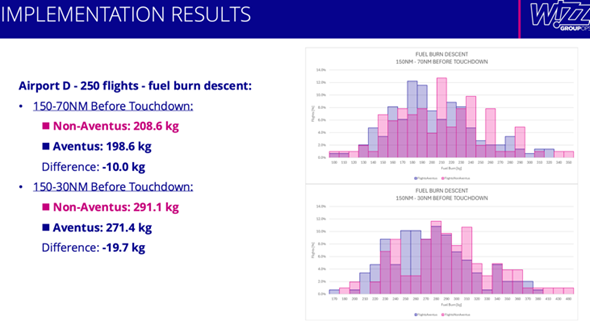
Figure 13
Getting the right data in all areas is the key to greater fuel efficiency on descent. By programming FMGS correctly especially getting the correct distance to touchdown, pilots have greater fuel efficiency on descent. That is why education and pilot training was essential to Wizz Air’s rollout of Aventus. We hold regular online discussions with our pilots to educate them about Aventus and to pass on the key message that fuel savings benefit the environmental targets as well.
Comments (0)
There are currently no comments about this article.
To post a comment, please login or subscribe.