
Articles
| Name | Author | |
|---|---|---|
| CASE STUDY: AirAsia Indonesia accelerates uptime and cuts costs by digitizing AOG parts sourcing | Haryo Hadie Negoro, Manager, Material & Purchasing Control, AirAsia Indonesia | Ahmad Naim Abdullah, Manager, Digital Transformation – Operations, Asia Digital Engineering (ADE) | View article |
| CASE STUDY: Southwest Airlines realizes the Power of historic data and digital maintenance | Barry Lott, Director of Aircraft Records and Maintenance Reliability, Southwest Airlines | Cameron Byrd, Founder and CEO, AIXI | View article |
| CASE STUDY: Accelerating Aviation Transformation at XWing | Jeffrey Wehrenberg, CEO, XWing | Jim Buckalew, CEO, AeroATeam | View article |
| CASE STUDY: How interCaribbean ended its paper chase by switching to electronic technical logs | Hugo Mendez, Director of Safety and Quality Assurance, interCaribbean Airways | View article |
| CASE STUDY: Modernizing asset records at CommuteAir | Heather Hinton, Director of Maintenance Programs, CommuteAir | View article |
| CASE STUDY: SolitAir embraces digital-first maintenance and engineering from day one | Sandeep Kumar, Director – Engineering & Maintenance, SolitAir | View article |
CASE STUDY: Southwest Airlines realizes the Power of historic data and digital maintenance
Author: Barry Lott, Director of Aircraft Records and Maintenance Reliability, Southwest Airlines | Cameron Byrd, Founder and CEO, AIXI
Subscribe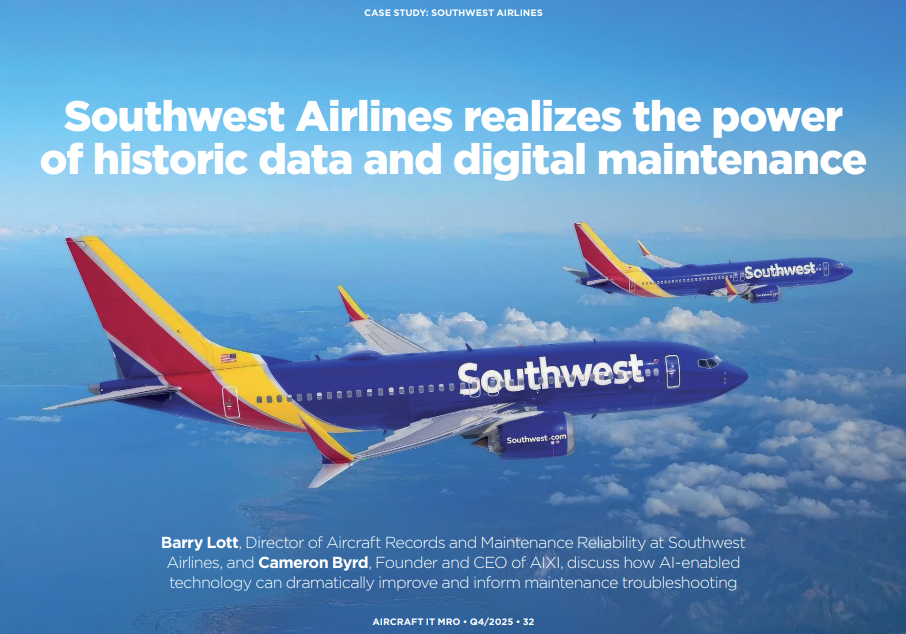
Barry Lott, Director of Aircraft Records and Maintenance Reliability at Southwest Airlines, and Cameron Byrd, Founder and CEO of AIXI, discuss how AI-enabled technology can dramatically improve and inform maintenance troubleshooting
This case study highlights how Southwest is using AI-enabled tools to extract strategic value from its maintenance records. It was also the subject of a joint presentation by Barry Lott and Cameron Byrd at the Airline & Aerospace MRO & Flight Operations IT Conference in late 2025.
Barry Lott
DRIVING DATA IN THE RIGHT DIRECTION
Southwest is committed to providing our aircraft maintenance and reliability teams with the most accurate data and advanced tool sets to optimize their efficiencies and effectiveness. Our journey to do that began with the reliability team, which I lead, and the data that helps us improve our fleet’s mechanical reliability and ensure compliance with our approved maintenance program. Southwest has built a product with AIXI that extracts value from previously unstructured data and maintenance logs. We continue to build tools that work on top of this data to extract information and deliver it to the right users.
KNOWLEDGE IS KING
Like every airline, Southwest faced a challenge: reliability analysts and engineers were tasked with improving the aircraft’s mechanical reliability by sifting through massive volumes of maintenance data to identify areas that could make a positive difference in the operation. To do this, we relied on SQL queries of unstructured data, Excel spreadsheets, and self-developed databases. This process was both complex and extremely time-consuming. We realized that there had to be a faster, more reliable, and consistent way.
From a front-line perspective, we also had the challenge of passing on years of troubleshooting and repair knowledge from our experienced aircraft maintenance technicians to our newer employees. Even with less aircraft maintenance experience, our newer (often younger) employees are technologically savvy. We are also competing to recruit them, not just from other airlines, but also against companies that make rockets and self-driving cars, and all the while, aircraft are becoming more complex to maintain. Digital maintenance was the solution to these challenges.
Manual Process Limitations
When we assessed how to improve our data, two things were evident. First, today we have needed information in our historical maintenance datasets. We didn’t have a way to give technicians the ability to quickly find relatable discrepancies, retrieve this data, and then use that data to learn from it.
Here’s an example: If you are driving your car, and an engine warning light comes on, most people with some mechanical knowledge will go online and search using an AI tool, YouTube, or Google to identify what the problem is and how to solve it. The answers are based on the collective knowledge of similar problems and previous successful solutions. That’s not been the case with aircraft maintenance. When I (Barry) joined the aviation industry back in the DC-9 and Boeing 727 era, maintenance manuals were paper-based. It was a step forward when we moved to microfiche, and we didn’t have to carry those big manuals around. Then, we went to floppy disks and PDFs. Today, our mechanics use iPads with Internet access to help maintain our aircraft. Now, it’s time to empower them with better data.
Tackling Data and Text Variations
Second, while our mechanics are very good at repairing aircraft, they are also required to document how they made those repairs, and the least favorite tool in their toolbox is their pen or keyboard. Misspellings, acronyms, and abbreviations often appear in this unstructured data. This complicates efforts by our analysts trying to find trends and solutions, making the research and analysis process slow and tedious.
If you cannot reliably find the data you are looking for, you risk having an incomplete picture of the problem. The various spellings of the term ‘oxygen light’ show this simple example. (Figure 1)
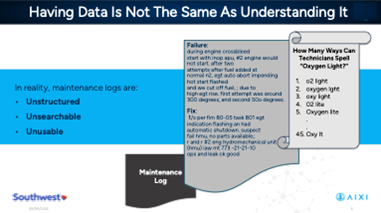
Figure 1
Creating A Real-Time Data Translator
At Southwest, we needed to access and understand our maintenance data before we needed another dashboard. We wanted to make sense of the unstructured data and apply standardized ATA coding, as well as additional key descriptions of the aircraft’s component/system, how it failed, and how the defect was resolved. AIXI’s ATA AutoCoder became foundational to our reliability program and the tools that we could build on top of it.
Using All of Our Data
One of the most significant enhancements of the AIXI ATA AutoCoder was the ability to quickly classify 100% of Southwest’s defects and non-routines, regardless of where the defect was documented, be it a logbook, on a regular check, or non-routine.
Many airlines will audit 100% of their log page entries, but only a limited number of their heavy check findings, thinking they have a representative sample. For Southwest, the benefit of classifying 100% of our maintenance data is that when we adjust our maintenance program, we can confidently say that our analysis is based on all of the applicable aircraft, with all of the finding data considered. We aren’t concerned that our fleet or data sample size is not reflective of what would be required. It just ends that question or concern. We could not do that without AIXI’s AutoCoder; it would simply take too much time.
Cameron Byrd
AI TOOLS THAT PROVIDE REAL-TIME RESULTS
Southwest’s interest in automating ATA coding was bolstered by knowledge that their primary manual coder was planning to retire. The plan was to automate the coding process using artificial intelligence (AI) built by their internal teams. Unfortunately, they were unable to achieve the desired accuracies, so they reached out to AIXI. Our team is rooted in the advanced learning group at intel and has had extensive aviation experience having worked with Boeing and the Navy. Leveraging large language model (LLM) technology, barely in its infancy in 2019, AIXI was able to create an ATA AutoCoder capable of extracting information from complex log entries in the form of the 7 code types as seen in Figure 2.
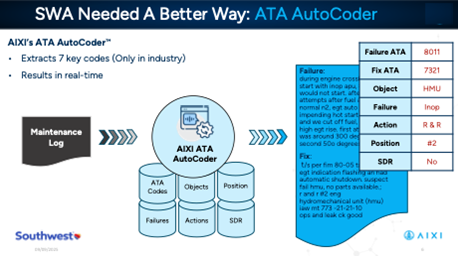
Figure 2
95% Accuracy in Real Time
Not only were we capable of automating the process, but our AutoCoder runs in real time with an accuracy rate of 95% and above. (Figure 3) AIXI’s AutoCoder doesn’t rely on a keyword approach or older NLP technology; it understands context. Even with new misspellings, it will still recognize and translate Barry’s ‘oxygen light’ example appropriately.
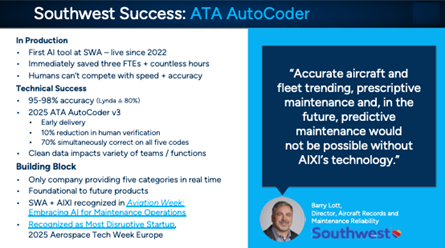
Figure 3
Providing Speed and Time
AIXI’s ATA AutoCoder went into production at Southwest in 2022. On day one, we saved the equivalent of three full-time employees and countless hours, freeing Southwest’s team to focus on other projects that depend on log entries being coded accurately. Now on Version 3, the AIXI team has improved our algorithm and models so that we can create other products to help Southwest with its MRO process.
Barry Lott
GET TECHNICIANS READY BEFORE THE AIRCRAFT LANDS
Think of a pilot on a flight from Dallas Love Field to Orlando. Somewhere above Atlanta, the pilot enters a discrepancy in the electronic logbook that automatically populates our maintenance system. When the aircraft is close to arrival, the technician on the ground enters the aircraft number on their iPad and is shown the original defect, plus the most common solutions potentially applicable to the original defect recorded. That’s possible because we’re using all of the data from our previous fixes to learn forward.
We want to make it easy for AMTs to confidently use a tool like this as a guide, putting the information in front of them when they need it. Contrast this approach with ”shotgun troubleshooting,” where sometimes the easiest component to replace is not the one that permanently fixes the problem, but the one that gets the aircraft out of the station.
What we see as the ideal solution is a tool that provides the AMT with defect resolution data alongside what has proven to be the most effective corrective actions, effectively stopping a recurring defect loop. The tool should provide the suggested AMM or task card references, tooling or components, and even the MEL code, along with the probability and duration of delay if the defect cannot be corrected, and give all of that to the technician before the aircraft is even at the gate. With that type of insight, our AMT could meet the aircraft, talk with the pilot, and carry out their own troubleshooting from an informed perspective. This reduces the time to a first-fix, limits delays, and keeps passengers happy.
Cameron Byrd
BUILDING ON A STRONG KNOWLEDGE BASE
Using Barry’s example, AIXI’s Prescriptive Maintenance tool (Figure 4) gives technicians exactly those types of insight – aircraft information, squawk description, and possible fixes. Delay probabilities are included, helping teams decide what to tell the passengers and if they need to bring in a backup aircraft.
All of the information presented in this tool is pulled from categories generated by AIXI’s ATA AutoCoder. The additional information on previous fixes, including our patented algorithm that indicates the likely percentage of a “final fix.” In Figure 4, the part that was replaced 62.88% of the time only has a final-fix rate of 16.46%. That’s useful information to a technician working on a tight schedule and managing significant delay costs.
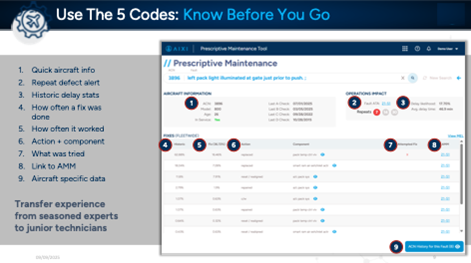
Figure 4
IDENTIFYING REPEAT DEFECTS
Repeat problems present another key area to tackle. AIXI’s Repeat Defect Identification tool (Figure 5) allows team members to select parameters, such as duration, the number of defects, specific ATAs, and fleet type, to get insights on top repeat and reliability issues. By ranking and weighting items based on an airline’s criteria, teams can immediately focus on the top problems and escalate if needed.
Figure 5 shows the ”Most Repeated Defects by ATA” view. Again, using historic and real-time maintenance data, we can provide top challenges based on repeat ATA codes not just a specific aircraft. This quickly helps can help a reliability team determine bottom-line impacts and make informed decisions.
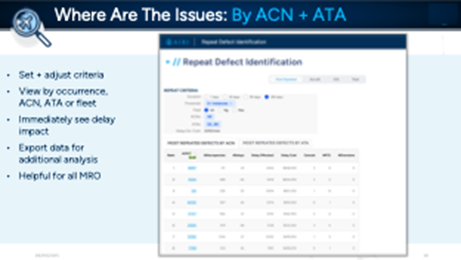
Figure 5
AIXI’s Repeat Defect Identification tool also shows maintenance reports for each aircraft. Teams can use AIXI’s AI summary feature to instantly generate a maintenance report by aircraft (Figure 6) to learn the cost impact, delays, and ATAs associated with an airline’s most problematic aircraft.
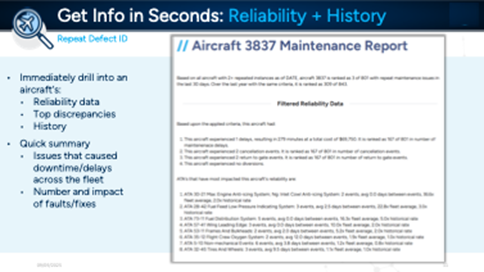
Figure 6
Barry Lott
EMPOWERING MAINTENANCE TEAMS
One of the best things for Southwest is that AIXI tools simply empower, but don’t replace, our key maintenance and reliability teams. The reports, based on our now structured data, quickly give a high-level overview and save time for our analysts. The AI-generated insights can tell our analysts if they need to dig deeper into the identified trend, or if it was an anomaly that should be monitored, with no immediate action required. The analyst’s work does not go away, instead it is focused on where they can best make a difference. And for our front-line technicians, they have the capability to ask questions through a tool that quickly and accurately provides answers.
Cameron Byrd
A RELIABILITY CHATBOT THAT ANSWERS WITH YOUR DATA
Among AIXI’s most exciting tools is one that can interrogate an airline’s data using simple natural language queries. Ask OTTO, AIXI’s real-time chatbot agent, is armed with dedicated information from an airline’s maintenance records, manuals, and other data sources. Ask OTTO can answer questions to jump-start an analyst’s work or support a technician in a critical moment. The example in Figure 7 shows the AMM links to the procedure for cleaning up a mercury spill, delivered in seconds, removing the laborious task to search through manuals.
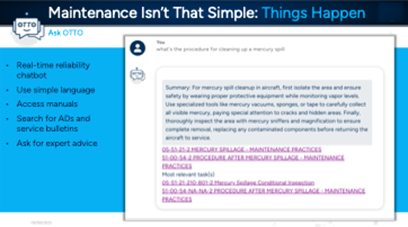
Figure 7
Ask OTTO also handles more complex questions, ones that could take an analyst a full afternoon or even days to answer. Figure 8 shows Ask OTTO providing a summary of the most common ATA codes in the last nine months, grouped by fleet. The result is a data snapshot and summary, plus the ability to download the data for additional reporting, graphs, or analysis.
Barry has tested Ask OTTO during its daily morning meetings to get quick answers to questions before they turn emotionally driven goose chases. This allows leaders to focus on actual challenges without having to wait for visibility into questions that may or may not require an additional data dive.
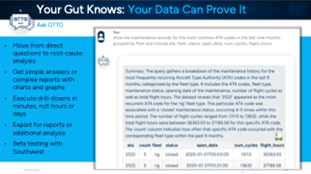
Figure 8
Barry Lott
CONCLUSIONS
AIXI’s ATA AutoCoder and the tools built on top of robust, clean maintenance data remove the need for technicians and reliability teams to rely on ‘gut feelings.’ They can use real data that is immediately accessible to fix planes and reduce AOGs. AIXI’s platform of tools, grounded by the ATA AutoCoder, empower a small reliability team or technician to do the work of multiple people by instantly extracting information they need.
Southwest’s approach is all about how you use data (Figure 9). First, you need to know your data, then clean and structure it in a way that can be easily understood. To work effectively, you also need to speak the language of your users by creating intuitive onscreen dashboards they can easily understand.
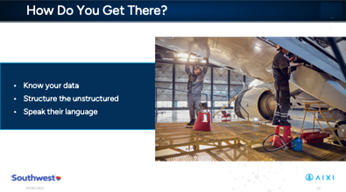
Figure 9
Southwest’s maintenance data is now in a structured format that is consistent and accurate, and we also have tools on top of it that allow us to query the data, run reports, and use those tools to recommend and guide what maintenance we need for our aircraft so that Southwest can dramatically improve performance.
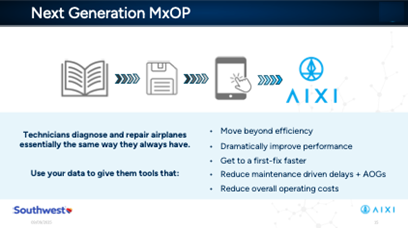
Figure 10
If Southwest had not made this change, we would have remained compliant with regulations, but we would not be as efficient and forward-thinking as we are today, or as we envision we will be tomorrow. What was once raw, unstructured data is now smart, actionable intelligence, empowering us to make faster, more efficient decisions that improve aircraft reliability, and the foundation of what provides this ability is our ATA AutoCoder.
Comments (0)
There are currently no comments about this article.
To post a comment, please login or subscribe.