
Articles
| Name | Author | |
|---|---|---|
| CASE STUDY: AirAsia Indonesia accelerates uptime and cuts costs by digitizing AOG parts sourcing | Haryo Hadie Negoro, Manager, Material & Purchasing Control, AirAsia Indonesia | Ahmad Naim Abdullah, Manager, Digital Transformation – Operations, Asia Digital Engineering (ADE) | View article |
| CASE STUDY: Southwest Airlines realizes the Power of historic data and digital maintenance | Barry Lott, Director of Aircraft Records and Maintenance Reliability, Southwest Airlines | Cameron Byrd, Founder and CEO, AIXI | View article |
| CASE STUDY: Accelerating Aviation Transformation at XWing | Jeffrey Wehrenberg, CEO, XWing | Jim Buckalew, CEO, AeroATeam | View article |
| CASE STUDY: How interCaribbean ended its paper chase by switching to electronic technical logs | Hugo Mendez, Director of Safety and Quality Assurance, interCaribbean Airways | View article |
| CASE STUDY: Modernizing asset records at CommuteAir | Heather Hinton, Director of Maintenance Programs, CommuteAir | View article |
| CASE STUDY: SolitAir embraces digital-first maintenance and engineering from day one | Sandeep Kumar, Director – Engineering & Maintenance, SolitAir | View article |
CASE STUDY: AirAsia Indonesia accelerates uptime and cuts costs by digitizing AOG parts sourcing
Author: Haryo Hadie Negoro, Manager, Material & Purchasing Control, AirAsia Indonesia | Ahmad Naim Abdullah, Manager, Digital Transformation – Operations, Asia Digital Engineering (ADE)
Subscribe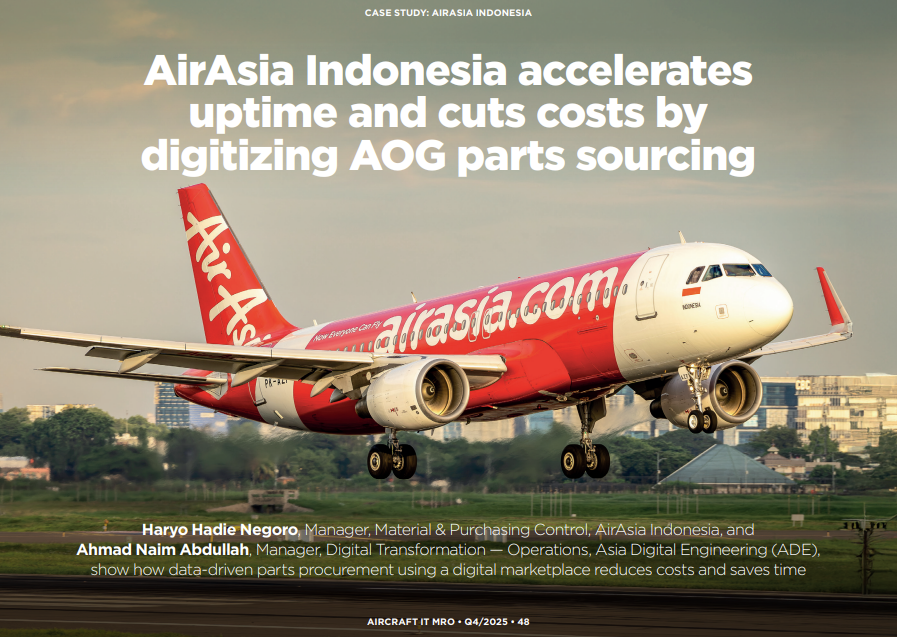
Haryo Hadie Negoro, Manager, Material & Purchasing Control, AirAsia Indonesia, and Ahmad Naim Abdullah, Manager, Digital Transformation – Operations, Asia Digital Engineering (ADE), show how data-driven parts procurement using a digital marketplace reduces costs and saves time
Haryo Hadie Negoro
I’d like to begin by going back to 2020, when Covid-19 hit. Aviation and other industries, such as hospitality and manufacturing, suffered a lot from that. We were forced to leave our aircraft on the ground without any chance of flying, but the maintenance still had to be performed. When the post-Covid recovery eventually began, people got their lives back and started to fly again. We needed to support our operations in getting back into business and generating revenue that had been lost during the pandemic years. But unfortunately, that wasn’t what happened. We thought that we could manage ourselves in supporting the operation the best way we knew how.
PURCHASING STUCK ON MANUAL
However, we realized that for sourcing parts for maintenance we were operating very conventionally, based on manual processes. That included RFQs (Requests for Quotation), contracts and correspondence with our business partners. Figure 1 shows our pain points and why speed is of the essence in AOG (Aircraft on Ground) situations.
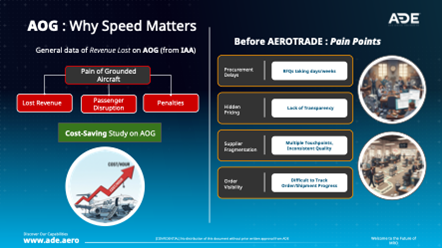
Figure 1
For example, we sent RFQs by email to a list of approved suppliers. Whenever we needed to purchase items, we would send ten to 20 emails to each supplier, and then receive responses, feedback and quotations by email. When we placed purchase orders, we tracked shipments and deliveries manually.
Staff could be overwhelmed by constantly monitoring emails, handling the administration and paperwork, and arranging deliveries from different suppliers. In addition, the process lacked transparency, especially around pricing, and there was inconsistent quality from having multiple suppliers, plus we had difficulty tracking orders and shipments.
Basically, because so many things were happening manually, we faced multiple AOG situations. Grounded aircraft meant passenger disruption and the prospect of penalties, so we needed to overcome the pain points (figure 2). As a consequence, we were losing potential revenue, with expenses to compensate for delays and cancellations.
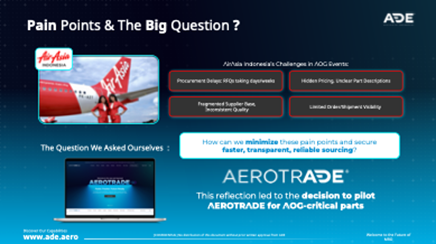
Figure 2
REPUTATION AT RISK
We were also receiving complaints from customers and even internally, from our stakeholders and shareholders. Concern grew that people would stop choosing to fly with AirAsia Indonesia and that meant we were jeopardizing our reputation by becoming an unreliable brand. To help us resolve the situation, ADE (Asia Digital Engineering), our sister company, suggested AEROTRADE. They realized this would be the best way to address the challenge of getting parts delivered fast.
DIGITAL SOLUTION
Ahmad Naim Abdullah
AEROTRADE is one of ADE’s digital MRO solutions. Providing digital marketplaces for aircraft parts isn’t new, but in the Southeast Asia region it is in its infancy. Our aim is to ease the procurement process for airlines and MROs, figure 3, with AEROTRADE, the business-to-business marketplace that connects suppliers with airline operators, MROs and anyone in the aviation industry in need of particular parts.

Figure 3
AEROTRADE launched in 2022 and is now on version 3.0. Having started in the Southeast Asia region, the solution is growing into the Middle East, with suppliers from Asia, the US and Europe. AEROTRADE is free for airlines and suppliers to join. Buyers pay certain charges when they place orders, while it’s free for the sellers to sell. Airlines and MROs can also sell their surpluses on the platform.
A UNIQUE ONLINE MARKETPLACE
A unique aspect of AEROTRADE is making it easier for buyers, airlines and MROs to procure parts without having to approve vendors themselves. We do this for them by applying our quality assurance processes. As Haryo mentioned above, while AirAsia Indonesia already has a long list of approved suppliers, we can approve anyone who is not on there.
Timeframes are another crucial aspect for airlines, which is why AEROTRADE sets deadlines for sellers to accept orders. For example, with an AOG event, this is usually within two hours while, for other purchases, approval periods tend to be longer. This makes it easier for airlines to look for other suppliers if those on the AEROTRADE platform don’t accept an order within their required timeframe.
Full procurement service
Logistics and payments are easier on AEROTRADE, with multiple payment modes offered by the platform. For established buyers like AirAsia Indonesia, credit terms are available, while for new joiners, payment in advance is normally required before credit terms are offered by ADE.
MULTIPLE BENEFITS
Haryo Hadie Negoro
The changes in our purchasing activities using AEROTRADE enable us to reduce costs and downtime and increase operational activity. That’s good news for our customers, stakeholders and shareholders.
An example of a cost issue was in man-hours spent dealing with information manually. When staff fatigue could set in, there was a risk that mistakes could be made and performance might fall as a result, so there was a potential hidden cost due to errors. This could be a planner making a mistake when producing future plans for five or six months in advance. Then, because they made the wrong decision, we would have incorrect data, which impacts maintenance and leads to higher costs. Moving to the platform made purchasing very easy, convenient and straightforward, with simple onscreen menus.
As you can see in figure 4, using AEROTRADE has cut AOG sourcing from days to hours. Vendor responses to RFQs are rapid and transparent, and, because AEROTRADE is a competitive marketplace, purchase costs are reduced. Being able to trade surplus stock on the platform helps AirAsia Indonesia to optimize its inventory through leaner stock management.
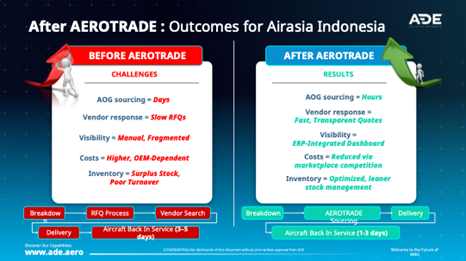
Figure 4
Listening to customers
Another aspect that makes a real difference for AirAsia Indonesia is that ADE listens to its customers. You can see that the ‘voice of the customer’ is really important to them, with the continuous improvements to AEROTRADE made in response to what customers want.
NEXT STEPS FOR AEROTRADE
Ahmad Naim Abdullah
ADE is currently working on the next version of AEROTRADE, figure 5. This will include better Enterprise Resource Planning (ERP) integration. AEROTRADE already has ERP integration with AMOS software and is working with more ERPs, both inside and outside the aviation industry. We are also looking at USM (Used Serviceable Material) listings.
A sister product to AEROTRADE is ELEVADE, our engineering maintenance solution, and we are ‘connecting the dots’ between the two. This will allow airline companies to better manage the repair of aircraft defects with the right parts in a solution that ADE aims to be better and more robust for customers.
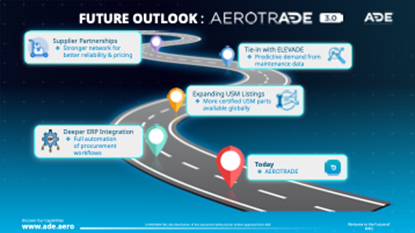
Figure 5
Comments (0)
There are currently no comments about this article.
To post a comment, please login or subscribe.