
Articles
| Name | Author | |
|---|---|---|
| CASE STUDY: AirAsia Indonesia accelerates uptime and cuts costs by digitizing AOG parts sourcing | Haryo Hadie Negoro, Manager, Material & Purchasing Control, AirAsia Indonesia | Ahmad Naim Abdullah, Manager, Digital Transformation – Operations, Asia Digital Engineering (ADE) | View article |
| CASE STUDY: Southwest Airlines realizes the Power of historic data and digital maintenance | Barry Lott, Director of Aircraft Records and Maintenance Reliability, Southwest Airlines | Cameron Byrd, Founder and CEO, AIXI | View article |
| CASE STUDY: Accelerating Aviation Transformation at XWing | Jeffrey Wehrenberg, CEO, XWing | Jim Buckalew, CEO, AeroATeam | View article |
| CASE STUDY: How interCaribbean ended its paper chase by switching to electronic technical logs | Hugo Mendez, Director of Safety and Quality Assurance, interCaribbean Airways | View article |
| CASE STUDY: Modernizing asset records at CommuteAir | Heather Hinton, Director of Maintenance Programs, CommuteAir | View article |
| CASE STUDY: SolitAir embraces digital-first maintenance and engineering from day one | Sandeep Kumar, Director – Engineering & Maintenance, SolitAir | View article |
CASE STUDY: Accelerating Aviation Transformation at XWing
Author: Jeffrey Wehrenberg, CEO, XWing | Jim Buckalew, CEO, AeroATeam
Subscribe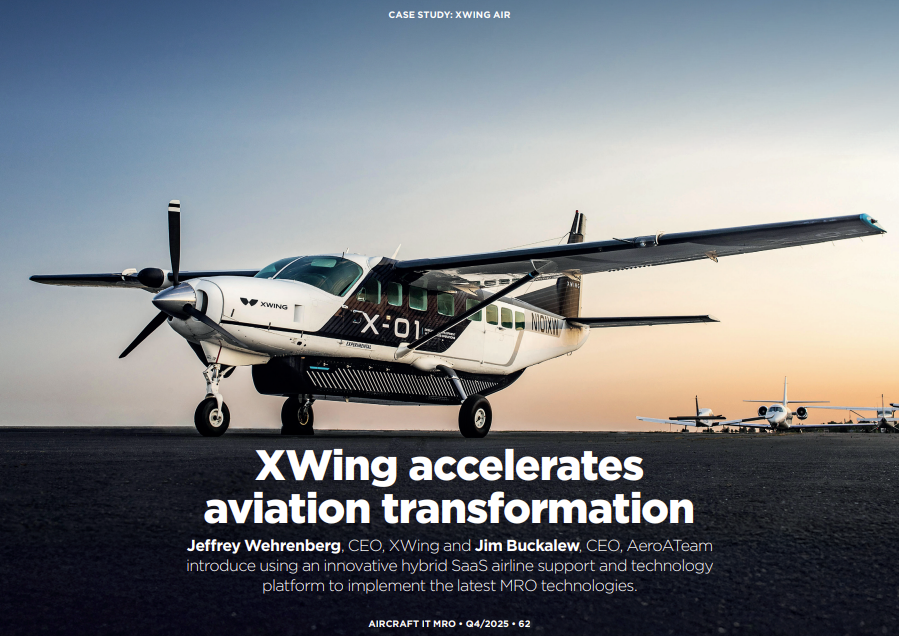
Jeffrey Wehrenberg, CEO, XWing and Jim Buckalew, CEO, AeroATeam introduce using an innovative hybrid SaaS airline support and technology platform to implement the latest MRO technologies.
Jeffrey Wehrenberg
Before we go into the meat of this case study, I’ll just give readers a brief introduction to the subject of this case, XWing Air.
X WING AIR
Started in 2016, XWing was originally working on aviation autonomous flight instrumentation, using the Cessna Caravan as its base model. That was very successful and we sold the technology to Joby who have continued using the autonomous technology for use in their newer eVTOLs. But that wasn’t all. When we started XWing, we also started an airline called XWing Air that flies Cessna Caravans for UPS domestically using manned aircraft as in figure 1.
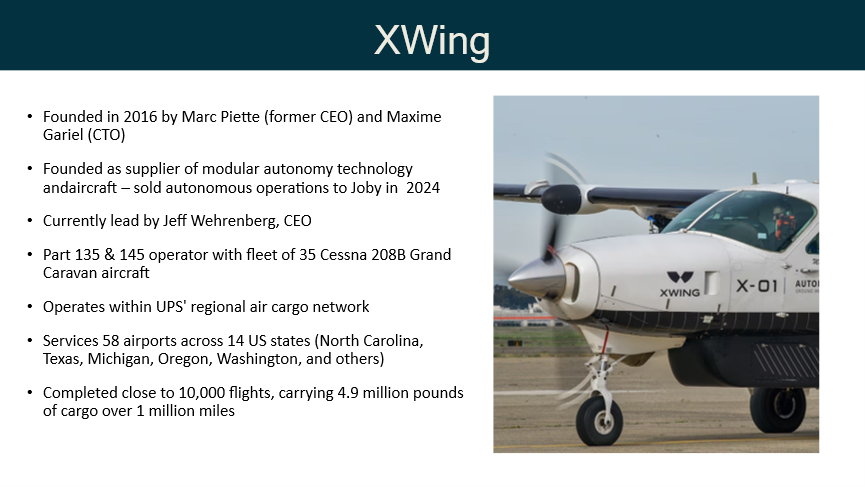
Figure 1
The plan was to move into autonomous flight for UPS and others as we progressed.
Enabling aircraft to fly without a pilot had been the original quest but expanding the impact of aviation through autonomy was the more general application of that. XWing Air without XWing, the technology piece of the business, still has autonomy in mind; it’s just taken on a different focus. Rather than using autonomy for aircraft. The AeroATeam is now helping us use autonomy for our business systems. It’s a different take on the idea. XWing was full of academics and experts from MIT, really smart people, but not so well suited to figuring out, say, a fuel slip process. So, we never really moved forward with the practical aspects of autonomy in business.
With autonomy, the aircraft is self-sufficient but it does have human intervention from the ground and it has safety systems; there’s redundancy. So now, rather than moving the pilot from the aircraft, we’re moving accountants out of their desks and automating their processes. That’s the application and that’s what the AeroATeam and the XWing group are venturing forward to do.
If you don’t know the Cessna Caravan, that’s it in the photo. It’s the most basic, simple aircraft there is. XWing Air flies 28 of them now. We have our operations in Portland, near Dallas and up in Lansing, Michigan. By most readers’ standards, we might seem pretty small. We operate small unsophisticated aircraft and the business itself, with $20 million a year revenue, is also pretty small. That said, every ten percent saved for us is as valuable as ten percent to any airline. If we’re able to find any kind of efficiencies, automate things and use autonomy in our business practices, it has the same effect. We save a great deal of money, and that’s as important to this small company as it is to a bigger company.
Jim Buckalew
In truth, 28 aircraft is not small by any means. The aircraft is a little smaller but, as readers will know, the operator has to meet the same regulatory requirements and support Flight Ops and Maintenance just like all other 135 or 121 operators. However, having sold the autonomous aircraft technology to Joby, XWing Air was left with a lot of manual processes in the airline’s operations. Jeff and I have worked together over many years in aviation and we’re proud to say the XWing Air has now trusted us at AeroATeam with automating the business and the operations. So, before going any further, I’ll give readers an introduction to the AeroATeam.
AEROATEAM
As you can see in figure 2, the AeroATeam has been in business for more than five years.
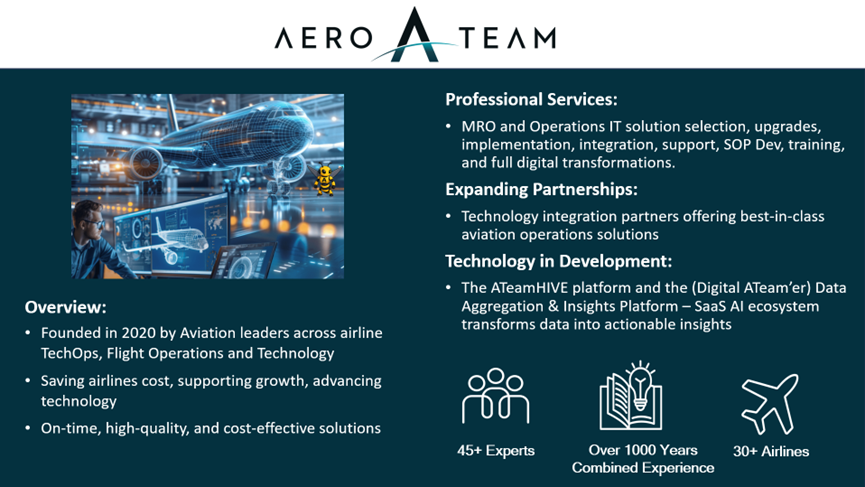
Figure 2
The team includes more than 45 people, and we are all airline experienced aviators with a common thread in technology. We’ve been bringing solutions to operators of all sizes, large, small and in between but we like to say that we bring big solutions to small operations. We are a software as a service (SaaS) hybrid. We’re not a technology company because we rely on the fine technology companies in the sector to leverage the latest technology; but we help implement it and support it and become the technology service as well. That’s our Software-as-a-Service component.
We also offer professional services, management consulting, and we have a lot of partnerships with technology companies. AeroATeam is not trying to be a tech company but, rather, the application integrators to airlines operations. We do have boutique solutions solving pain points and problems for operators through common solutions all rolled up into what we call the ATeamHIVE. That’s a platform that allows connectivity to the airline’s solutions, as well as one place to go for any custom solutions.
The ATeamHIVE
This concept is pretty common in many industries, but our technology stack is layered and customized for each operation. When we talk about the landing page or the portal, we call it the HIVE. That stands for the ‘Hub for Intelligence, Visibility and Efficiency,’ and it has layers or integration points to plug in any of the airline’s solutions. Now we have technology partners like Maxa and DOMO, which have incredible AI BI layers, so they bring all of a user’s data into a structured Snowflake database. These are the experts in AI and BI for real, practical solutions. Smaller operators that don’t have full IT departments, or IT labs to apply the technology come to us for that type of solution.
The data layer, of course, can also be plugged in. We have Snowflake but, Databricks and other data layers can be plugged in as well and then, typically, some application suites connecting through or to other solutions, such as the ones in the AircraftIT Software Directory, or some custom solutions that are connected right through the HIVE.
All of this takes a strong integration layer. We integrate to Trax software and all other MRO solutions, as well as emerging technologies like Tail Sight and Odysee, an Up.Laps innovation that brings a maintenance planning and a flight scheduling optimization solution together. We do have a full AWS (Amazon Web Services) infrastructure, maintained and managed as a hosted, managed service, and that ultimately brings us down to our autonomous layer for airline software SaaS, which is the connection with XWing Air and autonomy .
Many readers will know about workflow automation, know about RPA (Robotic Process Automation) and the technology bots that are available today. We call our bot the ATeam’er; it allows users to really leverage some of that advanced technology, once all of their data is boiled down to intelligence, we can now reach into your ERP (Enterprise Resource Planning) systems and either do the data entry for you, so you don’t have hands on the keyboards anymore, or we can integrate to those solutions without touching the data or touching the paper. We say we take your data the last mile to intelligence, and we use proven technology tools and ATeam SaaS to get there.
For instance, there are a lot of bots out there in many industries and they’re now being introduced to our industry in different forms. I’ll go up the stack to Masa Analyst Solution. Maxa.ai have patents pending on making sure that data is sanitized and eliminates the hallucinations that are common with public AI solutions. They primarily work in the finance industry where they have a very regulated environment. Maxa.ai are using their Analyst to manage critical financial records. AeroATeam is leveraging that same approach to XWing Air’s finainces and compliance records, which are also highly regulated
We’ve built a pretty robust stack, and at the bottom, we will have the Digital ATeam-er, this approach basically allows the automation of that data into your systems.
XWing Air AI USE CASES
Our theme here is the use cases that we’ve focused on with XWing. We’ve partnered with XWing to showcase a number of our tools, to prove the technology and to help with the airline’s efficiency. As XWing Air was going through changes which are normal in operations and with some attrition, ATeam stepped up to help with a number of these focus areas, the first two, which Jeffrey covers below, being the enterprise solutions and fuel management automation. Further on, I’ll address operational data and MRO solutions.
Jeffrey Wehrenberg
I’m going to consider two, what should be simple, processes unless you put them into a change mode, which is always challenging in a business. What I was able to do in teaming with the AeroATeam, is not just have them come and work with the team to build a new process. They came in with a team to do the work and build a new process. And because of that, for example, I was able to reduce our accounting staff by some sixty percent and our spend by some fifty percent. That was significant process improvement and payback, which is where it’s at. Processes made simple don’t yield everything if they don’t save you money, that’s just the fact. Jim and team have come in, have done that for us and are continuing to do that; so, they’re taking over some of our accounting.
To me, it’s now automated and autonomous and we get a better product. Our, customer, UPS, gets a better product from us, which is all about moving fuel. It seems so simple but it’s important to us, because it’s one of our bigger spends and one of our bigger revenues, it was very manual, and it’s always muddled up. It never reconciles easily and UPS pays our fuel. So, in a situation where we spend the money, we bill them and they pay us back, the process has to reconcile. And they’re very thorough, as they should be, to make sure that it all works. Now, with the input from AeroATeam, it’s gone from a headache to being autonomous as far as we’re concerned. Jim and the team have brought that to our business and that’s a part of the savings in the staff numbers that I used to have doing manual fuel reconciliation sheets. We’re able to bill UPS right away, and we get paid right away, so everyone’s happy. These are two really good examples of rubber hitting the road, saving money, getting it done better by partnering.
Jim Buckalew
We’ve used this use case across a number of different airlines, and talked about log page scanning; we’ll take those scanned solutions, whether it’s flydocs or AirVault or Box or anything that airlines use for a scanning solution, and we’ll turn that data, into intelligence. AeroATeam has a number of use cases with airlines where we’ll be able to make data entry right into the ERP system. Alternatively, we can take on sections of the log page, like the fuel uplift. A lot of cargo operators pass on fuel costs to their customers so the faster we can get that to the accounts receivable team, the sooner they can bill for the fuel which is better for the airline. We’re using those use cases just from the log page as well. Eliminating data for engine condition trend monitoring, eliminating data entry for defects, eliminating a lot of data entry.
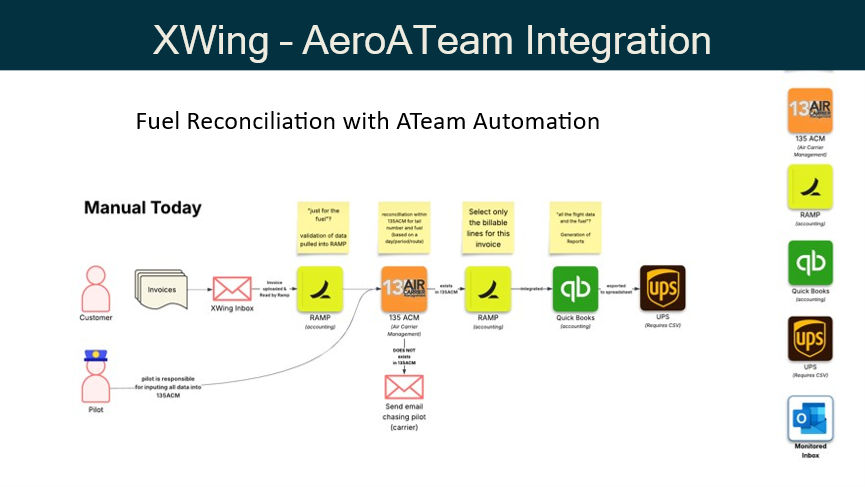
Figure 3
Figure 3 is a process flow with XWing, showing the different solutions that some of their manual processes passed through, such as QuickBooks, getting the invoice to UPS.
Two other areas that we’re focused on, again showcasing the technology with XWing, is the MRO systems intelligence. Being a 135 operator, even with 28 aircraft, it’s still complex, but XWing has a pretty simple approach to MRO solutions. The solution that they use is ACM (Air Carrier Management) 135 all web based, a nice product but again, it’s fairly one dimensional with the data. So, we’re going to pull the data out of ACM 135 and then start to apply some intelligence to it, again, with the Maxa AI solution, and just run the trends and monitoring and alerts that are pretty typical that any airline would look for. It’s the same with the planning intelligence. Again, we’ll have solutions like Tailsight and other solutions to look at the planning requirements for the fleet and where we’re pulling data from the aircraft, either from ACARS, if the aircraft has ACARS, or ADSB, will get feeds from aircraft positioning and flight profiles, and really start to look at FOQA (Flight Operational Quality Assurance) data for a smaller operator as well.
This is a use case with Steve Hiles, the VP of Flight Ops at XWing. With this approach we’re able to pull data from these various systems. Again, no airline is the same; each airline and operator has a portfolio or myriad different solutions. We’re able to bring that data into a structured database to apply some intelligence on it and ultimately deliver back refined operational and financial intelligence to the end users, company management and owners.
Jeffrey Wehrenberg
We’re a very basic company operating very basic aircraft. There’s no slinging information off that through the satellite system. I’m a former user of Trax, AMOS Ultramain… really good, sophisticated systems that XWing can’t afford. Jim and the team are helping us get that same kind of final output using more modern systems available now and their intelligence. That’s the game and that’s the win.
Comments (0)
There are currently no comments about this article.
To post a comment, please login or subscribe.