
Articles
| Name | Author |
|---|
CASE STUDY: Porter Airlines Transforms Operations for growth
Author: Brent Card, Vice President Flight Operations, Porter Airlines, and Barry Humby, Director of Technology, AeroATeam
Subscribe
Brent Card, Vice President Flight Operations at Porter Airlines, and Barry Humby, Director of Technology at AeroATeam, run through the challenging transformation process that is enabling the airline to rapidly scale up operations.
Brent Card
FIT FOR THE FUTURE
Porter Airlines is in a period of rapid growth. We have prepared this case study to share our experience in transforming operations to keep pace with Porter’s expansion.
AIMING FOR GROWTH
The need for an operations transformation becomes clear when you look at where Porter Airlines was and where it wants to be. We started in 2006, operating from Billy Bishop Toronto City Airport (then Toronto Island Airport), where the main runway is 3,988 feet (1,216 metres). We originally operated a fleet of Dash 8-400s, with the value proposition of speed and convenience (figure 1). Passengers appreciate that the distance from the heart of Toronto’s financial district to Toronto City Airport is less than the longest runway at Toronto Pearson International Airport.
[[INSERT SLIDE 2 HERE]]
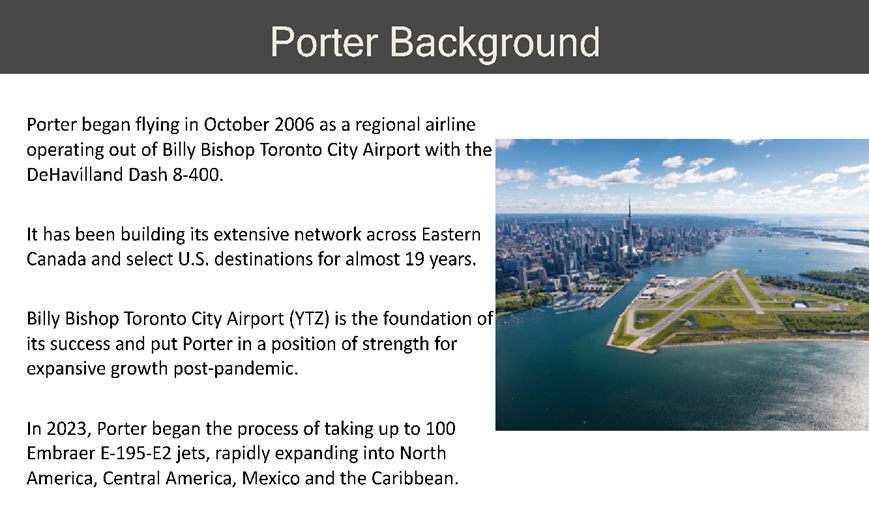
Figure 1
Operational isolation
Porter became a well-rooted, boutique downtown airline in a niche environment as the primary carrier at the airport. We had taken an entrepreneurial approach to our operations, using a mix of off-the-shelf software and bespoke internal systems built by our IT team. This worked well with our 29 Dash 8-400 fleet on a regional network covering eastern Canada and northeast U.S., however, our expansion plans forced a change in approach.
New tactics
The change came during the Covid-19 shutdown when Porter saw an opportunity in the market and purchased 75 Embraer E195-E2s (figure 2) with another 25 options Our strategy was speed – go to market with the new jets post-Covid and build frequency quickly. Frequency is a competitive advantage. This meant our operational systems were playing catch up.
Our existing systems structure that was built around the Dash 8-400s, was no longer suitable for what was quickly becoming a complex transcontinental operation across Canada and the U.S. At the same time, our internal resources were certifying the new E195-E2 fleet with our partner, Transport Canada.
[[INSERT SLIDE 3 HERE]]
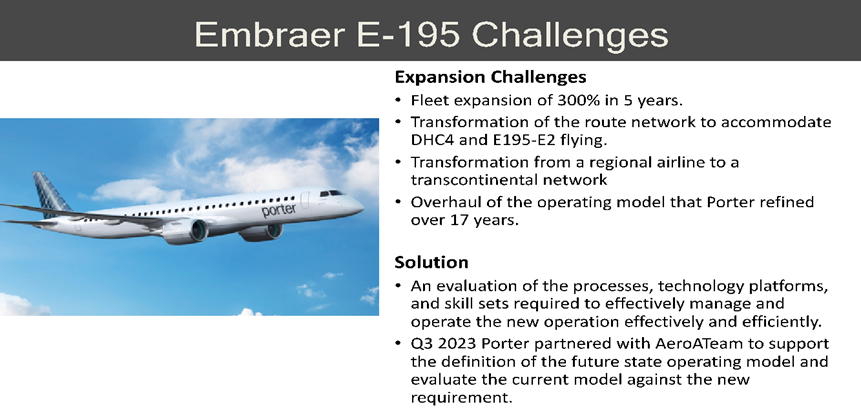
Figure 2
We quickly realized that we lacked the ability to scale internally. In 2023, we collaborated with AeroATeam to define a future-state operations model, identify the gaps and detail a roadmap for implementation.
Barry Humby
SUPPORTING RAPID EXPANSION
When Porter approached AeroATeam, our first priority was to conduct a joint evaluation that defined a new operating model, based on carrying out three core activities (figure 3). It was an intensive eight-week exercise.
[[INSERT SLIDE 4 HERE]]
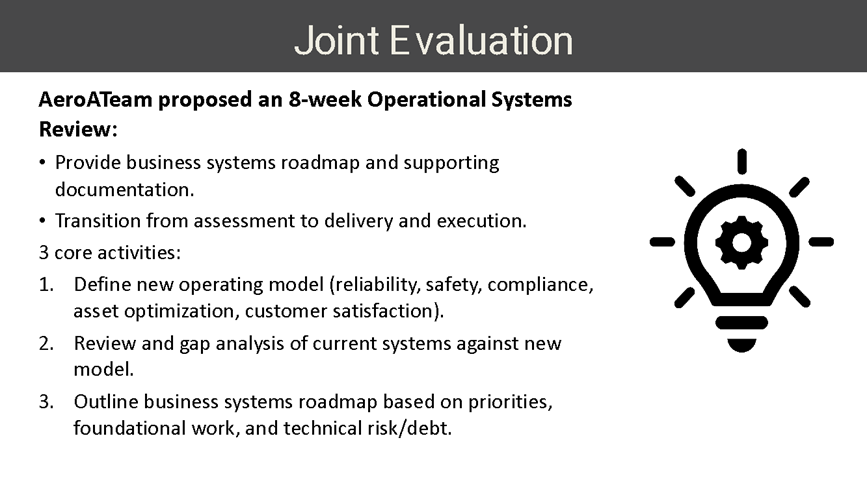
Figure 3
We incorporated Porter’s ambitions, operations, vision and mission into the design of the model to create a series of deliverables (figure 5). This gave us something against which we could measure our progress.
[[INSERT SLIDE 5 HERE]]
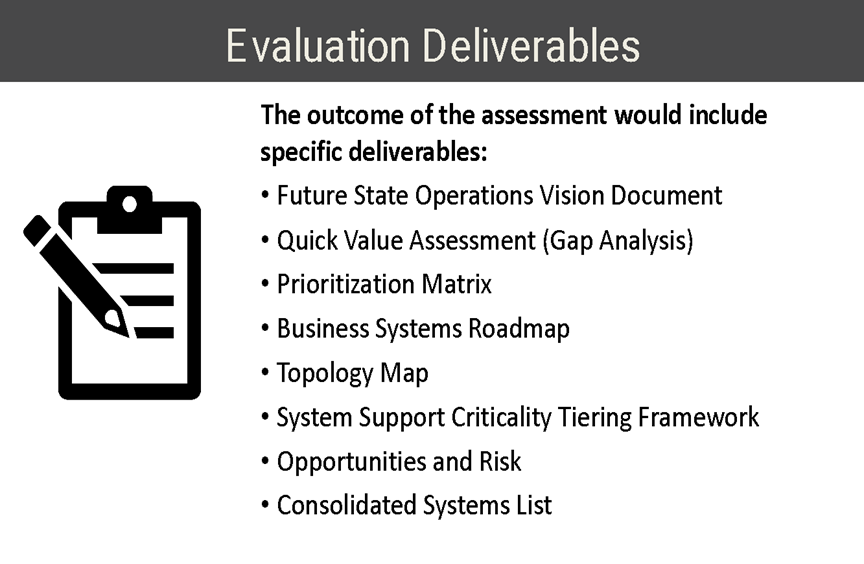
Figure 5
The bigger picture for Porter is to be the airline of choice, a leader in operational reliability who offers the highest levels of safety and regulatory compliance. Their vision includes providing passengers with a seamless, unparalleled travel experience by leveraging technology effectively, so that it is scalable to handle growth.
Quick assessment
Understanding the challenges of scaling from a 29 fleet Dash 8-400 operator to a 129 Dash 8-400 and E195-E2 operator was critical, and the gap analysis against our proposed operating model helped us define a critical path forward with Porter. We decided on a QVA (Quick Value Assessment) method, so we could move rapidly through the evaluation stage for each application. For this, we conducted interviews, met with stakeholders, gathered all the relevant information and looked at specific areas of impact. Asking the right questions provided the insight we needed. Then, we scored each application to assess how they measured up.
Brent Card
EVALUATING THE CHALLENGES
AeroATeam’s initial assessment of our operating software found that only 16% of our existing applications met the criteria under the new future state operating model (figure 6). That meant a lot of software had to be updated or replaced. We also recognized that there were many manual processes that needed to be digitized.
[[INSERT SLIDE 6 HERE]]
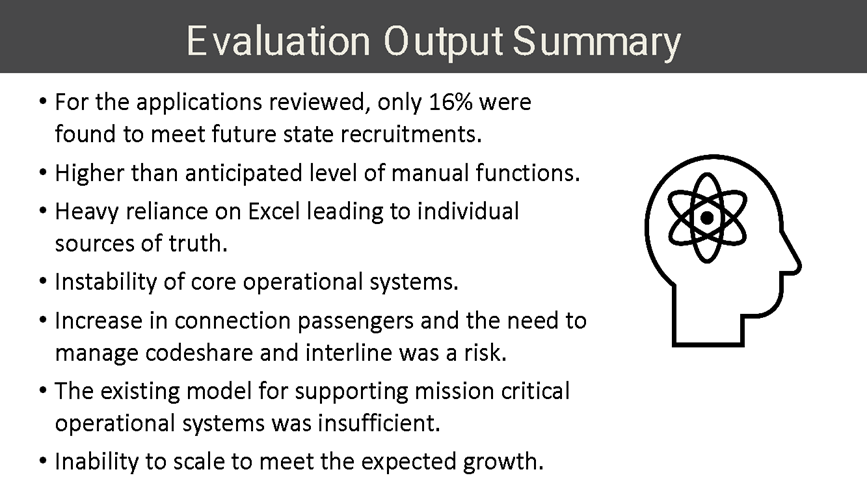
Figure 6
We knew that as we grew the airline with the E195-E2s, our systems would be under stress, causing system instability due to the increased volume of information. In addition, further complexity would come from the evolution of airline partnerships with codeshare and interline agreements. Speed of transformation was of the essence.
SETTING PRIORITIES
Barry Humby
With so few applications up to the task of meeting Porter’s future requirements, we worked on multiple projects simultaneously. Our next step was to rank them all in a prioritization matrix (figure 7). It was important for Porter to understand exactly how project dependencies impacted the roadmap, and the best sequence of activities to achieve their transformation goals. For each project, we looked at the business impact, risk, urgency, cost and available internal resources.
[[INSERT SLIDE 7 HERE]]
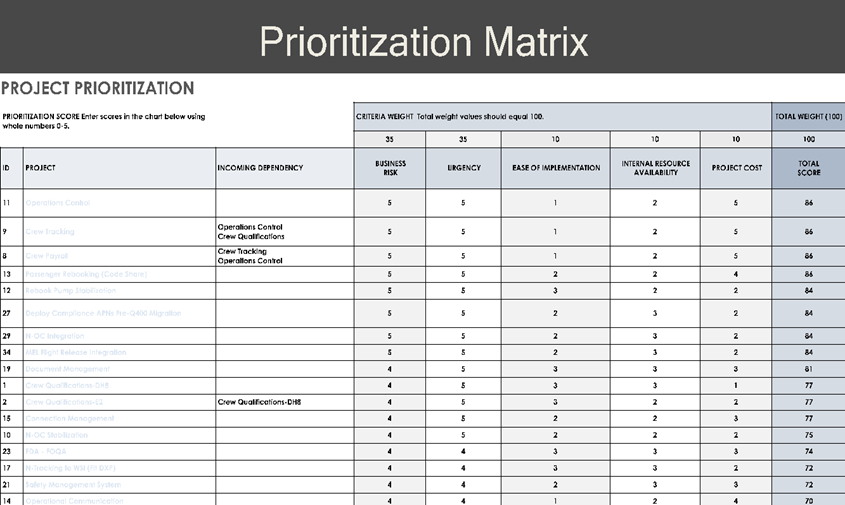
Figure 7
Following the initial eight-week operational systems review, we hit the ground running, and the transformation was underway. Despite its complex nature, throughout the transformation we referred continuously to three key areas – people, process and technology – we needed to succeed in all three.
As further support for Porter, a topology map was designed for the transformation (figure 8). This type of graphic depiction is useful for a project of this magnitude, where there are a lot of interfaces. The topology map enabled us to convey, in a non-technical way, the impact on Porter’s workforce, to highlight the interdependencies and systems that would be impacted by the change. We find the topology map is particularly useful for briefing new team members on the programme scope and the rationale for the approach and sequencing of activities, in a non-technical manner.
[[INSERT SLIDE 9 HERE]]
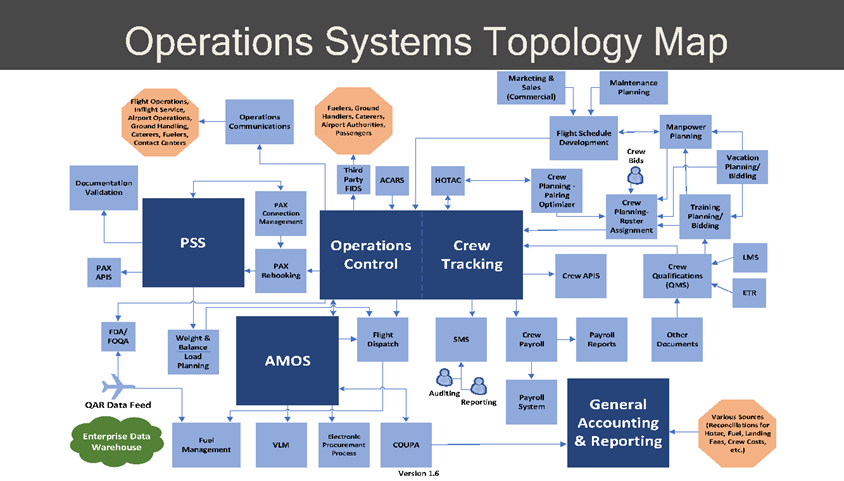
Figure 8
Another AeroATeam initiative was to walk Porter’s team through a system support criticality framework (figure 9). This provides a framework for evaluating the criticality of each application on Porter’s business, and, by extension, the appropriate availability requirements (RPO/RTO, etc), solution design components (HA, DR, etc), and service level agreements. This framework is useful for evaluating not only existing applications, but new applications prior to implementation as well as supporting the solution design process and agreeing on SLAs with 3rd party vendors, where appropriate.
[[INSERT SLIDE 10 HERE]]
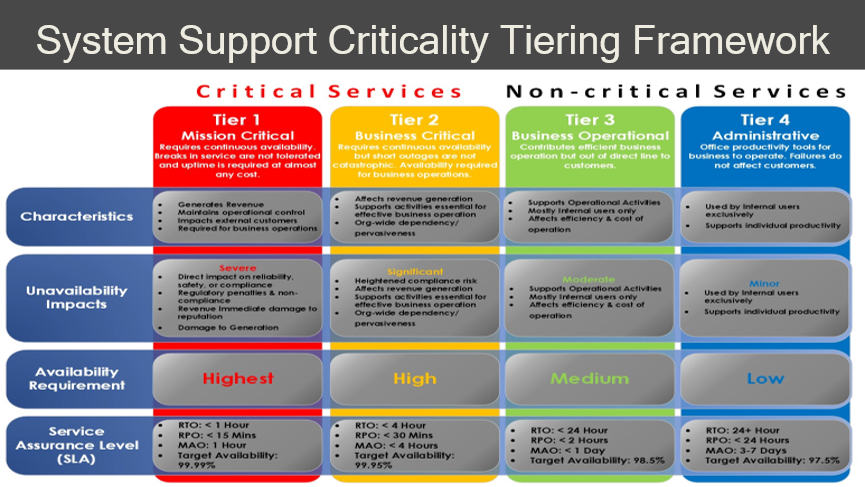
Figure 9
Brent Card
LOOKING AHEAD
Not many airlines are likely to be taking on something on this scale by replacing or updating the majority of their operating systems at the same time. It is an exceptionally complex approach, and not without risk. Knowing the current system would not support our growth plan, a transformation was the practical solution. The next steps were well defined (figure 10), and had support from the highest levels of the organization.
[[INSERT SLIDE 11 HERE]]
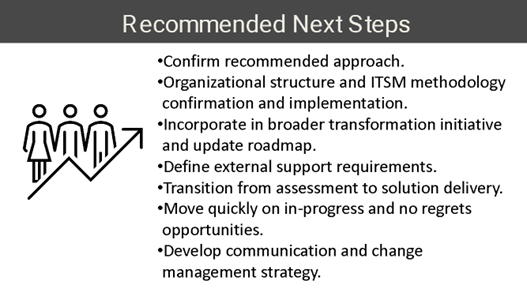
Figure 10
Overall, the AeroATeam partnership brought structure and expertise in an area where we lacked the internal experience and disciplines necessary to take on a transformation of this magnitude. AeroATeam has helped us scale into what we are today by being a catalyst for transformation and enabling quick decision-making based on their experience and industry best practice. With no room for trial and error, we had to move quickly from the structured assessment stage to delivery. We are fully satisfied with the AeroATeam partnership. Their proficiency and skillsets guided us to make the best decisions for Porter at a critical time in our expansion.
Comments (0)
There are currently no comments about this article.
To post a comment, please login or subscribe.