
Articles
| Name | Author |
|---|
CASE STUDY: Corsair cuts fuel consumption by optimizing flight trajectories
Author: Nicolas Moraes, Airbus A330 Line Captain, Instructor and Examiner at Corsair
Subscribe
Nicolas Moraes, Airbus A330 Line Captain, Instructor and Examiner at Corsair, offers an insight into how Thales’ FlytOptim is helping the airline to be more fuel efficient
In this case study, we examine how Corsair is benefiting from Thales’ FlytOptim to enhance operational efficiency and reduce CO2 emissions by leveraging AI-powered trajectory optimization that crews can trust.
IN FOR THE LONG-HAUL
As a mainly long-haul operator, Corsair can gain significantly by optimizing flight trajectories to improve fuel efficiency. The France-based airline was formed in 1981 and has a fleet of nine Airbus 330-900neo aircraft that fly to multiple overseas destinations in the Caribbean and Indian Ocean, as well as Africa, see figure 1.
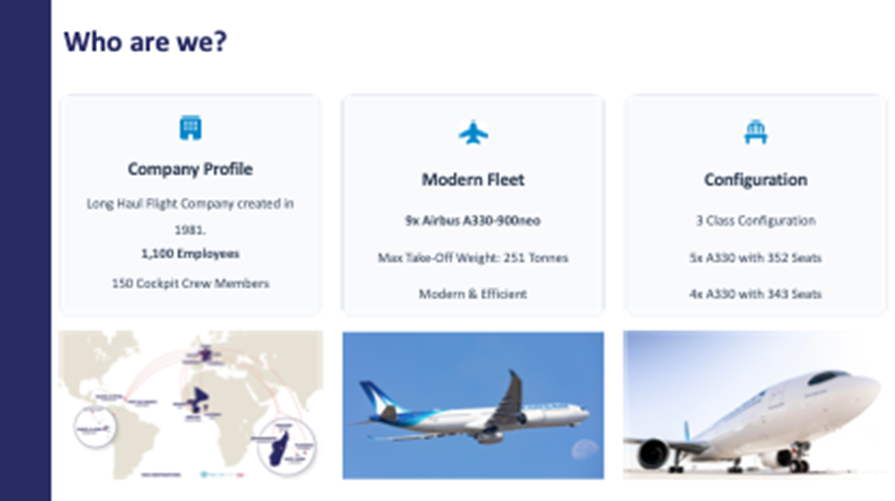
Figure 1
Corsair is also a pioneer in environmental efficiency, and our project with Thales aimed to reduce fuel consumption by being more accurate with the vertical profile, especially when flying for lengthy periods in cruise mode.
CHALLENGES TO FUEL SAVING
Previously, we used the optimum altitude suggested by our FMS (Flight Management System), but we wanted to be more accurate in identifying optimal flight trajectories. The FMS only provided limited data that was low-resolution because it was in a grid of about 500 nautical miles, with wind and temperature information that could be two to six hours old, which is quite a lot (figure 2).
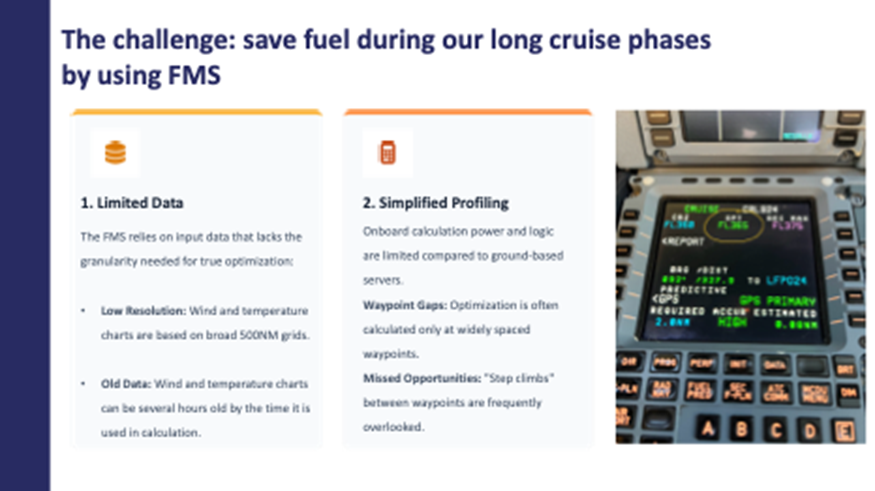
Figure 2
Furthermore, the onboard system had limited power compared to a ground-based computer. We could have around 300 nautical miles between waypoints, so optimization was a challenge and we suffered missed opportunities if ‘step climbs’ between waypoints were overlooked.
THALES SOLUTION
We chose Thales because we have had a great relationship with them since 1998, so we trust their expertise and data. FlytOptim is based on a new FMS algorithm that provides real-time data in grids of around 50 nautical miles (figure 3).

Figure 3
Using FlytOptim is six times more accurate than the data we had on board before. The application is also more efficient because it is simple to use, as we receive messages directly on board with ACARS (Aircraft Communications, Addressing and Reporting System) and on the printer. Our crews are confident using FlytOptim because the data is reliable.
FLYTOPTIM IN ACTION
Figure 4 shows an example of how Corsair used FlytOptim on an eleven-and-a-half-hour flight from Reunion Island to Paris. At the beginning of the flight, when we arrived at the plane, we used the initial flight plan, which was based on an estimated load and an estimated optimum altitude.
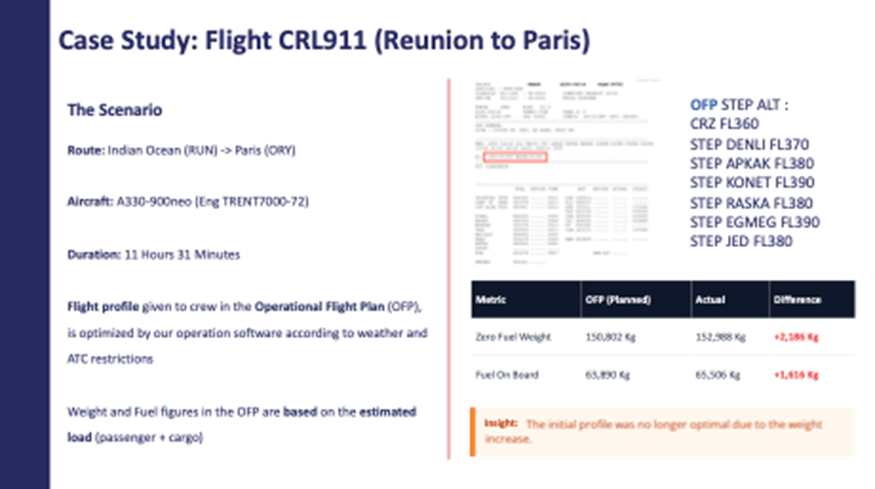
Figure 4
In this example, we had 150 tonnes of passengers, freight and fuel required. Just before departure, we noted that we had a new actual weight that was about two tonnes more than the initial weight. So, we needed to carry 1,616 kg more fuel for the flight.
Flight options
After departure, the FlytOptim team sent us a message via ACARS and on the printer (figure 5). The first message told us to climb to flight level 380 to save 640kg with one minute of extra flight time. Unfortunately, the crew was not able to climb to this level. So, we shifted the message to flight level 100 in order not to disturb the pilot.
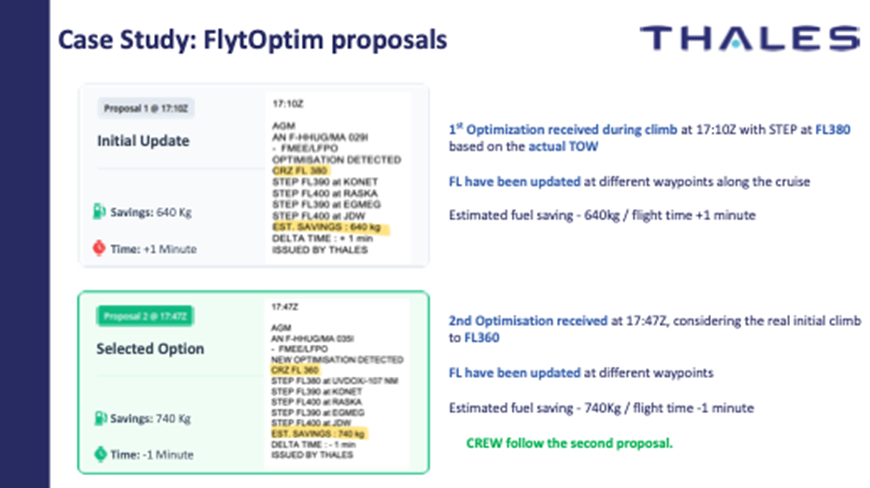
Figure 5
After that, the crew was not able to climb to flight level three zero due to ATC (Air Traffic Control) and flow restrictions because this is a well-used route. So, the plane climbed to flight level 360 initially, and when it arrived at flight level 360, we received another message from FlytOptim telling it that if we cruised at flight level 360 there was another optimum altitude afterwards, which is called a ‘step out’, where we could save 740kg and reduce the flight time by one minute. With that information, the crew decided to fly this second proposal.
Fuel savings
Looking at the aircraft data from the flight (figure 6), the blue line is the real fuel consumption and the real vertical flight path we had, and the yellow line is the information that was initially on the OFP (Operational Flight Plan).
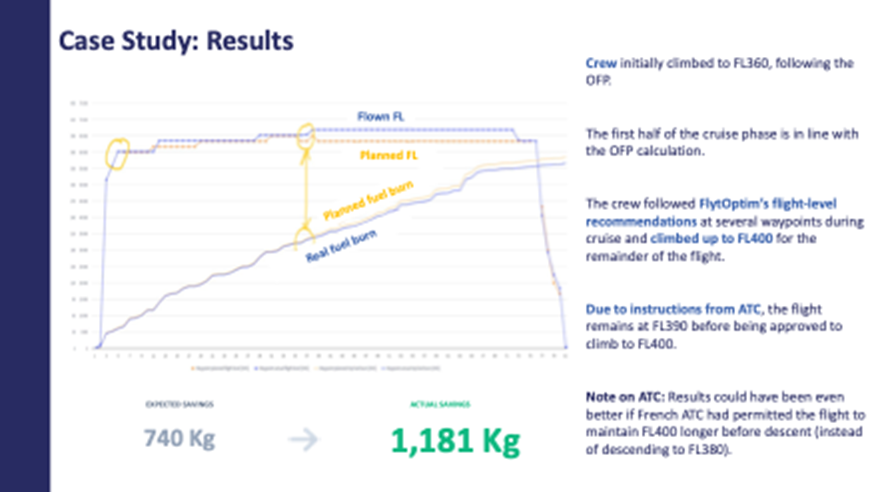
Figure 6
Initially, the crew climbed at 360, then flew what was told to them by FlytOptim. The real fuel consumption was the same as expected in the initial flight plan, arriving at a point where the proposal told the pilot to climb to flight level 400. After that, the real fuel burn was less than the planned fuel burn. At the end of the flight, we had saved 1,181kg of fuel when we expected to save only 740kg.
POSITIVE RESULTS
Looking at our results using FlytOptim across Corsair (figure 7), 61 percent of 1,605 flights received a proposal from the system.
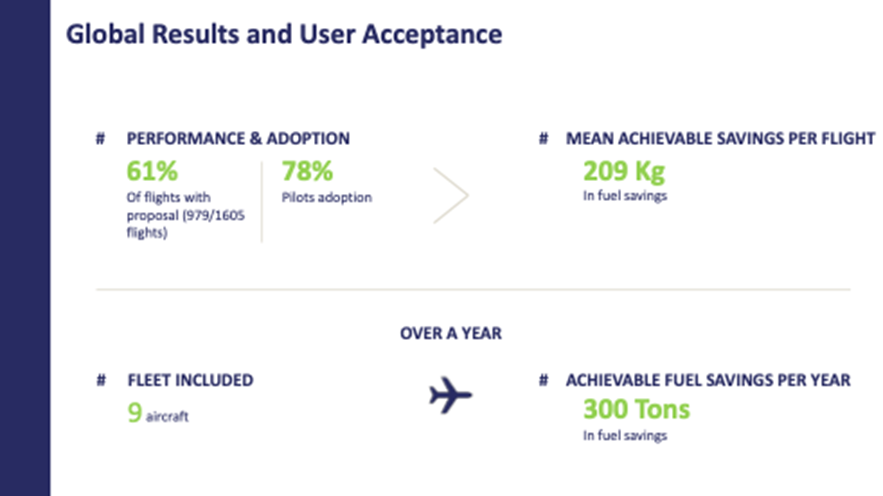
Figure 7
Sometimes, we don’t receive a proposal because there’s no more optimization available other than the initial flight line. User acceptance has been quite high, with 78 percent of our pilots following the Thales proposal. Over a year, our mean achievable fuel savings were about 200kg per flight, which totals 300 tonnes of achievable fuel savings per year.
LISTENING TO FEEDBACK
Initially, it was a little difficult for some crew members to get to grips with FlytOptim, but once we understood it, we gained confidence using the system. By encouraging our colleagues, we created a positive chain reaction across our crews about using FlytOptim (see figure 8).
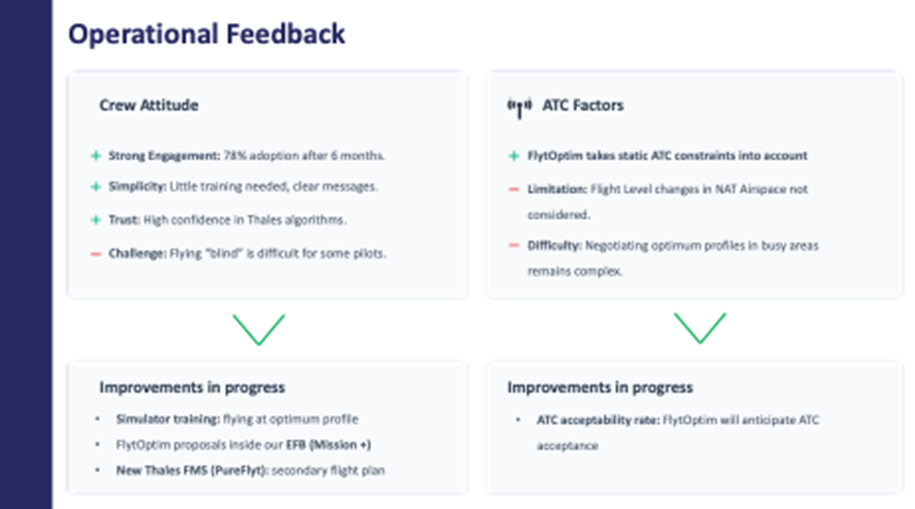
Figure 8
Two points stood out from the operational feedback provided by our crews. Firstly, there has been a strong adoption of FlytOptim because the application is simple to use, with a clear message and no need for training. We trust the data and are confident about what Thales sends us. We have run simulator sessions for the 22 percent of pilots who didn’t show strong engagement with FlytOptim. Pilots can find it quite difficult to fly blind, for example, if the instrument doesn’t tell them to climb – you have to trust the data.
The second point relates to ATC factors. Negotiating optimum profiles in busy spaces is complex. For example, it can be difficult to fly with the FlytOptim proposals in crowded airspace that doesn’t take into account when we go clear into the Atlantic Ocean. Thales is making improvements here, with work to anticipate ATC acceptance of FlytOptim proposals.
LOOKING AHEAD
Having taken on board vertical profile optimization, we recently started a lateral optimization project with the FlytOptim in the OCC (Operations Control Center), see figure 9.
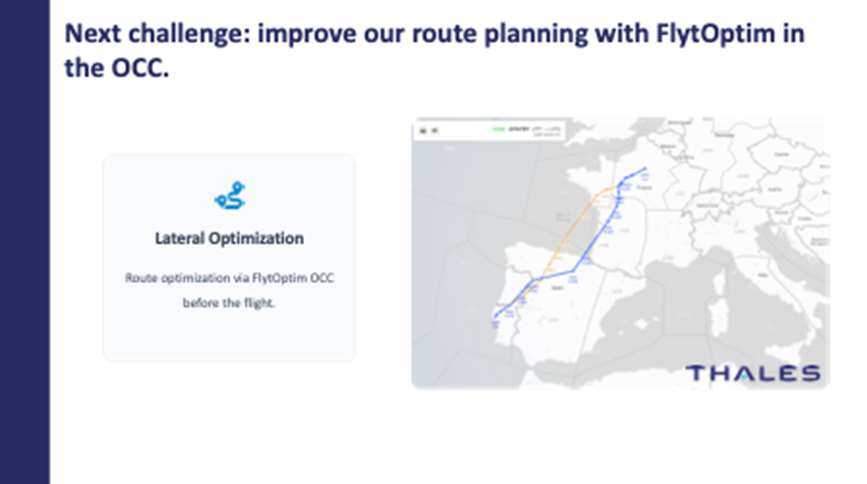
Figure 9
This will enable the OCC to give us more efficient routes to follow before we take off.
Comments (0)
There are currently no comments about this article.
To post a comment, please login or subscribe.