
Articles
| Name | Author |
|---|
CASE STUDY: A strong partnership for Helvetic
Author: Christian Suhner, Chief Technology Officer, Helvetic Airways & Michael Anklin, CEO, WinOps
SubscribeChristian Suhner, Chief Technology Officer, Helvetic Airways & Michael Anklin, CEO, WinOps share how a successful partnership has been built and how it works
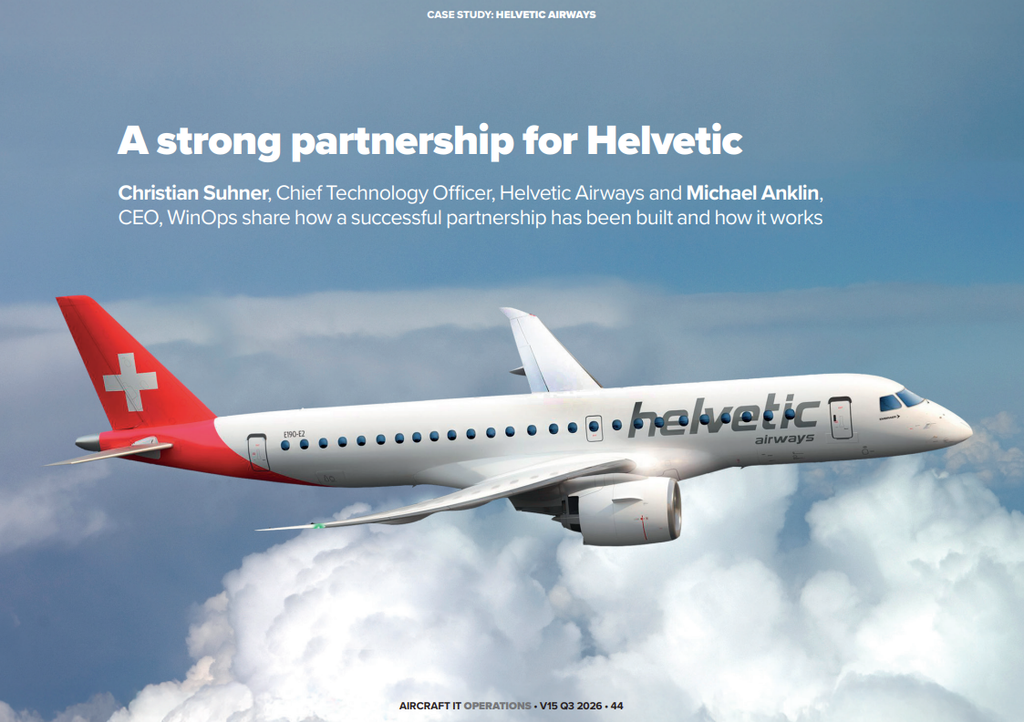
This article will focus on the close relationship between the airline operator, Helvetic Airways, and the software solutions vendor, WinOps Aviation Management Software. For some 20 years, they have been in almost daily contact, working together to find the best way forward. We will look at how sometimes Helvetic wants to do one thing, and then WinOps suggests a different possibility before they jointly come up with another idea which is what they implement. Also, there is the efficiency that both parties have gained over the years from their close relationship. It’s not the case of the vendor saying that, if the operator wants something, they first have to pay some money over and then wait.
HELVETIC AND WINOPS, A PARTNERSHIP
The two businesses grew up together from 2004 when Helvetic started with four Fokker 100 aircraft and wanted to track fuel figures, but digitally, not in analogue. In about 2008 they had to introduce flight time limitations in line with EU-OPS 1, which necessitated a digital solution to track those limitations. That’s where the relationship with WinOps started with a cloud-based solution, an online platform, not a legacy system. That meant no installations on Helvetic’s system but also, it gave access to crews.
Building on that, Helvetic and WinOps continued to develop the solution, adding modules, which was where the relationship showed its worth. When Helvetic approached pain points and issues that needed an IT solution, instead of thinking about possible providers from the market, they concluded that it would be best to include it into the existing solution and build up that solution. And that’s what makes the relationship work for Helvetic because they can build their own platform in their own way with full support from CBL and WinOps.
THE PAIN POINTS, THE SOLUTIONS AND THE BENEFITS
At the outset, the biggest pain point was EU-OPS 1 Flight Time Limitations. It was not possible to track flight times for individual personnel without the IT solution which developed further into a proper alerting system. That’s a key capability of WinOps which can track almost all of the limitations that an operator needs for an airline operation, all in one system.
Training was another significant pain point. It’s really difficult if you have one of the big training systems but it isn’t completely integrated into the crew planning process, crew planning or crew control. The WinOps training module, integrated on the platform, addresses that and feeds directly into the crew planning process, an important benefit of the full dispatch and flight planning process (figure 1).
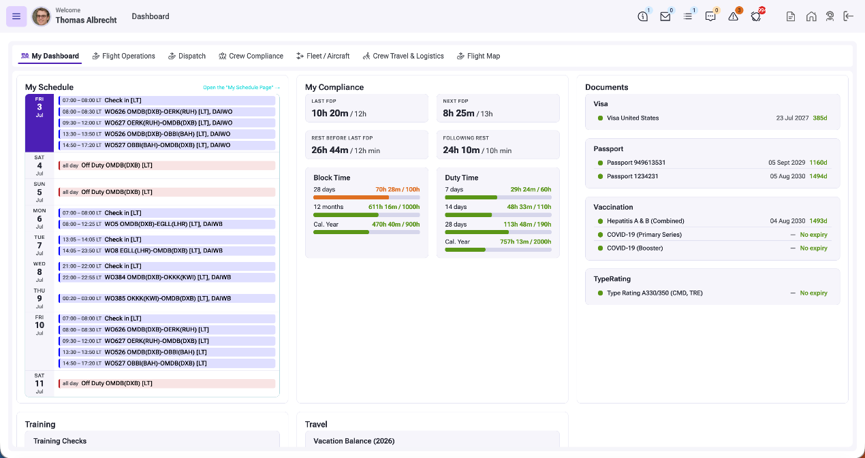
Figure 1
All the data is there for users to track almost everything, from proper airport categorization through the whole training module, which includes pilot qualification checks and expiries, feeding directly into crew planning and crew control (figure 2).
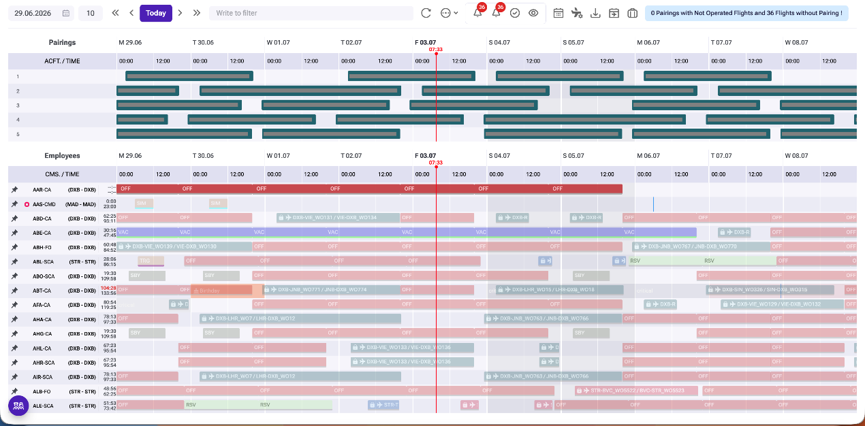
Figure 2
This ensures a proper planning and alerting system in the crew planning and crew control process. It goes on into the whole sales and scheduling process, which includes the alerts. So, if a salesperson sells a flight to an airport which is not yet categorized or is categorized as a Cat C airport, they’ll get an alert in order that they won’t sell it.
To continually improve this whole alerting system, it’s important that all the relevant data is available, as live and as accurate as possible. That’s where an operator can either take the data in via interfaces or can take the data directly in by managing the data. That’s, one of the benefits: to have different modules implemented in the same system which can be combined into a platform where the functions interlink.
Helvetic was early with implementing a complete paperless EFB solution. And now they’re realizing the benefits of that solution being directly integrated into the Flight Ops software platform, which is the case with the WinOps EFB pilot apps. Everything is integrated, including alerting and so on. This was another pain point where Helvetic needed to find a solution to integrate rather than having a standalone system.
It’s not only the users who benefit from a single platform. For Christian, as a CTO, the whole maintenance of the infrastructure behind a single integrated system is more efficient. It’s also good from a security point of view to have everything integrated in one platform: it is then possible to protect that one platform and keep everything within that. Whereas, as soon as you go outside with interfaces, you distribute your data and you lose a little bit of control of it. So, if you have everything integrated in one solution, it’s easier to track this, especially with passenger data coming in and so on.
For example, as Helvetic is often an ACMI operator, they are dependent on data from the operators they are flying for. Helvetic doesn’t need to connect 20 systems to receive the data from these flights. There is one point of entry which makes it much easier than before, especially when doing system updates, which are managed by WinOps. So, if they are changing something in one module, most of the time it’s reflected in all other modules. With several systems, when you have an update on one system, you need to track the impact of that change into all the other systems, into the interface and so on. In this case, having a single platform is a real advantage on the IT side. It’s also a benefit for users, especially with the EFP solution. For example, Helvetic was building up the EFP processes over twelve years and ended up with 8 apps for a pilot to navigate. So again, there was a significant efficiency advantage in bringing the relevant data into one platform and present it in a useful, effective, and efficient manner to pilots.
MODULES USED
When Helvetic was determining which modules to use, it was not done simply by module; the main consideration was which modules would deliver the most efficiency and compliance value. That said, today most of Helvetic uses almost everything from WinOps starting with crew planning, crew control, crew travel, the training process including the training content and then the whole of employee management, so that they have all the data together (figure 3).
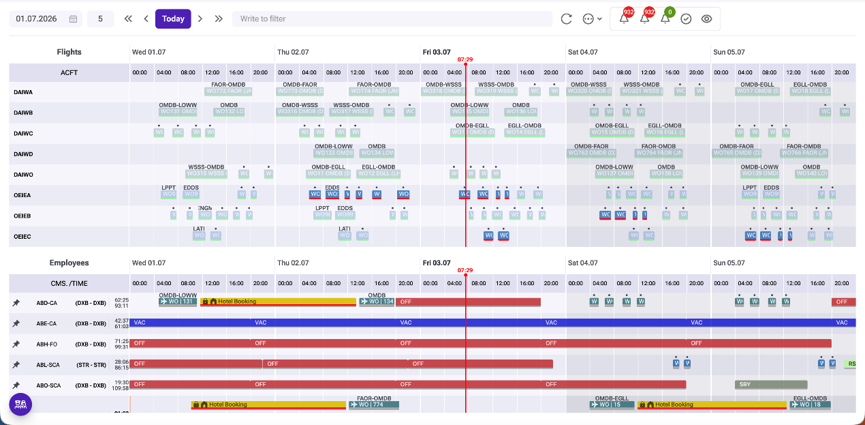
Figure 3
Helvetic uses WinOps almost completely for its HR software, the basis for employee data management. It’s important to have all the passport data in the Ops system. If you need to create the General Declaration, the information needs to all be in one system to generate it automatically. This could be done by an interface but it’s much easier to track the data in one system. Helvetic is even using the load sheet module.
The most recent module that Helvetic has implemented is WinOps EFB. This will be, one of the biggest projects, the merging of the EFB platform for pilots and implementing the ECB (Electronic Cabin Bag) for cabin crew to show where passengers are seated, passenger data and more. That’s a big step on an operational level which will bring big improvements. For an electronic tech log, Helvetic used REDiFly which is connected to WinOps via a fully integrated interface where the data is taken out of the REDiFly tech log system because they’re working closely together. It’s not an interface; it’s a complete integration of the tech log into WinOps so that, from a visual point of view, it’s exactly the same platform.
The whole module implementation process was based on ways to work together to find more efficient ways to deal with what had previously been inefficient processes. Also, the compliance system triggered some compliance issues that have been solved with the help of WinOps without any additional cost. That’s how the airline and the vendor have grown together. It’s also how WinOps grows with other airlines, getting ideas for functionalities from clients and then making them available to the whole WinOps user community, helping each other to get to the perfect level. For that to work at its best, everybody in a client business has to be involved. With Helvetic, Dispatch was involved, Training was involved, Flight Ops… if you’re setting up a new flight, the whole company is involved. This is how the solution was developed in one place, which was WinOps.
From WinOps’ side, because the solution is, of necessity, very complex, in order to be able to do a lot of things, they have worked hard on the manuals and have courses now that go through WinOps and tell users how to work with it. That’s very helpful for new operator clients. When WinOps has new clients, the vendor stays by them with weekly meetings. It’s not just about how to use WinOps; it’s like free consulting to make the operators’ processes more efficient; sharing the experiences of other operators in the WinOps community. That’s one of the big benefits of WinOps and they have invested a lot in all those training courses.
LOOKING TO THE FUTURE
For the future, Helvetic looks forward to exploiting the possibilities of AI and the development of further opportunities with WinOps. We have already implemented a lot of AI and now Helvetic is exploring the capabilities and working with WinOps to optimize them even more. For that, it’s most important to have one strong partner with whom to develop the best solutions which best fit the operator’s requirements. It’s a nightmare to track everything separately; the data, vulnerabilities and security. But with a strong partner, as Helvetic has with WinOps, that IT partner will be able to use AI to solve the problems that the operator brings to them. A partner who is fast and delivers high-quality solutions, allows an operator to implement changes quickly. This is a benefit that will help Helvetic adapt quickly and efficiently to changing requirements in the future and, of course, would also help other operators.
Everybody’s asking for AI so WinOps has assembled a group of people to research the subject. WinOps is already using AI for development, but how can it be integrated into an airline’s processes? The software solution provider has made a full system to allow the operator to select which kind of AI they want to use. That can be their own module or even an on-premises module if they don’t want to share data.
AI learns from what each user does with it and is then fully integrated where it returns with some suggestions on how to do a task. But you cannot say, okay, AI is going to solve all problems because you need to have all the data available and that’s a very big process. Because of that, WinOps is only publishing AI solutions that are tested in order to be sure that it works because it is very complex.
The implementation, the training of modules, implementation of machine learning and so on is much more efficient with the data needed by those capabilities in one place. If you have your data in one place, you can use it because, most of the time that’s the biggest issue, that there is no data available and/or accessible to train AI and you cannot use AI without data. WinOps is working with AI for planning, a highly complex task that depends on holidays, function, planned upgrades, so many factors; but because WinOps has lots of data from airline clients, it can produce a whole year’s planning of all an operator’s training, inclusive of content. With AI, at one click there is a schedule.
SUMMARIZING THE VALUE OF WORKING IN PARTNERSHIP?
From an operator’s point of view, Christian says: “It’s a win-win for us because we don’t need a big IT department but we can give feedback to WinOps, then test and introduce changes quickly; and help with developing solutions. That’s what makes it so successful.”
From a vendor viewpoint, Michael adds: “The advantage of working with a partner airline rather than treating them as a separate entity, is that you can make your software, your processes, more efficient when you get such close feedback from the airline.”
Comments (0)
There are currently no comments about this article.
To post a comment, please login or subscribe.