
Articles
| Name | Author |
|---|
CASE STUDY: From startup to multi-station airline: BeOnd digitizes and scales up flight operations
Author: Zain Eejaz, Manager, Flight Operations Technical & Planning, BeOnd
Subscribe
Lessons are learned fast launching an all-premium luxury airline, as Zain Eejaz, Manager, Flight Operations Technical & Planning, at BeOnd explains
This is a case study about BeyOnd, a startup airline. As things stand, we are small with a pretty lean team in which each of us wears several hats. For instance, my department handles performance engineering, technical dispatch, EFB (Electronic Flight Bag) and documentation. But, first, let me share with you an introduction to the airline and our target market.
PREMIUM LEISURE
We call ourselves the world’s first all-business-class leisure airline: there are other business-class carriers, but we believe we are the first all-premium carrier operating in the leisure market. Founded in 2022, BeOnd obtained its Maldivian AOC (Air Operator’s Certificate) in 2023. While the headquarters are in Dubai, our operational base is in the Maldives, see figure 1.
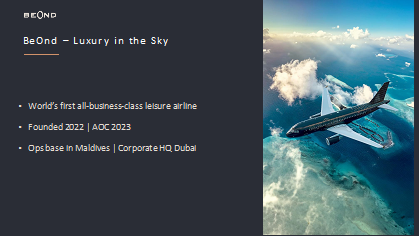
Figure 1
We fly the Airbus A320 family of aircraft with all business-class seats, so it is very luxurious and exclusive, almost like a private jet, but in a scheduled airline format, as figure 2 shows. The A319 carries only 44 people, while the A321 is limited to 68, giving passengers a unique and private experience.
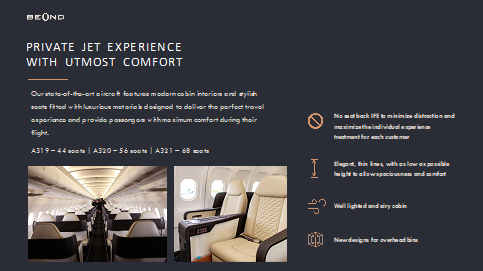
Figure 2
As we add more aircraft to the fleet, we are also continuously extending our network, including into Europe, via a technical stop in Dubai, to countries including Switzerland, Italy and Germany. We also plan to have more AOCs in the Middle East and Asia. You can see from figure 3 that we expect to grow our network much more than this, including with charter flights to supplement our scheduled business, because the Maldives is a seasonal market. Charters are usually one-offs but operationally they are a big revenue generator for us.
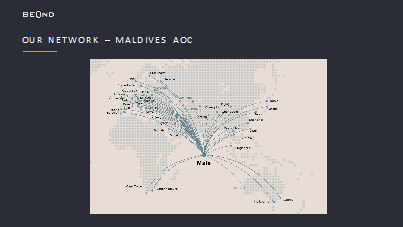
Figure 3
OCC CHALLENGE
When we launched, we outsourced the OCC (Operations Control Center) to a Dubai-based company, which took care of dispatch and crew control. Our flight operations technical team was also in Dubai, with operational control and flight watch in the Maldives, in order to meet AOC requirements. Our duty managers and OCC managers in the Maldives relied on good communications with the OCC in Dubai, see figure 4.
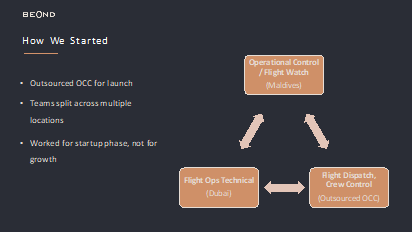
Figure 4
The startup situation was satisfactory when we didn’t have many passengers, but as we grew the pressure to perform increased. It was soon apparent that this operating structure was not cost-efficient, because we were paying another company to prepare our flight plans and the communication gap between countries made operations unreliable. As a result, flight plans were often delayed, with corrections taking hours to complete, and crew control support was weak, see in figure 5.
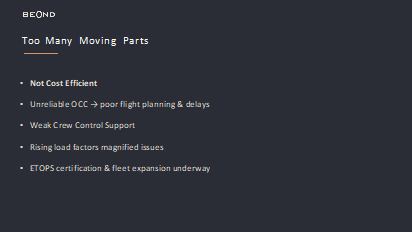
Figure 5
TAKING THE OCC INHOUSE
In order to address this problem, we decided to bring many of these outsourced activities inhouse, starting with the OCC, where the delays mentioned above were holding back our expansion. At the same time, we were working to gain ETOPS (Extended-range Twin-engine Operational Performance Standards) certification, which added to the pressure on us. Once the decision had been made to bring the OCC inhouse, our first step was to find a flight planning system that gave us control and reliability. We started the benchmarking process for most of the available flight planning systems, evaluating them against our technical and legal requirements, figure 6.
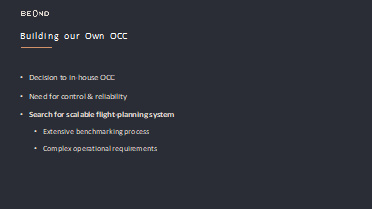
Figure 6
We chose PPS (Pre-flight Planning System) from AIR SUPPORT despite some resistance within the business. However, I fought for PPS to be included in our considerations and, once we had benchmarked it against the other providers, it soon became clear that the solution was the best for us, as figure 7 shows.
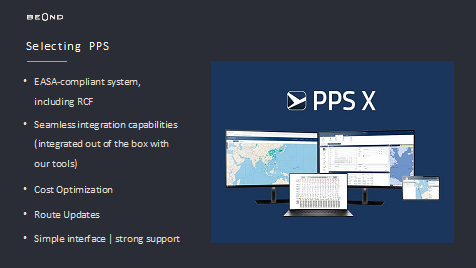
Figure 7
RAPID LAUNCH
Our first priority was RCF (Reduced Contingency Fuel). We found that PPS integrates well with multiple systems and is very good for optimizing fuel costs, giving good route comparisons and allowing for tankering. What’s more, our dispatchers like PPS’s simple interface for managing their workflow.
In true startup fashion, we were in a hurry to implement the new system because other contracts were ending. We went live within a few weeks of signing the PPS deal, with strong support from Tavi Dumitru, the Technical Manager at PPS, see figure 8. On-site training covered the OFP (Operational Flight Plan), fuel policies, performance data generation, the Aircraft Communications, Addressing and Reporting System (ACARS) flight plan uplink, and integration with scheduling, Flight Watch and EFB. We were very impressed with AIR SUPPORT’s approach.
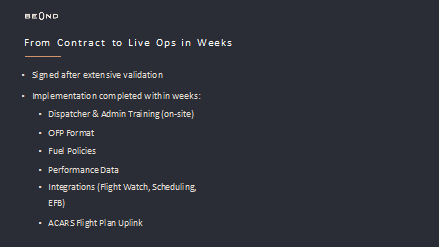
Figure 8
Again, in typical startup fashion, the day we went live (figure 9), was the same day that we took delivery of our second aircraft and also signed a charter to carry the Netherlands and the Norwegian football teams, flying from the Maldives to Oslo and Almaty, then back via Turkey. PPS really delivered for us and it was the first time in our startup history that we felt in control. Finally, we could plan our own flights after one year of struggling.
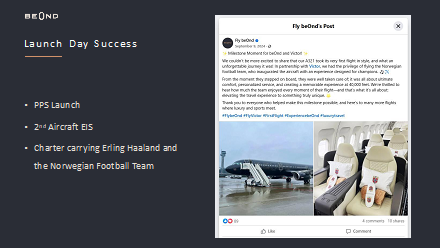
Figure 9
Load factors are high during our peak winter season in Europe and that’s when we put a lot of stress on PPS to make sure that everything is planned correctly. All in all, it is going well, with positive feedback from our dispatchers and pilots, as you can see in figure 10.
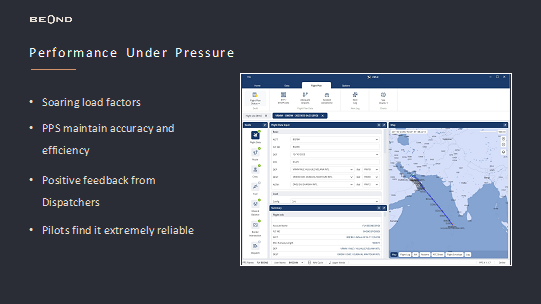
Figure 10
CONTINGENCY FUEL
We fly the A320eco from the Maldives to Dubai and then to Europe. The aircraft is designed mainly for short hops, and although there are fewer passengers on board, the aircraft is heavier with the addition of the business class seats. We are able to make longer flights by cutting contingency fuel.
We use 3 percent contingency fuel instead of the standard 5 percent, enabling us to fly up to seven hours and 45 minutes, as you can see in figure 11. To do this, when you reach a decision point about having sufficient fuel to reach your first stop, you either go there or divert because the contingency fuel you carry is only for use in the second part of the journey.
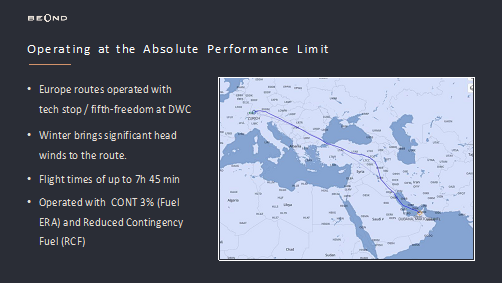
Figure 11
We always carry maximum fuel from Dubai, where fuel is cheaper than in the Maldives. We tell our dispatchers to be efficient but not at the expense of flexibility and they view this as a challenge. A recent example of that was a charter flight to carry the Inter Milan football team to Benghazi in Libya for a charity football match. Fuel is cheaper in Libya, but we opted not to carry less in order to take advantage of the price difference when refueling in the country as we needed to be carrying as much fuel as possible in case we had to reroute or divert. Calculating fuel requirements can be tricky and PPS supports us well in the decision-making process.
Precision counts
We can even reduce contingency fuel from 5 percent down to 1 percent. The flight plan in figure 12 shows we were carrying 188 kilos of contingency fuel, which is nothing when you consider the amount burned on taxiing and climbing.
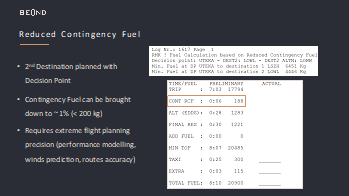
Figure 12
To achieve such low levels of contingency fuel, you need to be very precise. I had initial doubts about PPS, because larger airlines rely on many pages of performance tables and PPS has far fewer, but it does a lot of interpolations and extrapolations. Consequently, its fuel prediction is on point. For example, one thing we noticed with other systems is that they don’t do a very good job on climb profile calculations, which is when you can easily burn several hundred kilos of fuel; PPS, however, does it perfectly.
Avoiding diversions
Greater accuracy means fewer diversions, as the statistics in figure 13 illustrate. You can see that we had 104 flights going to Europe from Dubai, 23 of them were on contingency 3 percent and seven were with Reduced Contingency Fuel (RCF), but we experienced zero diversions, which is a testament to the accuracy of PPS.
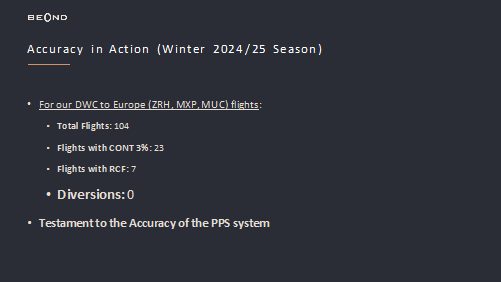
Figure 13
CREWBRIEFING APP
The CrewBriefing app is another essential part of the PPS solution, as you can see in figure 14. This is not an EFF (Electronic Flight Folder) app, but it is near-EFF. It contains all the briefing materials and charts, but doesn’t do the logging or the post data. Although it doesn’t classify as an EFF, it is approved as a Type B app for an EFB. We can put everything here or print the OSP/OFP (Onboard Single Pilot/Operational Flight Plan?) for the pilots.
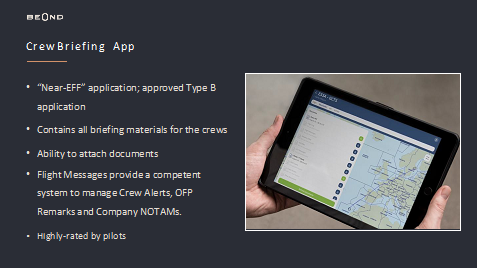
Figure 14
Our pilots like the simplicity of the CrewBriefing app and they enjoy using its Flight Messages function, which is like a company NOTAM (Notice to Airmen) system. You can also put in rules by FIR (Flight Information Region], destination or airport. Pilots like a ‘hidden’ feature of the app, where they zoom in on an airport using the iPad’s GPS, so it works like an AMM (Airport Moving Map), to see taxiways and other features.
PPS OPSCONTROL
We already had a flight quad solution (quadrantal solution?], but we took OpsControl in PPS as a backup. As figure 15 shows, it is a potent Flight Watch solution, as well as being compatible and compliant with both EASA (European Union Aviation Safety Agency) and GADSS (Global Aeronautical Distress and Safety System) flight tracking requirements. Although this is a backup, there have been a handful of times when our primary has failed and because we had OpsControl, we were able to continue operations without delay, which has been very useful.
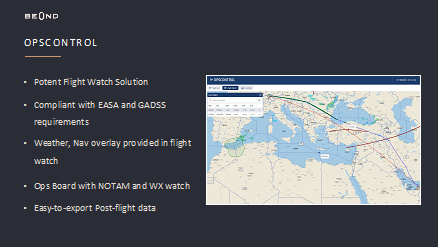
Figure 15
LESSONS FOR STARTUPS
As a startup, BeOnd was ready to scale from the outset, which is the first lesson we learned (see figure 18). We had one aircraft but were building software tools for a fleet of a hundred. At the same time when we were looking to scale, we also made sure that we could operate one, then two, then three aircraft without problems.
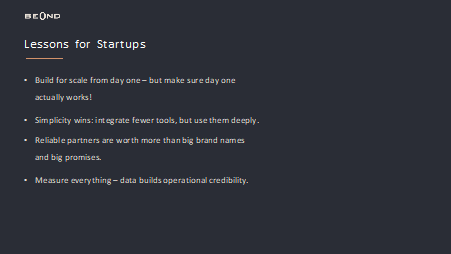
Figure 16
Another lesson learned is that simplicity wins. Make sure you prioritize getting the basic software tools into place; for example, your flight planning, scheduling and flight watch systems. It was only when we had these on board that we began looking at fancier solutions. We went for fewer software tools and made sure they worked for us, rather than taking on many tools, just because that’s what larger airlines do.
The third lesson is to make sure your technology partner is reliable and has tools that work for you. A mistake we made at the start was going for all the big names, then finding out they lacked the kind of support we needed. Finally, measure everything as that is how you will improve. Data is king when it comes to business improvement, especially for a startup airline.
NEXT STEPS
We expect to implement the updated version of PPS featuring enhanced performance data when it is available. I believe AIR SUPPORT is also working on improved route optimization, especially in the Middle East. Currently, running auto routes in the region can be tricky and I think all flight planning systems probably struggle with this problem. For example, if you enter Iraq from one point, you must exit at a specified point. The upgraded PPS should be a big improvement.
As I’ve said, one of the great things about PPS is that it integrates with many other software providers, giving us plenty of options in our EFF solution. This should help us to reduce our environmental footprint by achieving our fuel efficiency goals and moving us towards being a paperless cockpit, see figure 16.
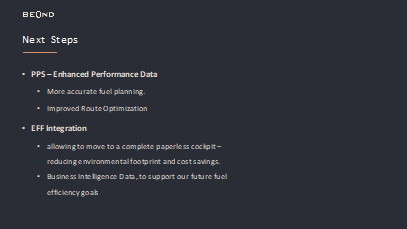
Figure 17
In summary, PPS and its support team are a great partner for BeOnd, see below. They are very responsive, keep improving and are very reliable. In fact, I can honestly say that PPS has been and remains critical to our success.
Comments (0)
There are currently no comments about this article.
To post a comment, please login or subscribe.